GST Penalties and Appeals Explained | Guide to Offences & Appeals
This guide explains the broad framework of GST penalties and the appeal avenues available to taxpayers. You will learn what triggers GST penalties, the general principles behind enforcement, how administrative actions such as inspections, searches, and seizures fit into the compliance ecosystem, and the options available if you want to contest an adverse decision. Understanding these topics matters because GST-related enforcement can affect cash flow, business continuity, and reputation; knowing what to expect helps businesses prepare compliant processes, respond appropriately to notices, and make timely legal choices. The material here focuses on concepts and practical implications rather than specific statutory numbers or case law. That makes the guide suitable for business owners, tax teams, and advisors who need a clear sense of how penalties arise under GST, what typical administrative measures look like, and how appeals interact with enforcement. After reading, you should be better equipped to: recognise actions or omissions that commonly lead to enforcement, appreciate why the law provides for inspections and seizures, consider compounding or dispute resolution options where available, and take informed next steps if you receive a demand or show-cause notice. This conceptual clarity reduces the risk of surprise penalties and supports better compliance and dispute management.
Offences and penalties under GST, an overview
Under the GST framework, certain acts or omissions by a taxpayer are treated as offences which can attract enforcement action. When an offence is established by the relevant authority, a penalty will have to be paid under GST. This is the central enforcement consequence taxpayers need to be aware of.
The term "offence" covers a range of conduct that the law regards as non-compliant, from procedural lapses to conduct that reflects deliberate tax evasion. The practical effect of the penalty requirement is to convert non-compliance into a monetary consequence, which the tax authorities use both to recover revenue and to deter future breaches.
For businesses, the focus should therefore be on prevention: maintaining accurate books, issuing proper documents, timely filings, and ensuring systems capture GST on supplies correctly. While prevention reduces the likelihood of penalties, preparedness, such as retaining documentation and knowing appeal routes, helps manage the financial and legal impact if enforcement arises.
Inspection, search and seizure: how administrative actions fit in
Tax administrations use a range of administrative tools to verify compliance. Inspections are routine or targeted visits to business premises to examine records and corroborate returns. Searches and seizures are more intrusive measures used when authorities suspect serious non-compliance or when evidence may be at risk of being destroyed.
These actions are part of the fact-finding process that can lead to the imposition of penalties if an offence is found. For taxpayers, cooperation during inspections, while preserving legal rights like seeking representation or clarifications in writing, usually helps resolve issues faster. When seizures occur, it is important to document what is taken and seek written details of the action to enable later challenge or recovery where appropriate.
Compounding, prosecution and arrest, enforcement escalation
Where offences are identified, authorities may have multiple enforcement pathways. Compounding allows settling certain offences by paying a specified amount and closing the matter administratively, which can be quicker and less risky than prolonged litigation. Prosecution is the criminal route available for more serious or deliberate breaches and may carry higher consequences beyond monetary penalties.
Arrest is a power tied to criminal proceedings and is exercised in severe cases where statutory thresholds or conditions are met. Because these outcomes vary widely in seriousness and process, businesses should seek early professional advice when an investigation becomes adversarial to understand the likely path and to preserve legal rights.
Appeals and dispute resolution: protecting your position
Tax laws provide appellate mechanisms so taxpayers can challenge assessments, penalties, or other adverse orders. Filing an appeal does not automatically negate the underlying obligation to pay tax or penalty unless a stay or suspension is granted by the appellate authority or a court.
Effective use of appeal remedies requires timely filing, clear grounds, and supporting documentation. Where possible, initial efforts at administrative resolution, such as providing clarifications, rectifying errors, or seeking compounding, often reduce the scope or quantum of disputes that proceed to formal appeal.
Practical steps for businesses to reduce penalty risk
Adopt robust record-keeping and compliance controls: accurate invoicing, reconciliation between sales and returns, and regular review of input tax credits help prevent errors that trigger enforcement. Timely responses to notices and maintaining a single point of contact for tax authorities also streamline communications.
When confronted with an alleged offence, obtain specialist advice promptly. Early engagement can clarify whether the matter is a procedural lapse or a more serious issue, and can identify options such as compounding or administrative settlement before escalation to prosecution or criminal processes.
Penalties are a core enforcement tool under GST: where an offence is established, a penalty will have to be paid. The best protection for businesses is proactive compliance and good documentation, together with prompt, professional responses to any notices. If you face enforcement action, consider options such as administrative resolution, compounding where available, and appeals to contest the decision while preserving your legal rights.
Frequently asked questions
What are the common GST offences I should know about?
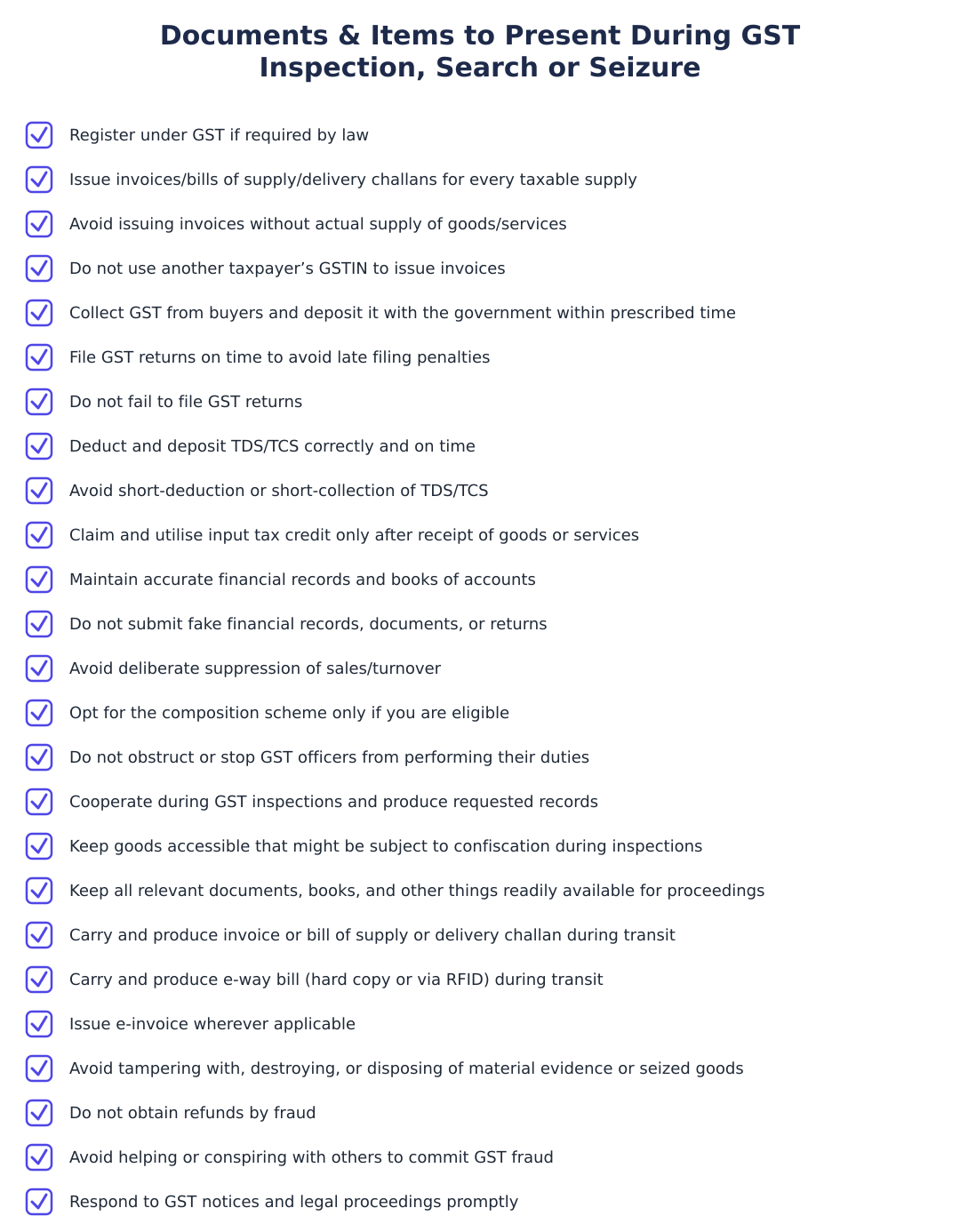
Common GST offences include not registering when required, issuing invoices without actual supply or issuing false invoices, claiming input tax credit (ITC) without receiving goods or services, and collecting tax from buyers but not depositing it with the government within three months of the invoice. Section 122(1) of the CGST Act lists 21 specific offences such as submission of fake documents/returns, obtaining refunds by fraud, deliberate suppression of turnover, using another person's GSTIN to issue invoices, and transporting goods without required documents. Some offences involve obstructing officers, tampering with evidence, or dealing in goods known to be confiscable, and penalties apply on detection. The law treats different offences with varying gravity depending on intent to defraud or evade tax, and some offences can lead to confiscation of goods or documents during enforcement actions.
What penalty applies if I file GST returns late?
For late filing of GST returns, a late fee applies which is calculated per day of delay and can increase with prolonged non-filing; specifics depend on the return type and period. The statutory late fee is levied in addition to the interest on the unpaid tax amount, and the exact per-day amount varies by return (for example, GSTR-3B and other monthly returns have specific late fee provisions). If the return remains unfiled for long, penalties and enforcement actions including notices, and in extreme cases prosecution or compounding, may follow. Always file as soon as possible to limit interest and fees and to avoid escalation to more serious penalties.
What happens if I don’t file GST returns at all?
If you fail to file GST returns altogether, you can face penalties including fixed fines, interest on unpaid tax, and possible prosecution for offences such as suppression of turnover or non-deposit of tax. Non-filing can trigger assessment actions by tax authorities, potential demand notices, seizure of goods or documents during inspections, and, in serious cases, arrest if the offence involves intent to evade tax. Persistent non-compliance may also result in denial of input tax credit and restriction on refunds, and the taxpayer may be treated as committing one of the 21 offences under Section 122(1) if related elements are present. Remedial action, filing pending returns, paying tax, interest and penalties, reduces further escalation but does not guarantee immunity from prosecution.
How are penalties different for the 21 GST offences when there is no intent to evade tax?
For the 21 offences listed under Section 122(1), if there is no intention to commit fraud or evade tax, the penalty typically involves payment of tax along with specified fines and possible confiscation, but criminal prosecution is less likely. The law distinguishes culpable intent: innocent or negligent breaches attract monetary penalties and administrative actions, while deliberate fraud invites harsher criminal remedies. Confiscation of goods or documents may still occur during enforcement even for non-intentional breaches, and compounding of offences (settling the case by payment) may be available for certain contraventions. Exact penalty amounts and relief depend on the specific provision breached and facts of the case, so early rectification helps mitigate outcomes.
What penalties apply for the 21 GST offences committed with intent to evade tax?
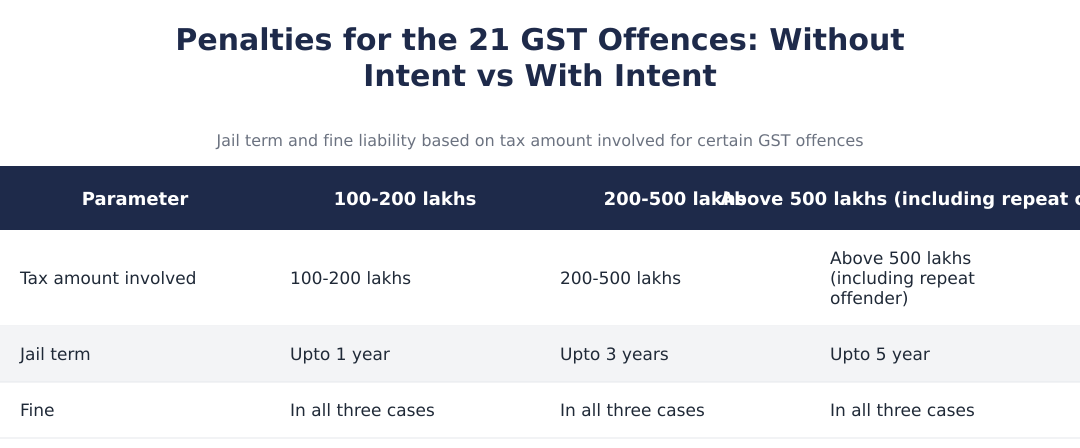
If any of the 21 offences under Section 122(1) are committed with intent to commit fraud or evade tax, the taxpayer faces harsher penalties including heavier fines, confiscation, and possible prosecution leading to imprisonment. Jail terms vary with the tax amount involved: for tax evaded between INR 100–200 lakhs, imprisonment can be up to 1 year; for INR 200–500 lakhs it can be up to 3 years; and for amounts above INR 500 lakhs (or if the offender is a repeat offender), imprisonment can be up to 5 years, with fines in all these cases. The authorities may also seize goods, documents, or records and proceed with criminal proceedings; compounding is generally not available for serious fraudulent offences. Therefore, intentional evasion attracts severe criminal consequences beyond monetary penalties.
What powers do authorities have for inspection, search and seizure under GST?
GST authorities have statutory powers to inspect premises, search for and seize goods, books, or other things, and to detain items that may be relevant to tax proceedings when they have reason to believe offences are being committed. During inspection they can demand invoices, delivery challans, e-way bills, e-invoices and other records; hidden or concealed documents and goods can be searched and confiscated. Search and seizure actions can lead to seizure of goods liable for confiscation, detention of vehicles, and collection of evidence for initiating penalties, compounding, or prosecution; safeguards and procedure requirements apply but rapid action can be taken if evasion is suspected. It's important to retain proper records and comply with officer notices to reduce risk of adverse enforcement outcomes.
What is compounding of offences under GST and when can I use it?
Compounding under GST means settling certain offences by paying a specified composition amount so that no further prosecution is pursued in respect of that offence. Only certain non-serious offences are compundable and the authority may allow compounding before or after initiation of proceedings, subject to conditions and specified scale of composition fees. Compounding is not available for serious offences involving fraud, large-scale evasion, or where prosecution has already commenced for non-compoundable offences; the exact offences and amounts are prescribed in law and rules. Using compounding can avoid lengthy litigation and criminal records, but requires admission of the offence and payment as per the prescribed matrix.
When can prosecution and arrest happen under GST law?
Prosecution and arrest under GST law can occur when an officer reasonably believes a person has committed offences involving fraud, willful suppression of turnover, or intentional evasion of tax, particularly under the 21 offences in Section 122(1). Arrest provisions are invoked for serious offences, for example where tax evaded is large or there is deliberate use of fake invoices or fraudulent refund claims, and the officer (e.g., Joint Commissioner) may initiate prosecution after following prescribed procedures. Prosecution can lead to imprisonment according to the thresholds (up to 1/3/5 years depending on tax amount) and fines, while arrest requires compliance with safeguards like recording reasons, informing the accused of grounds, and producing them before a magistrate. Early voluntary compliance and cooperation can reduce the likelihood of prosecution or arrest.
How do appeals work under GST if I disagree with an order or penalty?
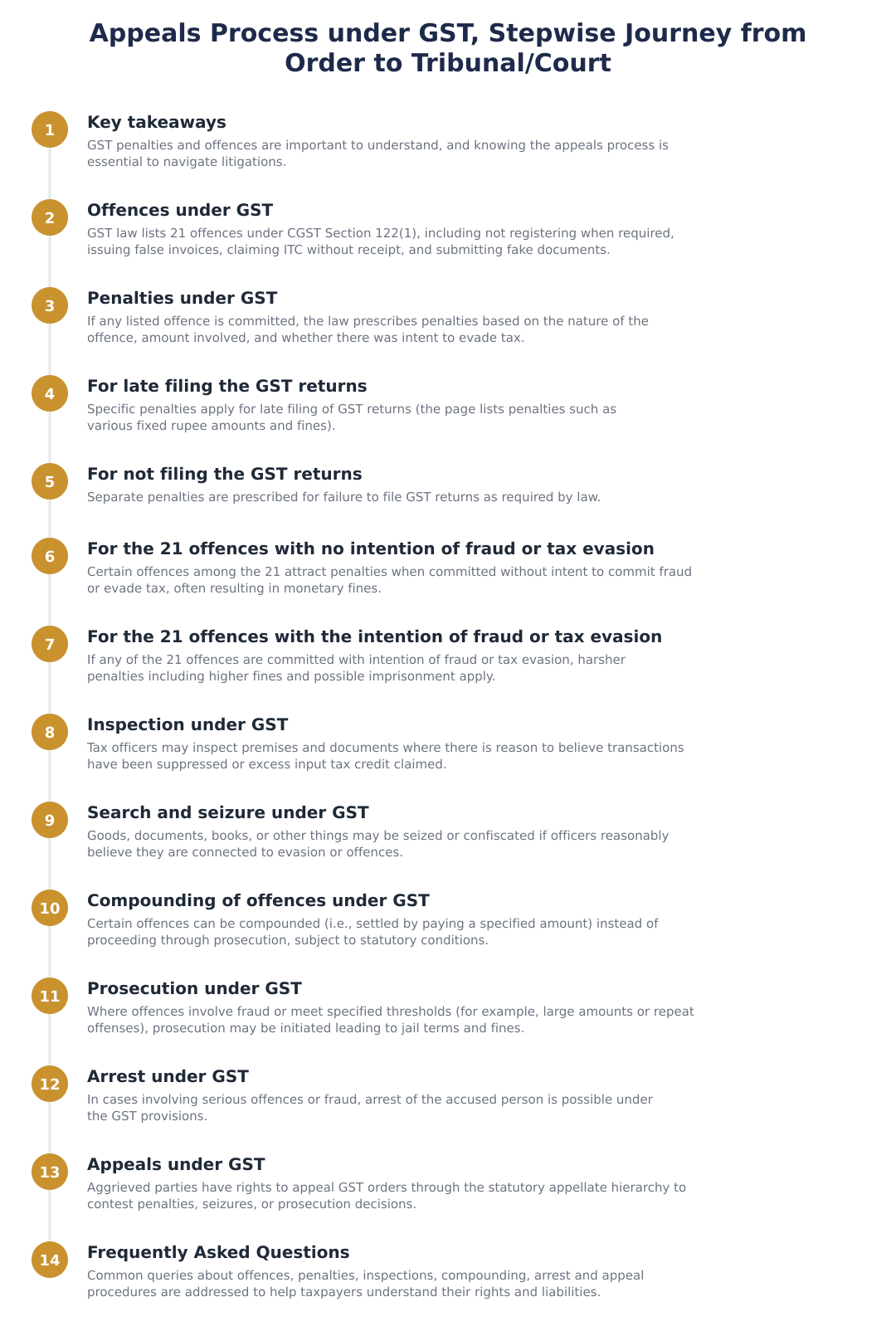
Under GST, you can file appeals against assessment, demand, penalty, seizure, or other adverse orders through a structured appellate hierarchy, first to the GST Appellate Authority or Tribunal and then to higher courts, within prescribed time limits and with payment of required pre-deposit percentages. The appeals process requires filing the appeal within statutory limitation periods (usually 3 months from service of order) and often payment of a portion of the disputed tax, interest and penalty as a pre-deposit to stay recovery; exact pre-deposit percentages vary by type of order. Remedies include rectification, stay applications, and further appeals to the Appellate Tribunal (AAAR/CCA-related fora), and ultimately High Court or Supreme Court on substantial questions of law. It is important to challenge adverse orders promptly and follow procedural steps precisely to preserve rights and obtain stays or relief.
Need help staying GST compliant?
MoneyGence's AI Finance OS tracks your compliance, wallet share, and finances in one place, built for agencies and growing businesses.
Get started with MoneyGence