GST on Professional Services in India: Rates, Applicability & Calculat
This guide explains how GST applies to professional services in India and what a service provider needs to know about applicability, registration requirements, supporting documents, and tax calculation. You will learn how to determine whether your professional services attract GST, what the registration outcome looks like once you apply, which supporting files you must upload during registration, and the step-by-step arithmetic for computing GST on an invoice. Understanding these points helps professionals, from solo practitioners to firms, remain compliant, price services correctly, and avoid common filing issues. The guide avoids quoting specific rates or thresholds and instead focuses on the practical mechanics of registration and tax computation based on official procedures. Read on to get clear, actionable explanations of the GST registration result process, the document upload requirement during registration, and the exact formula you should use to calculate tax on professional fees. By the end you will be able to prepare a compliant invoice, complete the registration process with the required file uploads, and calculate the correct tax amount to add to client bills.
Applicability of GST on Professional Services
GST is a tax on the supply of goods and services; professional services supplied to clients are generally captured within the GST framework when they fall under the definition of taxable supply. Whether a particular professional engagement attracts GST depends on the nature of the service, the contractual terms, and the place of supply rules that determine where the service is treated as supplied. Practically, service providers should assess each engagement to determine if the consideration received constitutes a taxable supply under GST.
For professionals, the key operational implication is accounting for GST on invoices and maintaining records of supplies. If your services are taxable, you must charge GST to the recipient (unless the transaction is specifically exempt or outside the scope), collect it, and remit it to the government as per applicable returns and timelines. Properly classifying services and documenting the transaction helps avoid disputes at the time of assessment or audits.
GST Rates Applicable on Professional Services
GST rates for professional services are set by the tax authorities and can vary depending on the category of service. Different types of professional work may attract different rates based on how the service is classified in the GST tariff. Because rates are determined administratively, professionals should consult the official notifications or a qualified tax advisor to identify the correct rate for the specific service they provide.
Even when a rate is known, correct application depends on invoicing and classification. The taxable value used for rate application normally excludes GST itself and includes fees and other incidentals billed to the client. Ensuring accurate service classification helps avoid under- or over-charging and reduces the risk of interest or penalties arising from incorrect tax treatment.
GST Registration for Professional Services
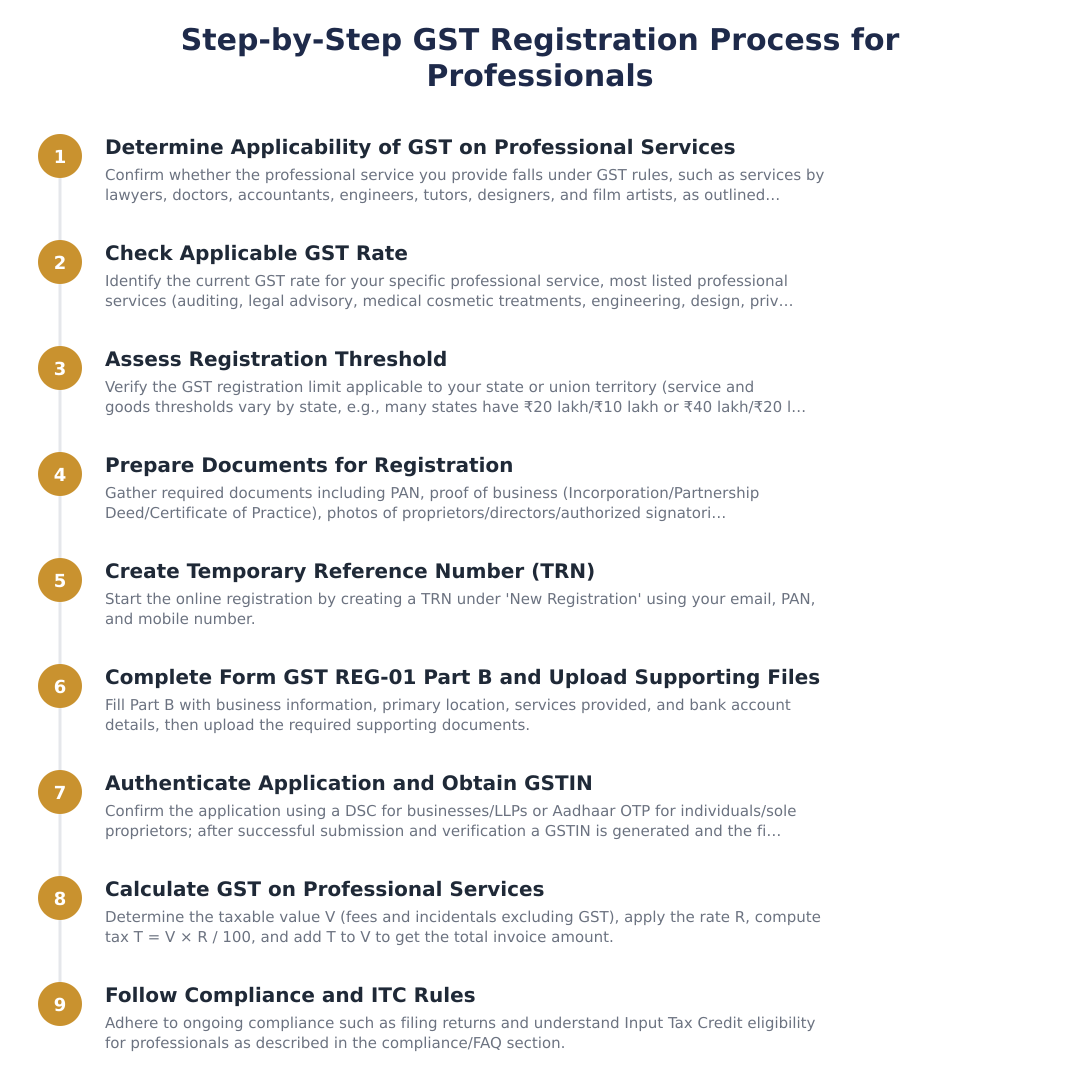
Registration is required when a supplier meets the statutory conditions for registration under GST. The registration process is completed online through the GST portal and involves submitting information about the applicant and the business, along with supporting documents and verification as required by the authorities.
A GSTIN is generated following a successful submission and, after document verification, the final registration certificate is issued. In practice, this means applicants receive an acknowledgement in the form of a provisional identifier once their application is submitted correctly; the issuance of the formal registration certificate follows after the tax authority verifies the documents and details provided.
Documents Required for GST Registration
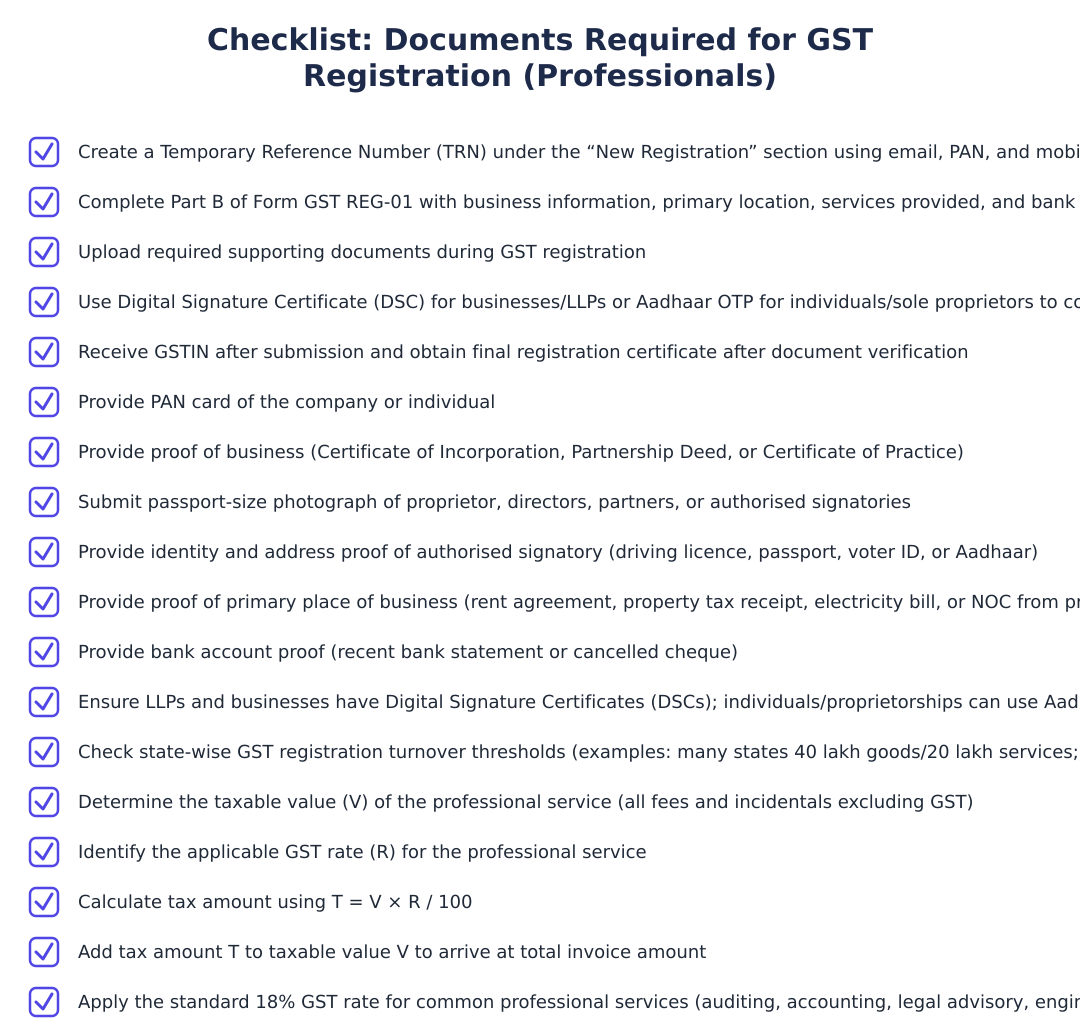
The online registration application requires supporting documents to establish identity, business existence, and the location of the primary place of business. These documents are essential for the authorities to verify the information submitted in the registration form and to complete the registration process.
Upload required supporting files during GST registration. Ensuring that the uploaded documents are clear, legible, and in the formats accepted by the portal helps prevent delays in verification and issuance of the final registration certificate.
Calculation of GST on Professional Services
Calculating GST on professional services involves establishing the taxable value of the supply and then applying the appropriate GST rate. The taxable value generally comprises the fees and incidentals billed to the client, excluding GST itself. Being clear about what elements form part of the taxable value avoids miscalculation and ensures compliance when preparing client invoices.
Use the following method to compute the tax and the final invoice amount: Determine taxable value V (fees and incidentals billed excluding GST), use relevant GST rate R, compute tax T = V × R / 100, and total invoice = V + T. This arithmetic is the standard procedure for arriving at the GST amount and the total amount payable by the client.
Frequently Asked Questions
Q: What happens after I submit a registration application? A: After you submit the application successfully on the portal, a GSTIN is generated and the application will undergo document verification; the final registration certificate is issued following verification.
Q: What must I do during registration to avoid delays? A: Make sure to upload required supporting files during GST registration and ensure they meet the portal’s clarity and format requirements, because document quality and completeness are common causes of verification delays.
Staying compliant with GST for professional services requires understanding when your services are taxable, completing the online registration process with the necessary uploads, and using the standard calculation method to compute tax on invoices. Keep your supporting documents ready and consult the official portal or a tax advisor if you are unsure about service classification or the correct rate to apply.
Frequently asked questions
Do professional services attract GST in India?
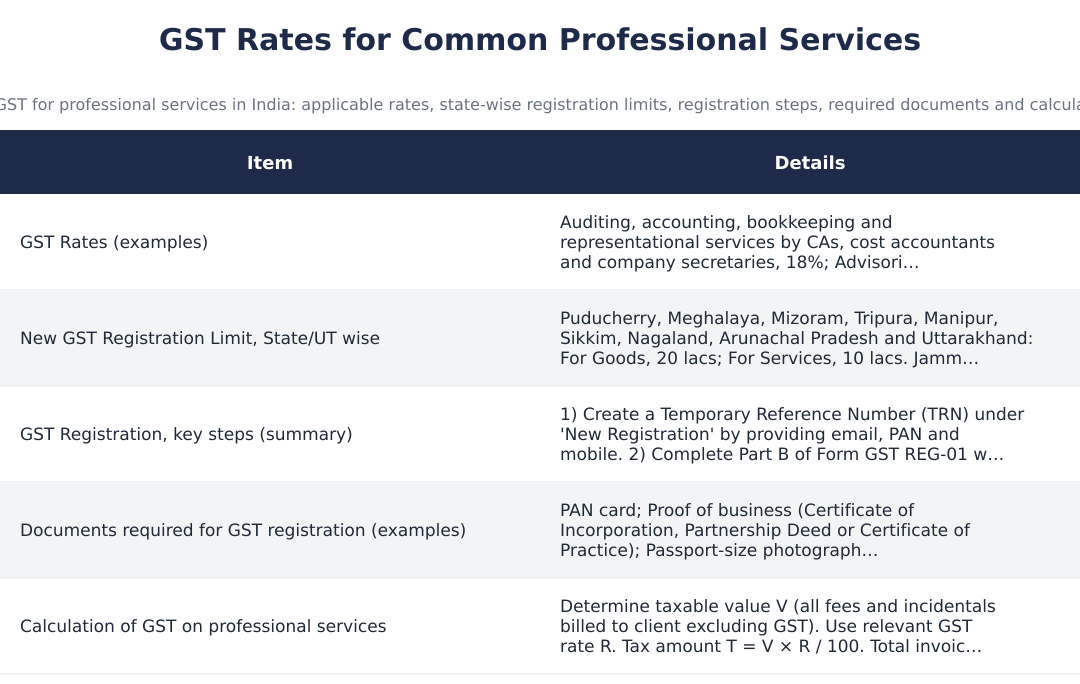
Yes, most professional services in India are subject to GST when supplied by a registered person and the turnover exceeds the prescribed threshold for the state/UT. The levy applies to services supplied by chartered accountants, advocates, doctors, engineers, tutors, designers, film artists and similar professionals unless a specific exemption applies. Small professionals whose aggregate turnover is below the state-specific registration threshold may be outside the GST net, but once registered they must charge GST on taxable supplies. For cross-border or export-related professional services, specific place-of-supply rules and export provisions determine GST applicability.
What is the GST rate on professional services like auditing or legal advice?
The standard GST rate on most professional services such as auditing, accounting, bookkeeping, legal advisory, engineering services, medical procedures like dental or cosmetic surgery, and private tuition is 18%. This 18% rate applies to services offered by chartered accountants, cost accountants, company secretaries, advocates, doctors, engineers, industrial and fashion designers, film artists, and coaching centres. There may be exceptions or different treatment for specific government-specified services or where a composition scheme applies, but the broad applicable rate for professionals listed is 18%.
What is the GST registration threshold for professional services in different states?
Registration thresholds for services vary by state: many larger states and most union territories have a services threshold of Rs 20 lakh while certain special category states have lower limits (Rs 10 lakh) and some states use Rs 40 lakh for goods but Rs 20 lakh or Rs 10 lakh for services. For example, Puducherry, Meghalaya, Mizoram, Tripura, Manipur, Sikkim, Nagaland, Arunachal Pradesh and Uttarakhand have a services threshold of Rs 10 lakh; Jammu & Kashmir, Ladakh and Assam have Rs 10 lakh for services; Telangana and many larger states have Rs 20 lakh for services or Rs 20–40 lakh for goods depending on the state. A professional whose aggregate turnover of taxable supplies exceeds the applicable state-specific threshold must obtain GST registration and start charging GST.
How do I register for GST as a professional service provider?
You register for GST by applying online on the GST portal, creating a Temporary Reference Number (TRN) under 'New Registration' using your PAN, email and mobile, completing Part B of Form GST REG-01 with business details, uploading supporting documents, and verifying the application with DSC (for companies/LLPs) or Aadhaar OTP (for individuals/sole proprietors). After submission a provisional GSTIN is generated and the final registration certificate is issued once documents are verified by authorities. The process requires you to provide details of the primary place of business, bank account information and the nature of services supplied.
What documents are required to register for GST as a professional?
You need your PAN card, proof of business (Certificate of Incorporation, Partnership Deed or Certificate of Practice), passport-size photograph of the proprietor/directors/partners/authorised signatory, identity and address proof of the authorised signatory (driving licence, passport, voter ID or Aadhaar), proof of primary place of business (rent agreement, property tax receipt, electricity bill or NOC), and bank account details (recent bank statement or cancelled cheque). Additionally, Digital Signature Certificates (DSCs) are required for companies and LLPs while individuals and proprietorships may complete registration using Aadhaar OTP. Ensuring accurate and legible documents speeds up verification and issuance of the GST registration certificate (GSTIN).
How do I calculate GST on a professional services invoice?
Calculate GST by first determining the taxable value V (total fees and incidentals billed excluding GST), then apply the applicable GST rate R using the formula T = V × R / 100 to get the tax amount T, and finally add T to V to arrive at the total invoice amount. For example, if professional fees are Rs 50,000 and the applicable GST rate is 18%, tax T = 50,000 × 18 / 100 = Rs 9,000, so the invoice total = Rs 59,000. Ensure that the invoice separates the taxable value and GST components and uses the correct rate for the specific service rendered.
Can professionals claim Input Tax Credit (ITC) on expenses?
Yes, registered professionals can claim Input Tax Credit (ITC) on GST paid for inputs and input services used for making taxable supplies, provided they hold valid tax invoices and the inputs are used for business purposes. ITC cannot be claimed for personal expenses or supplies that are specifically blocked under GST law (for example, motor vehicles for personal use unless used for specified purposes). To claim ITC, the professional must ensure the supplier has uploaded the invoice details in their GSTR filings and must maintain proper records supporting the credit claim.
What compliance and returns do professionals need to follow under GST?
A registered professional must comply with GST by charging GST on taxable supplies, issuing tax invoices with GST details, maintaining books and records, filing periodic GST returns and paying tax within prescribed due dates. Typical compliance includes filing regular returns (such as monthly/quarterly returns and annual return formats), reconciling outward supplies with supplier filings, and preserving invoices and supporting documents for audit and ITC claims. Failure to comply can attract interest, penalties and denial of ITC, so timely filing and accurate invoicing are essential for professionals.
Are there simpler GST options for small professionals like a composition scheme?
Small service providers may opt for simplified compliance under schemes available in GST, but most composition schemes are applicable primarily to suppliers of goods and have limited applicability for service providers; where available, the turnover and eligibility conditions must be met. If a composition scheme for services is applicable in specific situations, the taxpayer pays tax at a prescribed lower rate on turnover and has relaxed return requirements but cannot collect GST from customers separately. Professionals should check eligibility thresholds and scheme conditions for services in the GST law and consult a tax adviser before opting in, because opting out or non-compliance can have consequences.
Need help staying GST compliant?
MoneyGence's AI Finance OS tracks your compliance, wallet share, and finances in one place, built for agencies and growing businesses.
Get started with MoneyGence