GST Interest Calculation 2026: Revised Rules & GSTR-3B Breakup
This guide explains recent changes in how interest on delayed GST payments is understood and handled, and what taxpayers should watch for when reconciling tax liabilities in GSTR-3B. You will learn the legal basis for interest on late payments, why accurate breakup of tax liability matters for interest computation, how to approach recomputing any interest shown in returns, and practical steps to reduce interest exposure. The guidance is aimed at GST registrants, tax teams, accountants and advisors who must ensure compliance when filing GSTR-3B and settling tax dues. While the law imposes liability for interest on late payment, the way systems and ledgers interact with returns can affect how much interest is ultimately calculated and collected. Understanding these interactions reduces surprises at the time of filing, helps in timely payment planning, and supports accurate reconciliation between outward supplies, liability tables and cash/credit ledgers. Throughout this guide we stay grounded in the statutory position on interest liability and focus on practical controls, reconciliation approaches and documentation habits that help taxpayers limit avoidable interest and address discrepancies efficiently.
Background of GST Interest Levy
The statutory foundation for charging interest on delayed GST payments is important to understand before reviewing any system-level or procedural changes. Under the law, a taxpayer is liable to pay interest where there is a delay in filing GSTR-3B and in the payment of tax. This creates an obligation that attaches to delayed payment events and is independent of how a return is prepared or how the tax ledger is maintained.
Practically, this means that businesses must treat interest as a likely consequence of late payment and incorporate it into their compliance checks. Reconciliations between sales records, outward supplies, and the tax payable shown in returns are necessary to avoid underpayment situations that can give rise to interest. Because interest is driven by timing of payment and filing, even otherwise correct tax calculations can attract interest if payment is not made by the due date.
Key features to consider when interest is computed
When assessing interest exposure, focus on three practical dimensions: timing, the composition of payment (cash versus available credits), and the accuracy of liability allocation in the return. Timing determines when the interest clock starts; payments made later than the statutory deadline are the events that trigger interest liability. The make-up of payment, whether tax is discharged from cash balances or by using input tax credits, affects how much cash outflow is required and therefore the potential shortfall that may attract interest.
Accuracy in allocating liability across tax heads in the GSTR-3B matters because the allocation influences how ledger balances are debited and how interest may be computed. Errors or mismatches between the liability declared and the actual amounts available in cash and credit ledgers can create apparent shortfalls and lead to interest being calculated on those shortfalls. Effective internal controls, timely bank-to-ledger reconciliation, review of credit utilisation, and cross-checking GSTR-1 or outward supplies, help minimise such mismatches.
Advisory on re-computation and reconciliation
If you detect any discrepancy between your records and the liability or interest shown in your filed return, undertake a careful recomputation. Begin by reconciling the tax payable shown in GSTR-3B with your sales/book records and any return summaries that feed into it. Identify whether any short payment resulted from timing differences, incorrect allocation, or omission of transactions.
Where recomputation shows that interest has been incorrectly charged or overstated, prepare a clear audit trail: statement of differences, supporting vouchers or bank statements showing dates and amounts of cash deposits, and corrected calculation of the shortfall and applicable period. Having this documentation helps when communicating with tax authorities or when seeking rectification through the appropriate return amendment or other prescribed remedies.
Operational controls to reduce interest risk
Adopt routine controls that prevent avoidable delays: calendar reminders for deposit deadlines, pre-validation of ledger balances before filing, and an internal sign-off process for GSTR-3B that verifies cash and credit sufficiency. These measures minimise the chance that a filing will proceed while cash or credit ledgers are insufficient to meet the declared tax liability.
Also institute a periodic reconciliation between the accounting system and GST ledgers. A monthly check that matches outward supplies to the tax liability reported and confirms cash ledger replenishments ensures that any deficits are spotted and corrected before they attract interest. In case of large or unusual adjustments, document the rationale and retain supporting evidence to demonstrate due diligence.
Frequently Asked Questions
Q: What is the legal basis for charging interest on delayed GST payment? A: The law states that a taxpayer is liable to pay interest for delay in filing GSTR-3B and making the payment of tax. This statutory provision forms the basis for any interest assessed for delayed payment or filing.
Q: If there is an apparent interest charge after filing, what should I do? A: Reconcile your records with the return and ledger entries to identify the cause of the charge, timing differences, misallocation in the return, or a genuine short payment. Compile supporting evidence and follow the prescribed amendment or rectification routes available under GST procedures to correct any error.
Interest on delayed GST payment is a statutory risk that flows from late filing or late payment. By understanding the legal basis for interest, maintaining timely cash balances, reconciling returns to internal records, and keeping clear documentation, taxpayers can minimise unexpected interest and address any discrepancies efficiently.
Frequently asked questions
What are the GST interest calculation changes coming into effect in 2026?
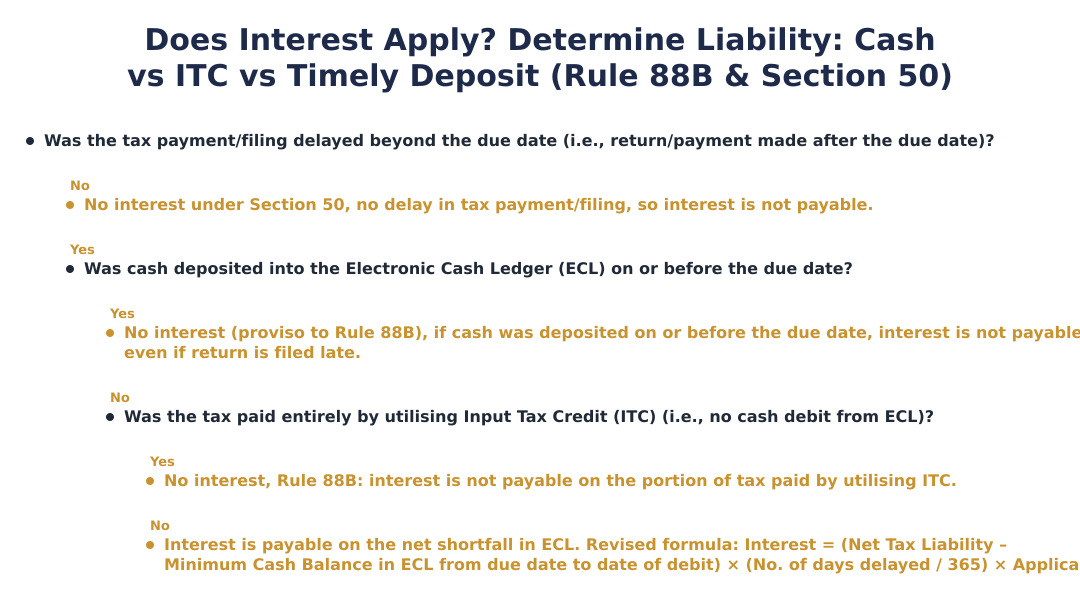
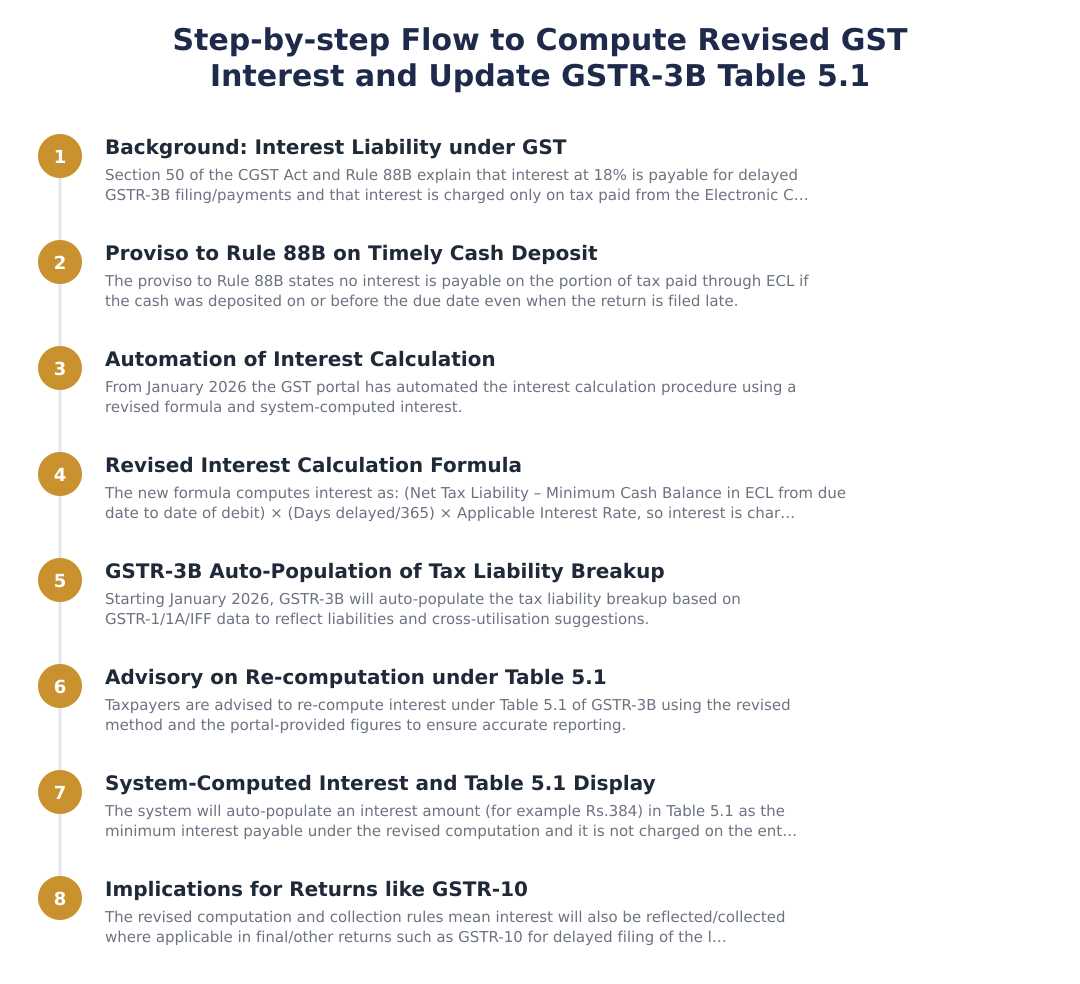
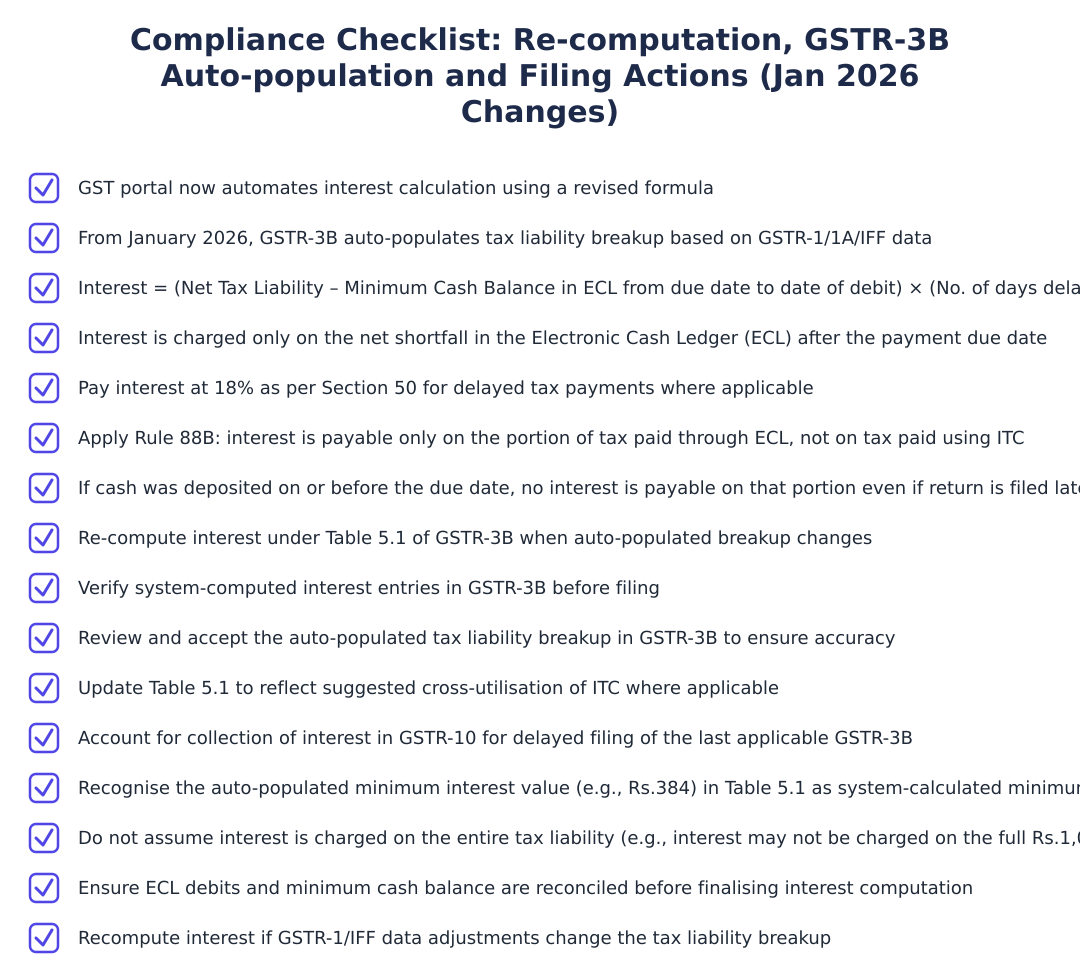
The 2026 changes introduce an automated, revised interest calculation in the GST portal that charges interest only on the net shortfall in the Electronic Cash Ledger (ECL) after the due date instead of on the entire tax liability. The portal will apply a new formula and auto-populate interest and tax liability breakup in GSTR-3B from GSTR-1/1A/IFF data starting January 2026, reducing manual computation errors. Section 50 (interest at 18% on delayed tax payments) and Rule 88B (interest only on ECL-paid portion) remain the legal basis, but the system now enforces the proviso that cash deposited on or before the due date is not subject to interest. Taxpayers should review auto-populated figures and recompute interest where necessary before final submission to avoid mismatches or short payments.
How is the revised GST interest calculated under the new 2026 formula?
The revised interest is calculated as: Interest = (Net Tax Liability – Minimum Cash Balance in ECL from due date to date of debit) × (Number of days delayed / 365) × Applicable Interest Rate. This means interest is charged only on the net shortfall in the ECL after accounting for the minimum cash balance available between the due date and the date the cash was debited, not on full tax liability. The applicable interest rate remains 18% per annum as per Section 50 unless notified otherwise, and days are computed on actual delay; for example, shortfall multiplied by days/365 at 18% gives the interest amount. The GST portal will now auto-compute this figure, but taxpayers should verify the ECL minimum cash balance used by the system for accuracy.
When will GSTR-3B auto-populate tax liability breakup and how does that affect me?
Starting January 2026, GSTR-3B will auto-populate the tax liability breakup based on data from GSTR-1/1A/IFF, reducing manual entry and reconciliation work for taxpayers. This auto-population helps ensure consistency between outward supply returns and GSTR-3B, but taxpayers must still verify and correct any mismatches before final submission to avoid incorrect payment or notices. If you have adjustments, amendments, or timing mismatches between supplies and cash payments, you should cross-check auto-filled values and maintain supporting records in case of scrutiny. The automated break-up also feeds into the revised interest calculation, so errors in source returns can affect interest computed by the portal.
Does the revised system still require interest on tax payments when ITC is used?
No, interest is not payable on the portion of tax paid by utilising Input Tax Credit (ITC); interest applies only to the tax paid from the Electronic Cash Ledger (ECL) as per Rule 88B. The proviso to Rule 88B further clarifies that if cash was deposited into the ECL on or before the due date, no interest will be charged on that cash even if the return is filed late. Therefore, only the net shortfall in cash payments (after considering ECL credits and minimum cash balances) attracts interest under the revised portal computation. Taxpayers who rely heavily on ITC should ensure proper classification of payments so the system does not wrongly compute interest on non-cash payments.
What is the taxpayer's responsibility after the GST portal auto-computes interest and tax breakup?
Taxpayers must verify and, if necessary, recompute and correct any auto-populated tax liability breakup and interest figures before submitting GSTR-3B because the portal's computation is suggestive and errors in source returns can propagate. While the system computes interest using the revised formula, legal liability ultimately rests with the taxpayer under Section 50 and Rule 88B, so you should reconcile GSTR-1/1A/IFF data, ECL balances, and payment dates to ensure accuracy. If discrepancies are detected, adjust entries or provide explanations in your records and correct the return to avoid interest shortfall, demands, or penalties. Retain reconciliation worksheets and evidence (bank challans, ECL ledger) for at least the statutory record-keeping period to defend your position in case of notices.
What changes have been made to Table 5.1 of GSTR-3B concerning interest?
Table 5.1 of GSTR-3B will show system-computed interest figures, including a suggestive minimum interest amount auto-populated by the portal; for example, the system might auto-populate an interest amount such as Rs.384 in Table 5.1 to indicate minimum payable interest. This reflects the portal's application of the revised formula and serves as a suggestive computation that taxpayers should accept or adjust based on their reconciliations; it does not replace the taxpayer's duty to ensure correctness. The portal's entry is intended to aid timely and correct payment but taxpayers should cross-verify ECL debits, cash deposits, and the days of delay used in calculation before finalizing GSTR-3B. Any disagreement should be corrected within the return filing process to avoid downstream notices or mismatch with GSTR-1.
How does the revised process handle recomputation of interest for past periods?
The revised process allows re-computation of interest under Table 5.1 when taxpayers identify discrepancies, but the portal will use the same formula and historical ECL data to auto-recompute suggested interest amounts. If past cash deposits were made on or before due dates, the proviso to Rule 88B means interest will not be shown for those portions; otherwise, the system will calculate interest on net shortfalls for the historic period. Taxpayers should reconcile past ECL balances, payment dates, and GSTR-1/1A data and amend returns or pay differential interest where necessary to regularise liabilities. Keep supporting documents such as challans and ECL statements when you recompute interest to substantiate any corrections during scrutiny.
What is the applicable interest rate under the revised computation and where is it prescribed?
The applicable interest rate for delayed GST payment under the revised computation remains 18% per annum as prescribed under Section 50 of the CGST Act, 2017, unless a different rate is notified by law. This 18% rate applies to the net shortfall in the ECL calculated using the revised formula and is multiplied by days delayed/365 to compute the interest amount. Rule 88B and its proviso explain that interest applies only to cash-paid portions and not to ITC-paid tax, and the portal implements this rule in its auto-computation. Taxpayers should monitor notifications from CBIC in case any future changes to the rate or computation method are issued.
Will the portal charge interest on the entire tax liability of Rs.1,00,000 under the new rules?
No, the portal will not charge interest on the entire Rs.1,00,000 tax liability; it charges interest only on the net shortfall in the ECL after accounting for minimum cash balances and ITC utilisation. For example, if the portal auto-populates Rs.384 as interest in Table 5.1, that indicates the minimum interest computed on the shortfall using the revised formula rather than interest on the full Rs.1,00,000. Therefore, cash deposits made on or before the due date and tax paid by ITC will not attract interest, and only the unpaid cash portion for the delayed days is considered. Taxpayers should still verify the components (ECL debits, dates, ITC usage) used by the portal to ensure the computed amount is correct.
Need help staying GST compliant?
MoneyGence's AI Finance OS tracks your compliance, wallet share, and finances in one place, built for agencies and growing businesses.
Get started with MoneyGence