GST FY 2026-27 Compliance Checklist: 10 Key Actions for Businesses
This guide gives businesses a concise, practical compliance checklist for GST for the financial year 2026–27. You will learn the core administrative and operational actions that reduce audit risk, preserve input tax credit, and keep statutory filings in order. The checklist is written for accountants, CFOs, compliance officers and business owners who want a clear plan of action for GST compliance without wading through dense notifications. It focuses on recurring tasks, registration and profile management, invoicing and recordkeeping, returns and reconciliations, credit controls, and readiness for inspections or notices. Following these recommendations will help you avoid common compliance slip-ups, ensure smoother month‑end and year‑end processes, and make statutory audits and assessments easier to manage. Throughout the guide you will find practical steps you can implement immediately, as well as notes on internal controls and documentation best practices so your team can sustain good compliance habits across the year.
1. Registration and GST profile upkeep
Confirm that every business vertical and place of business that requires GST registration is registered and that the registration details accurately reflect your current structure. Keep addresses, bank details, authorised signatories and business descriptions up to date in the GST profile to prevent mismatches during assessments or supplier validations.
If your business structure changes, through addition or closure of units, change in trade name, or appointment of new authorised persons, update the GST portal records promptly. Timely updates reduce the likelihood of downstream disputes around invoices, returns or credits and ensure correspondence reaches the right person.
2. Invoicing, e-invoicing and document controls
Adopt a disciplined invoicing regime: issue tax invoices, debit/credit notes and other statutory documents as required by GST law, and store them in a retrievable format. Standardise invoice templates across the business so mandatory fields are captured consistently and audit trails are preserved.
Where electronic invoicing or portal-based reporting applies to your transactions, ensure your billing systems integrate with the relevant interface and that staff understand submission timelines and error-resolution procedures. Maintain a clear internal process for correcting and reissuing invoices when mistakes occur.
3. Returns, reconciliations and claim management
Set up a calendar for periodic GST returns and related reconciliations and make these part of your month‑end routine. Reconcile sales records, output tax liability, purchase registers and input tax credit so that reported figures align with underlying invoices and accounts.
Document the rationale and supporting evidence for every input tax credit claimed. Where adjustments, reversals or provisional credits are required, record the calculations and authorisations to demonstrate good faith and an audit-ready position.
4. Supplier and buyer diligence
Perform regular due diligence on key suppliers and high-value customers. Verify that suppliers’ GST registrations are active and that invoices from third parties meet documentary standards for credit eligibility.
Implement controls for onboarding new suppliers, capture registration proofs, verify the supply address, and include clauses in purchase contracts requiring timely compliance. For customers, set internal thresholds that trigger additional validation before extending credit or accepting bulk orders.
5. Internal controls, audits and dispute readiness
Institute a periodic internal audit or compliance review focusing on critical GST risk areas: classification of goods and services, place of supply determinations, and reconciliations. Use findings to strengthen controls and close gaps promptly.
Maintain a structured file of communications, show-cause notices and orders, and establish an escalation path for notices so that legal or accounting teams can respond within prescribed timelines. Preserve evidence of corrective actions taken after any non-compliance is detected to demonstrate proactive remediation.
A proactive approach to GST compliance, regular profile updates, disciplined invoicing, timely reconciliations, supplier diligence and internal audits, reduces risk and preserves value for your business. Use this checklist to build repeatable processes and assign clear ownership within your finance and operations teams so GST compliance becomes part of routine business operations rather than an afterthought.
Frequently asked questions
Do I need to opt into the GST composition scheme before 31 March 2026?
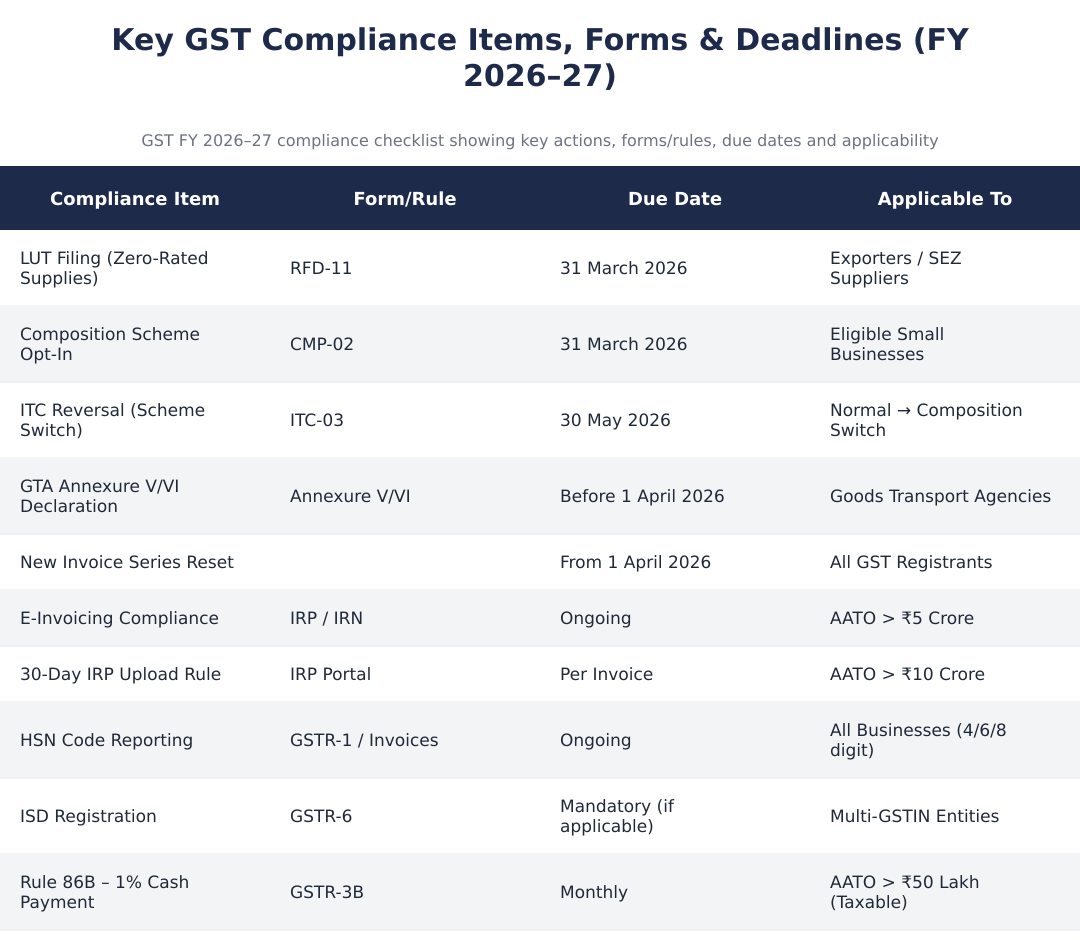
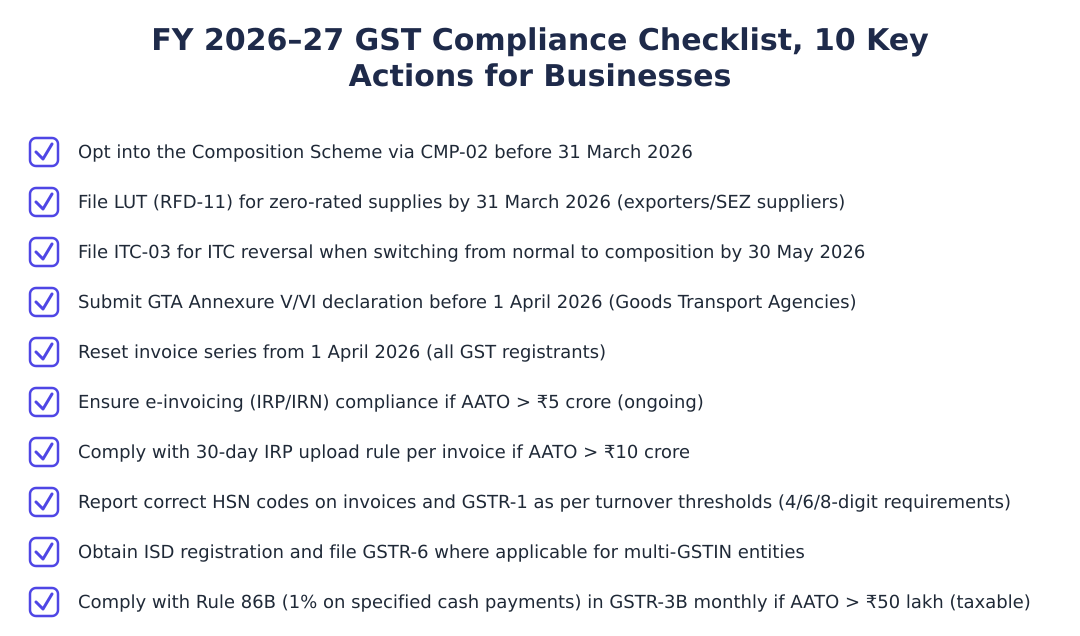
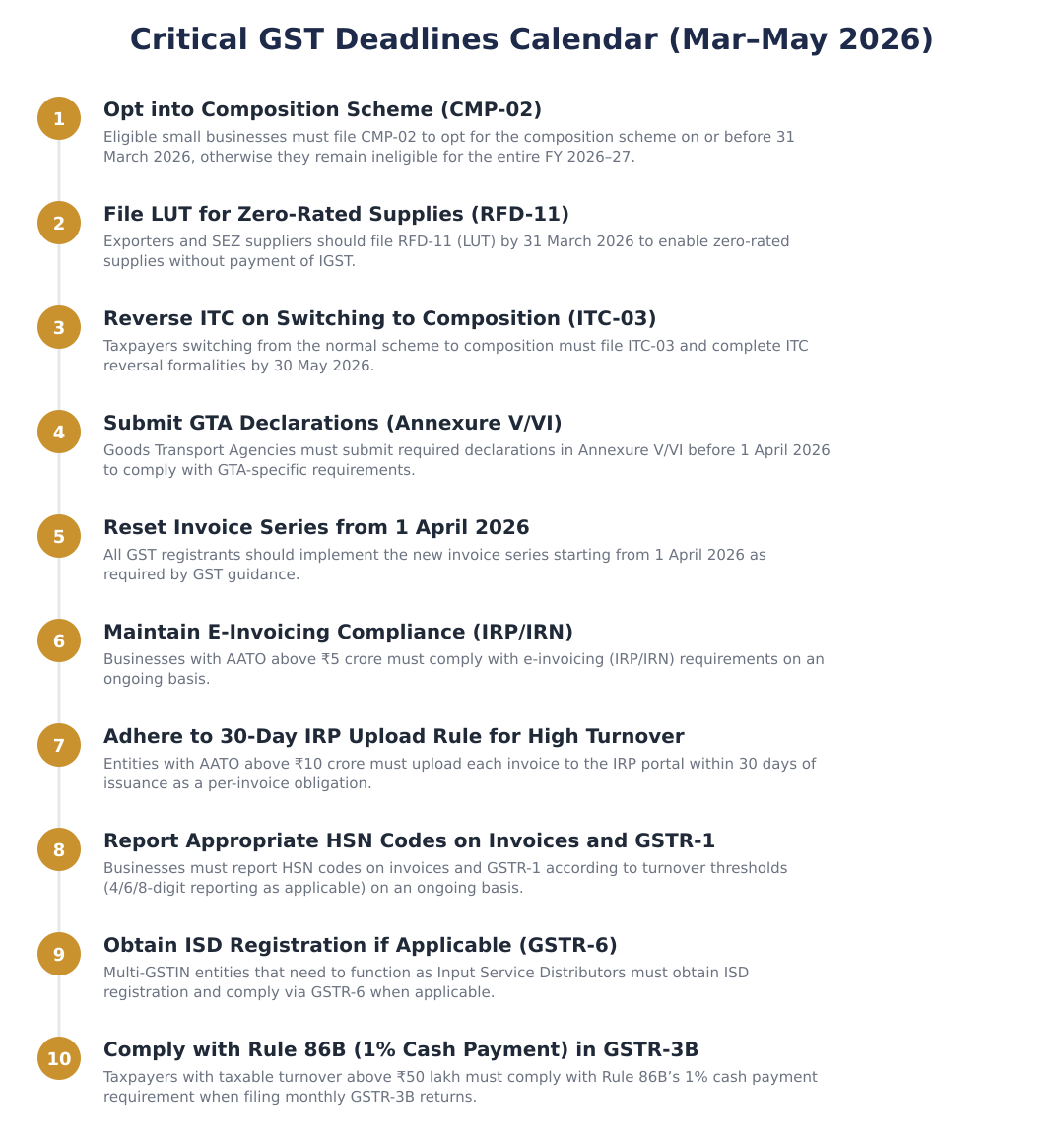
Yes, eligible businesses must opt into the GST composition scheme by 31 March 2026 or they will be ineligible for the entire financial year 2026–27. The option is filed using Form CMP-02 and applies only to taxpayers who meet the turnover and activity conditions for composition; missing the deadline means you cannot avail composition rates (lower tax and simple returns) until 1 April 2027. If you miss the deadline but still wish to convert later, you must remain under the regular scheme and comply with normal ITC, invoicing and return rules; switching to composition mid-year has ITC reversal consequences (see ITC-03). Check state-wise notifications for any minor procedural variations before filing CMP-02 online.
What happens if I miss the 31 March 2026 composition opt-in deadline?
If you miss the 31 March 2026 deadline you cannot opt for the composition scheme for the whole financial year 2026–27. That means you must continue as a regular GST registrant for the entire year, file regular returns (GSTR-1/GSTR-3B), comply with e-invoicing/HSN rules applicable to your turnover slab, and you will not be eligible for composition rates or its simplified compliance benefits until the next financial year. Additionally, businesses that later choose composition must reverse eligible input tax credit using ITC-03 and meet other exit-entry conditions, which can create cash-flow impact and extra compliance. Plan transitions and compliance calendars in advance to avoid losing composition benefits.
Who must file an LUT for zero-rated supplies by 31 March 2026?
Exporters and SEZ suppliers who intend to make zero-rated supplies without payment of IGST should file an LUT (Letter of Undertaking) by 31 March 2026 if they plan to continue supplies in FY 2026–27. The LUT filing lets registered suppliers export goods or services under bond without paying integrated tax; exporters must submit Form RFD-11 for LUT and adhere to conditions like timely filing of returns and not having been prosecuted for certain offences. If you do not file LUT, you can still export but will need to pay IGST and later claim a refund, which can delay cash flows. Ensure the LUT is renewed/valid and submit necessary bank guarantees only if required by the jurisdiction or past defaults.
When must I reverse input tax credit if I switch from regular scheme to composition?
You must reverse input tax credit when switching from the regular GST scheme to the composition scheme by filing ITC-03 by 30 May 2026 for switches affecting FY 2026–27. ITC-03 captures details of ITC attributable to inputs, capital goods and input services that need to be reversed upon moving to composition, and failure to file ITC-03 in time can attract interest and compliance issues. Calculate reversals carefully, capital goods and inputs have specific apportionment rules and block-wise adjustments, and retain documentary evidence to support computations in case of scrutiny. Consult your tax advisor before making the switch so you budget for the cash outflow due to ITC reversal.
Do goods transport agencies need to submit Annexure V/VI before 1 April 2026?
Yes, Goods Transport Agencies (GTAs) must submit declaration Annexure V/VI before 1 April 2026 if they want to continue issuing consignment-specific declarations under GST. These annexures are used to declare taxable supplies and parameters relevant for GST compliance specific to GTAs and should be filed as required by GSTN timelines to avoid classification or invoicing issues. Missing this pre-April declaration can lead to reconciliation mismatches, e-way bill or return complications and possible notices during assessments, so GTAs should prepare their records and submit the annexures timely. Check whether your state GST portal requires any additional supporting documents when submitting Annexure V/VI.
When do I need to reset my invoice series and what does it mean from 1 April 2026?
All GST registrants should reset or start a new invoice series from 1 April 2026 if they wish to maintain year-wise continuity and proper numbering under GST rules. Resetting the invoice series means starting a fresh sequential invoice numbering (for example, INV/2026-27/001) to reflect the new financial year, improve audit trail and simplify reconciliation; there is no mandatory format but numbers must be unique and continuous. This is especially useful for taxpayers using multiple GSTINs, multiple business verticals, or transitioning to e-invoicing where IRN generation depends on correct invoice numbering. Ensure accounting and billing systems are updated before 1 April to avoid duplicate numbers and ensure compliance with GST invoicing rules and HSN reporting requirements.
Which businesses must follow the new e-invoicing and IRP upload rules in FY 2026–27?
Businesses with aggregate annual turnover (AATO) above ₹5 crore must comply with e-invoicing and IRP/IRN generation on an ongoing basis, and those with AATO above ₹10 crore must upload invoices to the IRP within 30 days per invoice. E-invoicing via the IRP (Invoice Registration Portal) is mandatory for specified turnover thresholds to generate an IRN and QR code for B2B invoices; non-compliance can lead to return mismatches and notices. Track your AATO for FY 2025–26 to determine applicability in FY 2026–27, ensure your billing software is integrated with IRP APIs, and maintain backups as per new digital books rules to prevent data loss or processing delays. Also verify applicable HSN digit reporting as e-invoicing ties into GSTR-1/H1 reporting requirements.
What HSN code reporting is required for FY 2026–27?
You must report HSN codes on invoices and in GSTR-1: taxpayers with annual turnover up to ₹5 crore may report 4-digit HSN optionally, those above ₹5 crore must report 6-digit HSN for B2B invoices, and notified categories must report 8-digit HSN irrespective of turnover. HSN reporting thresholds affect the level of detail on B2B and B2C invoices and non-compliance can lead to matching issues and notices during assessment or audits. Make sure your billing and ERP systems map product SKUs to the correct HSN at the mandated digit level and update codes for any new notifications or tariff changes for FY 2026–27. Retain supporting documentation for HSN classification as disputes on classification are common in GST scrutiny.
Am I subject to Rule 86B 1% cash payment restriction in FY 2026–27?
You will be subject to Rule 86B (1% cash payment blocked) in FY 2026–27 if your taxable supplies’ aggregate turnover exceeds ₹50 lakh and you do not pay tax through electronic modes for specified liabilities, in which case 1% of net cash liabilities may be blocked. Rule 86B aims to discourage high-value tax evasion by restricting credits for taxpayers whose electronic tax payments are insufficient; the provision applies monthly and the block is reflected in GSTR-3B by the tax restricted amount. Check your AATO and monthly payment patterns: businesses crossing the ₹50 lakh threshold must maintain prescribed electronic payments and return compliance to avoid the debit block, and reconciliations should be done monthly to claim any release or correction. If wrongly applied, you can challenge or seek rectification through the GST portal and maintain evidence of electronic payments and returns.
Need help staying GST compliant?
MoneyGence's AI Finance OS tracks your compliance, wallet share, and finances in one place, built for agencies and growing businesses.
Get started with MoneyGence