GST Composition Scheme: Rules, Turnover Limit, Rates & Benefits
This guide explains the GST Composition Scheme in clear, practical terms and highlights the rules a small taxpayer must follow if they choose this simplified compliance route. You will learn who is eligible to opt for the scheme under the law, which categories of taxpayers are explicitly excluded, the key operational conditions a composition taxpayer must observe (including invoice and display requirements), and how certain supply types such as inter-state sales or reverse charge transactions are treated. Understanding these points matters because the composition option changes how tax is charged, how documentation is issued, and what credits or supplies a taxpayer can or cannot make. For many small businesses the scheme reduces compliance burden, but it also carries limitations, for example, composition dealers cannot claim input tax credit and face restrictions on the nature and territory of their supplies. This guide focuses on the statutory and practical consequences that follow from those core rules so you can weigh whether the scheme fits your business model and what operational changes you must implement if you opt in.
Who can opt for Composition Scheme?
The Composition Scheme is available to "regular taxpayers" who meet the conditions set out in Section 10 of the CGST Act. That is the statutory gateway: taxpayers who satisfy the criteria listed in that provision may choose this simplified levy instead of the regular GST mechanism.
Choosing composition relieves a taxpayer from certain routine compliance obligations under the regular scheme but does not remove all statutory responsibilities. Opting taxpayers must ensure they continue to meet the eligibility requirements contained in Section 10 for the period they remain on the scheme.
Who Cannot opt for Composition Scheme
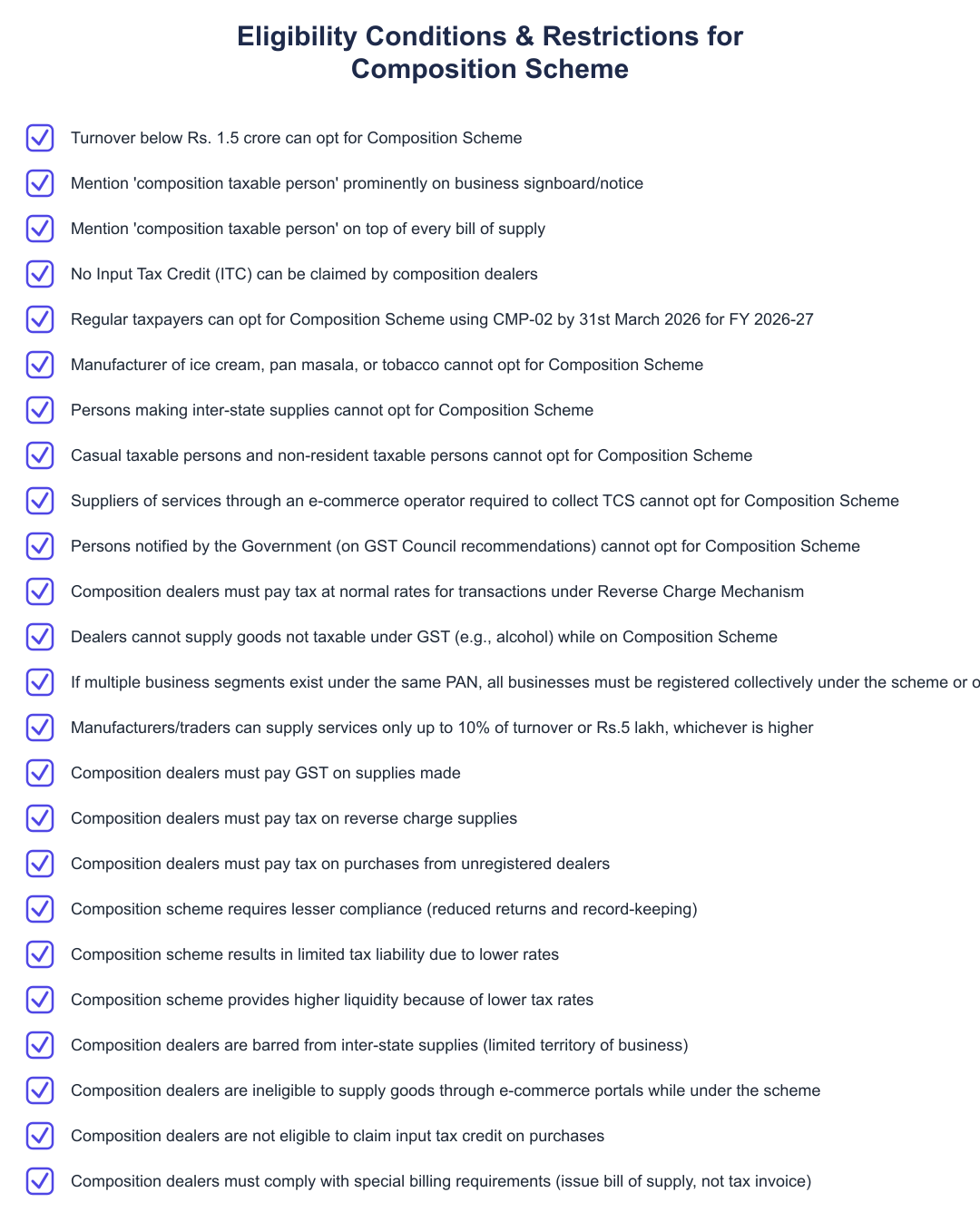
Several categories of persons are specifically barred from taking the composition route. A person making inter-state supplies is not eligible to opt for the composition scheme, so businesses that sell goods across state lines cannot avail themselves of this option.
Casual taxable persons and non-resident taxable persons are also excluded from the composition scheme. Additionally, composition taxpayers are not permitted to supply certain goods that lie outside the GST scope, for example, alcohol for human consumption, nor can they supply goods through e-commerce platforms.
These exclusions are statutory and must be checked carefully before choosing composition: if your business falls in any of these categories you cannot lawfully adopt the composition scheme.
What are the Conditions for Availing Composition Scheme?
A fundamental condition is that the taxpayer must satisfy the requirements laid down in Section 10 of the CGST Act. In addition to the statutory eligibility criteria, turnover for determining entitlement must be calculated by aggregating the turnover of all businesses registered under the same PAN. This aggregation is binding when assessing whether one qualifies for composition.
Operational conditions apply once a taxpayer opts in: a composition dealer cannot issue a tax invoice and must instead issue a Bill of Supply. The law also mandates prominent display of a notice indicating the taxpayer’s composition status. Specifically, the taxpayer has to mention the words 'composition taxable person' on every notice or signboard displayed prominently at their place of business and on the top of the Bill of Supply.
Another important operational consequence is that composition taxpayers cannot claim Input Tax Credit. Also, when purchases or supplies fall under the Reverse Charge Mechanism, the composition taxpayer has to pay tax at the normal rates applicable under reverse charge despite being on the composition scheme.
How Should a Composition Dealer Raise Bill?
Composition dealers are not permitted to issue tax invoices. Instead, they must prepare a Bill of Supply for every taxable supply. The Bill of Supply must carry the prescribed statement that distinguishes the taxpayer’s status under the scheme.
Legally required wording must appear on the Bill of Supply: a composition dealer must mention 'composition taxable person, not eligible to collect tax on supplies' on the bill. This wording helps recipients and tax authorities recognise that the supplier is on the composition levy and is not charging tax in the ordinary manner.
How Should GST Payment be Made by a Composition Dealer?
Composition taxpayers remain liable to discharge GST on taxable supplies as per the composition levy rules. One critical aspect to note is that where supplies fall under the Reverse Charge Mechanism, the taxpayer must pay tax at the normal rates applicable to reverse charge transactions even if they are on the composition scheme.
Because composition dealers cannot claim Input Tax Credit, GST payments cannot be offset by recoverable input credits. This affects cash-flow and pricing decisions: businesses should plan procurement and pricing keeping in mind that inputs will effectively be taxed without any credit benefit.
Advantages and Disadvantages, Practical Implications
The composition route is designed to ease compliance for eligible small taxpayers by simplifying return and accounting obligations relative to regular GST compliance. For businesses that meet the statutory criteria under Section 10 and whose supply profile fits within the permitted scope, the scheme can reduce the administrative burden associated with frequent tax filings and complex input-credit accounting.
However, there are tangible trade-offs. Composition dealers cannot claim Input Tax Credit, which increases the effective cost of inputs. They are barred from making inter-state supplies and from supplying certain goods (for example, alcohol for human consumption) or using e-commerce operator routes, which restricts market reach. The reverse charge rule adds another compliance wrinkle because tax on such transactions must be paid at normal rates.
Operationally, dealers must also comply with display and documentation requirements, signboards and Bill of Supply wording are mandatory, and they must include turnover across all registrations under the same PAN when checking eligibility. These factors mean that while compliance is lighter in some respects, composition status also imposes business and procedural limits that need careful consideration.
Opting for the GST Composition Scheme can simplify tax compliance for eligible regular taxpayers, but it brings specific legal restrictions and operational consequences. Before electing the scheme, verify that you meet Section 10 conditions, aggregate turnover across the same PAN, and understand limitations such as the inability to claim input tax credit, the ban on inter-state supplies, and required signage and Bill of Supply wording. Assess these trade-offs against your business model and consult your advisor to determine whether composition or regular registration better serves your commercial needs.
Frequently asked questions
Who is eligible to opt for the GST Composition Scheme?
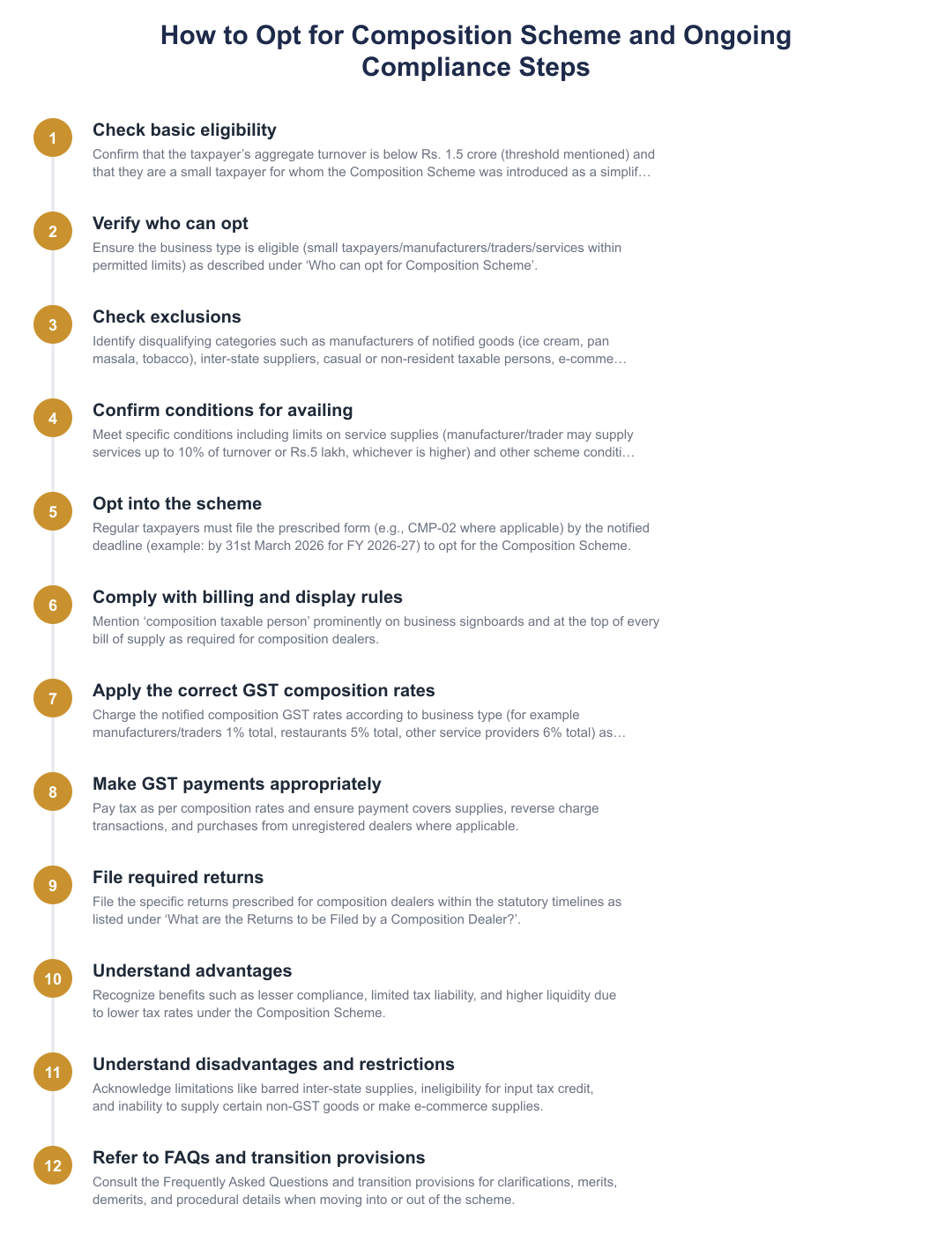
A taxpayer with aggregate turnover up to Rs 1.5 crore (Rs 75 lakh for North‑Eastern states and Himachal Pradesh) can opt for the Composition Scheme. Aggregate turnover includes turnover of all businesses registered under the same PAN and the threshold is assessed for the preceding financial year; a composition dealer can also supply services up to 10% of turnover or Rs 5 lakh (whichever is higher) as per the CGST (Amendment) Act, 2018 effective from 1 Feb 2019. Regular taxpayers who meet other conditions in Section 10 of the CGST Act must file CMP‑02 to opt in at the start of the financial year. Note that some notified classes of taxpayers and supplies are excluded from the scheme (see exclusions).
Who cannot opt for the Composition Scheme?
Several categories are ineligible, including manufacturers of notified goods (e.g., ice cream, pan masala, tobacco), persons making inter‑state supplies, casual or non‑resident taxable persons, suppliers on e‑commerce platforms required to collect TCS, and any other classes notified by the Government. These exclusions mean such persons must remain under the regular GST regime even if their turnover is below the threshold. The Government may notify further exclusions on GST Council recommendation, so always check current notifications before applying.
What are the main conditions for availing the Composition Scheme?
Key conditions include inability to claim Input Tax Credit, requirement to pay tax at notified composition rates, restriction from making inter‑state supplies, and obligation to mention ‘composition taxable person’ prominently on business signboards and on every bill of supply. A composition taxpayer must pay tax on supplies, on purchases from unregistered persons, and on supplies liable to reverse charge at normal rates, and if operating multiple business verticals under one PAN they must include all under the scheme. Also, manufacturers or traders can supply services only up to 10% of turnover (or Rs 5 lakh) under the amended rules effective 1 Feb 2019.
How does a taxpayer opt into the Composition Scheme on the GST portal?
A regular taxpayer opts into the Composition Scheme by filing CMP‑02 on the GST Portal, typically at the start of the financial year, with the deadline for opting for FY 2026‑27 being 31 March 2026 for that year. The option must be filed online via Services → Registration → Application to opt for Composition levy and applies for the whole financial year unless cancelled or revoked. Taxpayers switching from regular to composition must ensure they meet eligibility and inform the tax authorities through the portal; late or incorrect filings may require follow‑up compliance.
How should a composition dealer prepare bills and invoices?
A composition dealer must not issue tax invoices and instead issue a Bill of Supply that clearly states ‘composition taxable person, not eligible to collect tax on supplies’ at the top. Since composition dealers cannot charge GST from customers, the tax is paid out of their own funds and the Bill of Supply should not show tax charged. The dealer must also display the words ‘composition taxable person’ prominently on the business premises notice or signboard. Non‑compliance in invoicing can attract penalties and affect the validity of supplies.
What are the GST rates applicable under the Composition Scheme?
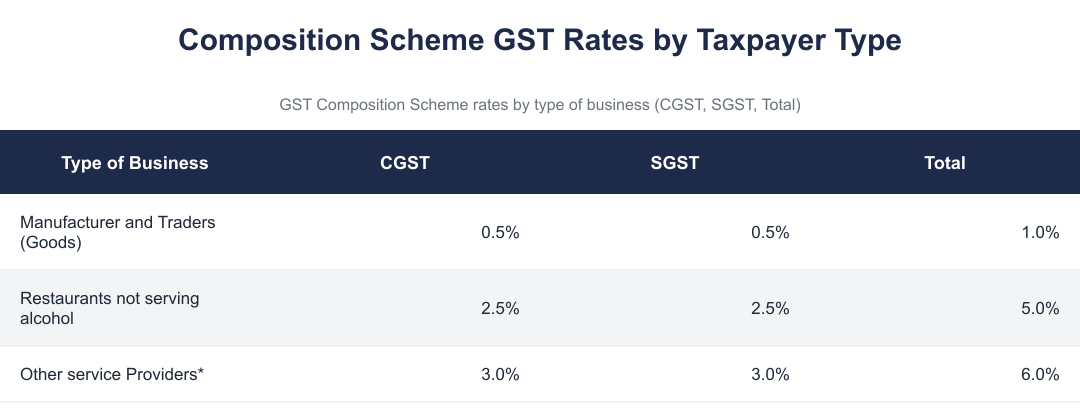
Composition rates are flat and depend on business type: manufacturers and traders pay 1% (0.5% CGST + 0.5% SGST), restaurants not serving alcohol pay 5% (2.5% + 2.5%), and notified other service providers pay 6% (3% + 3%). These rates are final with no input tax credit entitlement and apply to intra‑state supplies by composition taxpayers. The government may notify different or additional rates for specific classes, so verify the current notified rate before calculating liability.
How and when should a composition dealer pay GST?
A composition dealer pays tax quarterly by filing form CMP‑08 and depositing the tax by the 18th day of the month following the quarter, and must also file an annual return in GSTR‑4 (due 30 April of the next financial year) from FY 2019‑20 onwards. Taxable events attracting payment include supplies made, purchases from unregistered dealers, and any supplies where reverse charge applies (reverse charge is paid at normal rates). CMP‑08 is a summary quarterly challan/payment; failure to pay timely can lead to interest and penalties, and switching to the regular scheme may be mandated in some cases.
What are the advantages of opting for the Composition Scheme?
The main advantages are simplified compliance (fewer and simpler returns and relaxed record‑keeping), lower tax liability due to concessional flat rates, and improved liquidity since taxes are charged at lower composition rates instead of full GST rates. Composition is designed for small taxpayers to reduce administrative burden and compliance costs, making cash flow management easier. However, these benefits come with trade‑offs such as ineligibility to claim Input Tax Credit and restrictions on inter‑state trade and certain supplies.
What are the disadvantages or limitations of the Composition Scheme?
Disadvantages include no entitlement to Input Tax Credit, prohibition on inter‑state supplies, inability to supply goods/services via e‑commerce marketplaces, and non‑eligibility to supply certain non‑GST items like alcoholic liquor for human consumption. The composition levy may also be less beneficial if customers are registered businesses who would prefer input credit on purchases, and turnover growth beyond the threshold forces migration to the regular scheme. Additionally, composition dealers must still pay tax on purchases from unregistered persons and on supplies liable to reverse charge at normal rates.
Need help staying GST compliant?
MoneyGence's AI Finance OS tracks your compliance, wallet share, and finances in one place, built for agencies and growing businesses.
Get started with MoneyGence