GST compliance report: Free GST Health Check | ClearTax
This guide explains how to obtain and interpret a GST compliance (health check) report for a GSTIN, what insights such a report typically provides, and why regular reconciliation and review matter for businesses of all sizes. You will learn what to look for in the report, for example, mismatches between outward supplies and returns, differences in input tax credit, delays in filing, and vendor compliance, and how these issues can affect tax positions and the risk of notices. The guide also outlines practical steps to prioritise fixes once issues are identified and describes the time span of data you can expect in a comprehensive GSTIN-level report. Understanding GST compliance at the GSTIN level is important because discrepancies between your books and filed returns can lead to blocked credits, additional tax liability, interest, or notices from tax authorities. A structured health check helps you spot recurring errors, reconcile vendor invoices, and prepare for annual consolidation. Read on to learn what elements a health check report normally contains, how to read the key sections, why reconciliation is a routine necessity, and what to prioritise when remediating differences.
Get your GST compliance report
A GST compliance report, often branded as a ‘health check’, summarises how a particular GSTIN has performed on key compliance parameters. Typical outcomes include identification of delayed or missing return filings, mismatches between outward supplies reported in different returns, and gaps in input tax credit reconciliation. The goal is to provide a single view that highlights sources of risk and opportunities to correct filings before they escalate.
For a business, this report acts as both a diagnostic and a roadmap. Diagnostics show where values in different returns or books diverge; the roadmap suggests corrective actions such as amending returns, following up with vendors for missing invoices, or adjusting internal processes to avoid repeated mistakes. Regularly running a health check makes it easier to manage closing activities for periodic and annual filings.
What is ClearTax GST Health Check?
A branded GST Health Check typically packages multiple compliance checks into a consolidated report for a GSTIN. While product names and exact report layouts vary by provider, the common intent is to automate comparisons across filed returns and purchase records to surface material differences and filing gaps.
Key areas examined in such reports usually include return filing status, reconciliation between outward supplies and corresponding return tables, comparison of input tax claimed versus available vendor-supplied data, and vendor-level compliance trends. The output is a prioritized list of exceptions and recommended follow-up actions to reduce exposure and tidy up books.
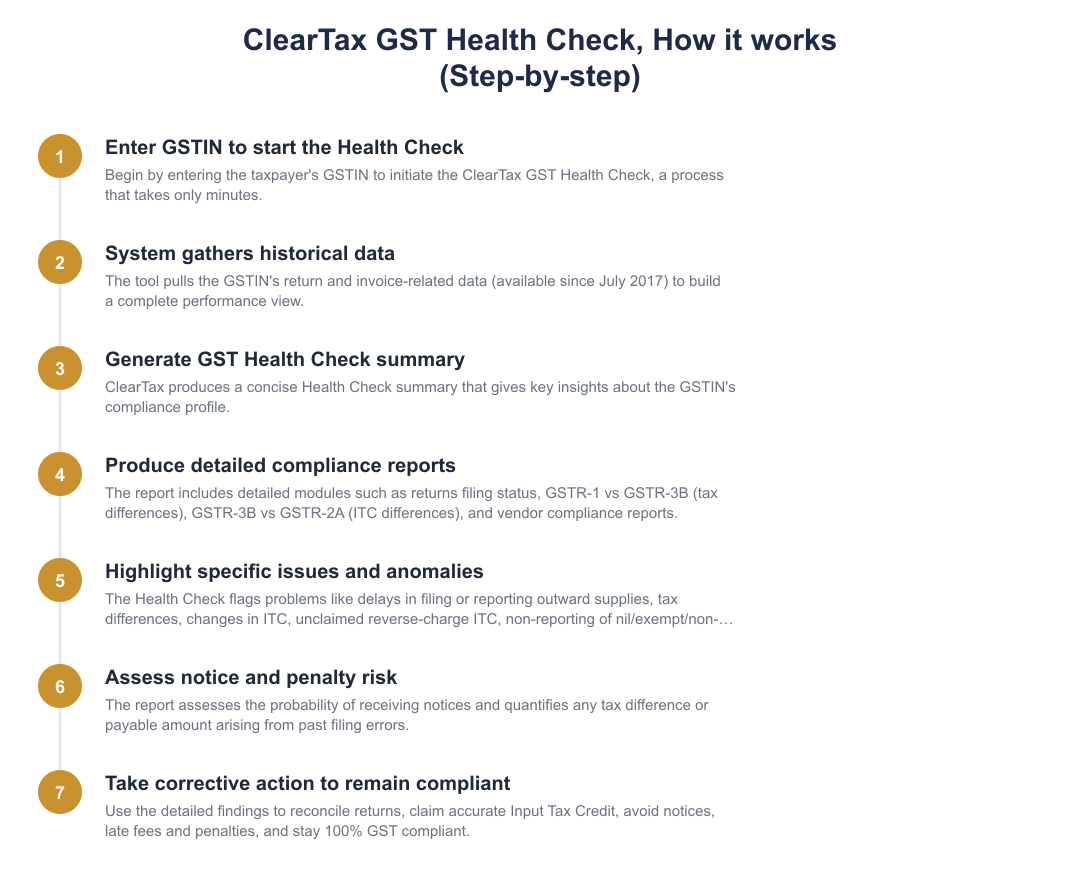
How does the GST Health Check work?
A health check aggregates data for the GSTIN, return filings, purchase and sales records, and available vendor-supplied information, and runs rule-based comparisons. Examples include reconciling outward supplies across different return forms, checking whether input tax credit claimed matches vendor-reported invoices, and flagging periods with late or missing filings. The report groups exceptions by severity so teams can focus on the items with the largest tax or compliance impact.
Practically, this means the health check helps you move from reactive troubleshooting to a structured remediation plan. Instead of handling one-off queries when notices arrive, businesses can proactively fix discrepancies, align vendor follow-ups, and maintain a cleaner audit trail for future returns or assessments.
Why do you need ClearTax GST Health check?
Reconciliation and regular reviews reduce the risk of unexpected liabilities and notices. When returns and books are reconciled periodically, discrepancies are easier to explain and correct; this lowers the probability of contested demands and simplifies preparation for annual consolidation. A health check also helps identify procedural issues, for example, incorrect classification of supplies or systematic omission of certain invoice types, which, when fixed, improve the accuracy of future filings.
Beyond risk management, health checks save time during close processes. By surfacing exception clusters and providing vendor-level insights, the report helps finance and compliance teams allocate effort efficiently: concentrate on high-value differences, chase missing invoices only where necessary, and implement process changes to prevent recurrence. This makes compliance an ongoing, manageable task rather than a year-end scramble.
Frequently Asked Questions
What time period does a comprehensive GSTIN report cover? You can obtain a complete view of a GSTIN’s performance since its inception; data is available since July 2017. This long-range visibility helps in mapping trends, identifying recurring errors across years, and preparing accurate annual consolidations.
How should businesses act on the exceptions noted in the report? Start by prioritising items with the largest tax impact or the longest-standing differences. For invoice-level gaps, follow up with vendors for missing invoices or corrections. For reporting or classification errors, make timely amendments if permitted and document the rationale for any adjustments to maintain a clear audit trail. Finally, update the internal controls or filing checklists that allowed the error to occur to prevent repetition.
A GST compliance report consolidates complex return and invoice-level data into actionable insights. Regularly running a health check and following a disciplined remediation process reduces tax risk, streamlines annual filings, and improves the accuracy of input tax credit claims. Use the historical span of data available (since July 2017) to detect long-term patterns and build stronger compliance routines.
Frequently asked questions
What is ClearTax GST Health Check and what does the report show?
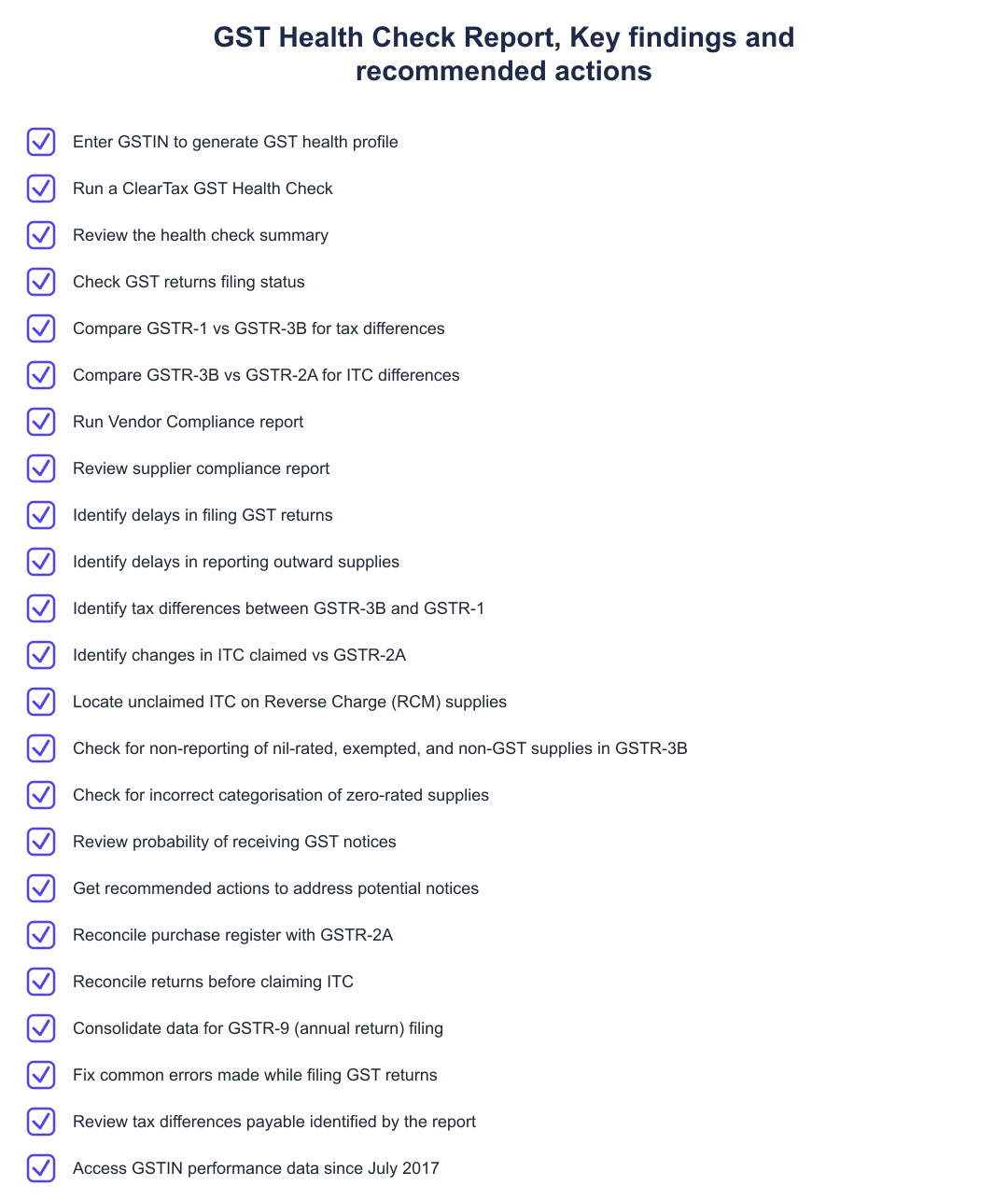
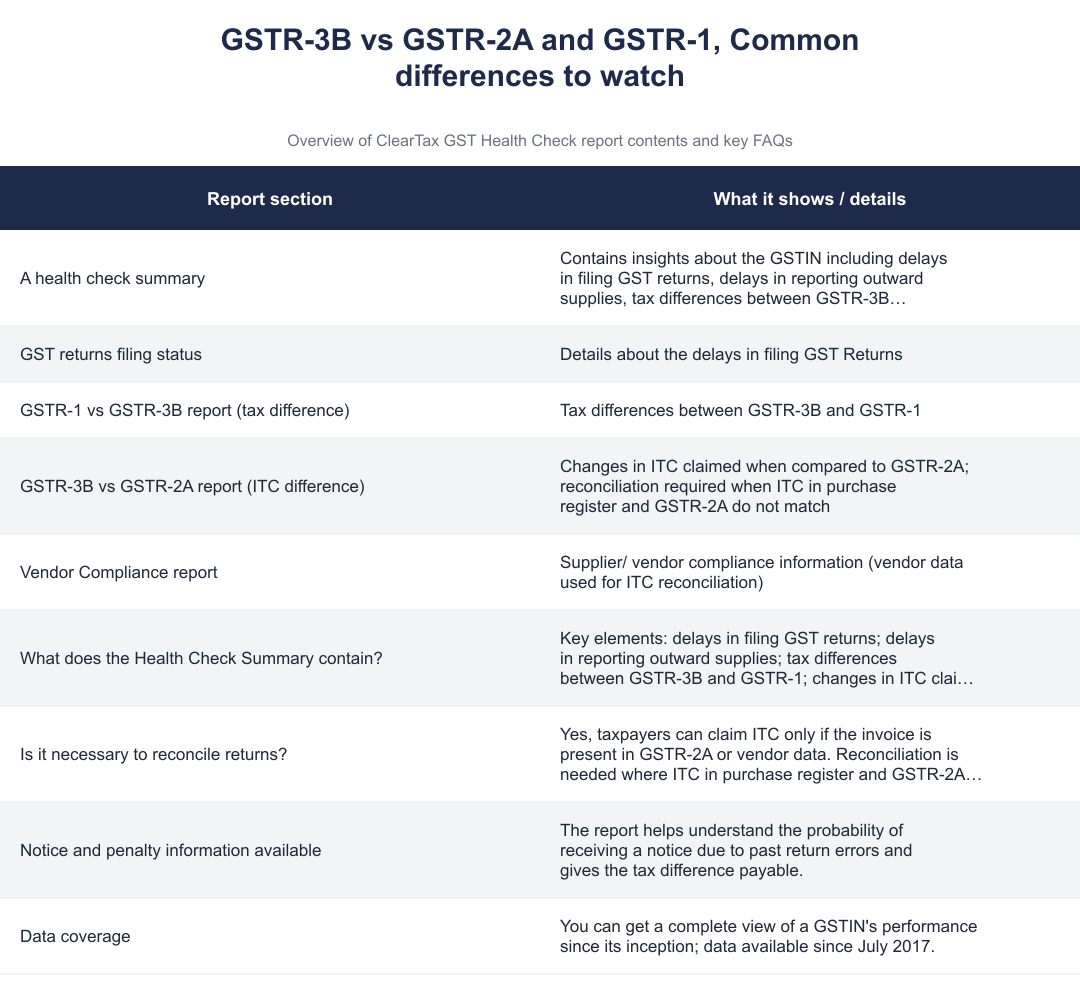
ClearTax GST Health Check is an automated GST compliance report that gives a complete GST health profile for a GSTIN. The report includes a health check summary, GST returns filing status, GSTR-1 vs GSTR-3B tax differences, GSTR-3B vs GSTR-2A ITC differences, and a vendor compliance report. It also highlights delays in filing, delays in reporting outward supplies, unclaimed ITC on reverse charge, non-reporting of nil/exempt/non-GST supplies, and incorrect categorisation of zero-rated supplies. Finally, the report offers an analysis of the probability of receiving notices and suggested corrective action to avoid penalties.
How does the ClearTax GST Health Check work if I enter a GSTIN?
When you enter a GSTIN, ClearTax pulls return and purchase data since registration and runs automated reconciliations and checks across returns. It compares GSTR-1 vs GSTR-3B to surface outward supply and tax differences, and GSTR-3B vs GSTR-2A to identify ITC mismatches between purchases and vendor-reported data. The tool also analyses filing timeliness, nil/exempt/non-GST reporting and reverse-charge transactions to flag compliance risks and computes likely tax differences that could attract notices. Based on these findings it generates suggested actions to correct filings and reduce penalties.
Why should I run a GST Health Check before filing GST returns or the annual return?
You should run a GST Health Check to identify mismatches and filing delays so you can claim accurate Input Tax Credit and avoid notices, late fees and penalties. The Health Check highlights GSTR-3B vs GSTR-2A ITC differences and GSTR-1 vs GSTR-3B tax differences, which helps reconcile purchases and sales before filing GSTR-9 (annual return). Detecting and fixing errors early reduces the risk of demand notices and ensures consolidated FY data is accurate when making annual declarations. It also points out non-reporting of exempt or zero-rated supplies which commonly cause discrepancies.
What specific items are included in the Health Check summary?
The Health Check summary includes delays in filing GST returns, delays in reporting outward supplies, tax differences between GSTR-3B and GSTR-1, changes in ITC claimed compared to GSTR-2A, unclaimed ITC on reverse-charge transactions, non-reporting of nil/exempt/non-GST supplies in GSTR-3B, and incorrect categorisation of zero-rated supplies. It consolidates these issues into a snapshot that shows compliance gaps and quantifies tax differences where applicable. The summary also provides an assessment of the likelihood of receiving GST notices based on the identified errors and suggests remedial actions.
How many months of data does ClearTax GST Health Check analyse?
ClearTax GST Health Check can analyse a GSTIN's complete history since the GST system began, effectively from July 2017. That means you can get a full view of returns, filings and vendor-reported GSTR-2A data across all available months since inception. This long-range view helps when preparing reconciliations for multiple financial years and when compiling data for the annual return (GSTR-9).
Will the report tell me if I'm likely to receive a GST notice or penalty?
Yes, the Health Check estimates the probability of receiving a GST notice and identifies tax differences that could trigger notices or demands. It flags discrepancies such as tax under-reporting, ITC mismatches, unreported supplies or incorrect classifications that commonly attract scrutiny, and quantifies the tax difference payable. The report also recommends corrective actions to reduce notice risk, such as reconciling vendor invoices, amending returns or paying outstanding tax and interest where necessary.
Is it necessary to reconcile GSTR-3B with GSTR-2A and vendor records?
Yes, reconciling GSTR-3B with GSTR-2A and your purchase register is necessary to ensure you can legitimately claim Input Tax Credit (ITC) and to prepare an accurate annual return. ITC can be claimed only if the invoice appears in GSTR-2A or vendor-provided data, so mismatches must be reconciled and either corrected or supported by documentation. Reconciliation also prevents duplication and inaccuracies when consolidating transactions for GSTR-9, and helps identify unclaimed ITC or incorrect classifications that could lead to notices.
Who should use ClearTax GST Health Check?
Any registered taxpayer, tax consultant or compliance team responsible for GST filings should use ClearTax GST Health Check to monitor and improve GST compliance. It is useful for businesses of all sizes that want to reconcile ITC, detect filing delays, identify tax differences and reduce the chance of notices or penalties. The tool is particularly beneficial before filing GSTR-9 or when preparing for audits, as it provides historical analysis and specific corrective recommendations.
How does the Health Check help me claim accurate Input Tax Credit (ITC)?
The Health Check helps claim accurate ITC by comparing the ITC claimed in GSTR-3B with invoices reported in GSTR-2A and identifying differences that need reconciliation. It highlights unclaimed ITC on reverse-charge supplies and purchases missing from GSTR-2A so you can follow up with vendors or amend returns before claiming. By reconciling monthly and annually, the report reduces the risk of disallowed ITC during assessments and supports accurate declaration in GSTR-9.
Need help staying Compliance compliant?
MoneyGence's AI Finance OS tracks your compliance, wallet share, and finances in one place, built for agencies and growing businesses.
Get started with MoneyGence