Gratuity in India: Meaning, Rules, Eligibility & Form F Guide
This guide explains gratuity in India, what it is, the law that governs it, who qualifies, how the amount is worked out, when an employer can withhold it, and nominee/claim basics. You will learn the statutory basis for gratuity, the components used to compute the payment, the limited exceptions to eligibility, and the situations in which an employer may forfeit all or part of the benefit. Knowing these rules helps employees understand their exit benefits and helps employers remain compliant with the Payment of Gratuity Act, 1972. The guide focuses on practical clarity: the definition of wages used, the formula for computing gratuity, the special treatment in cases of death or permanent disablement, and the disciplined process required before any forfeiture. Whether you are planning for long-term employee compensation or preparing to claim gratuity at exit, these core legal points will help you evaluate entitlement, verify calculations, and identify when a dispute may arise.
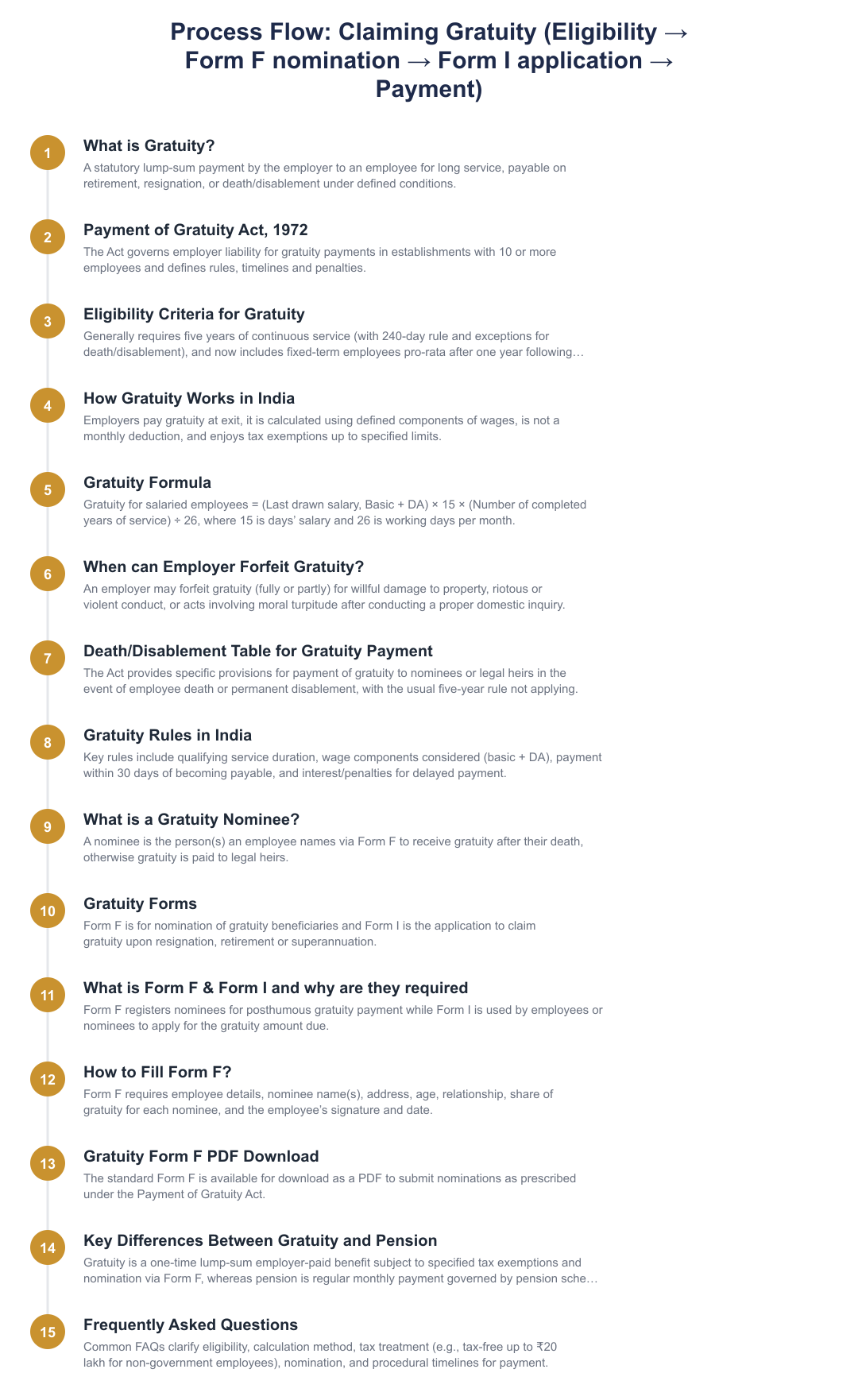
What is Gratuity?
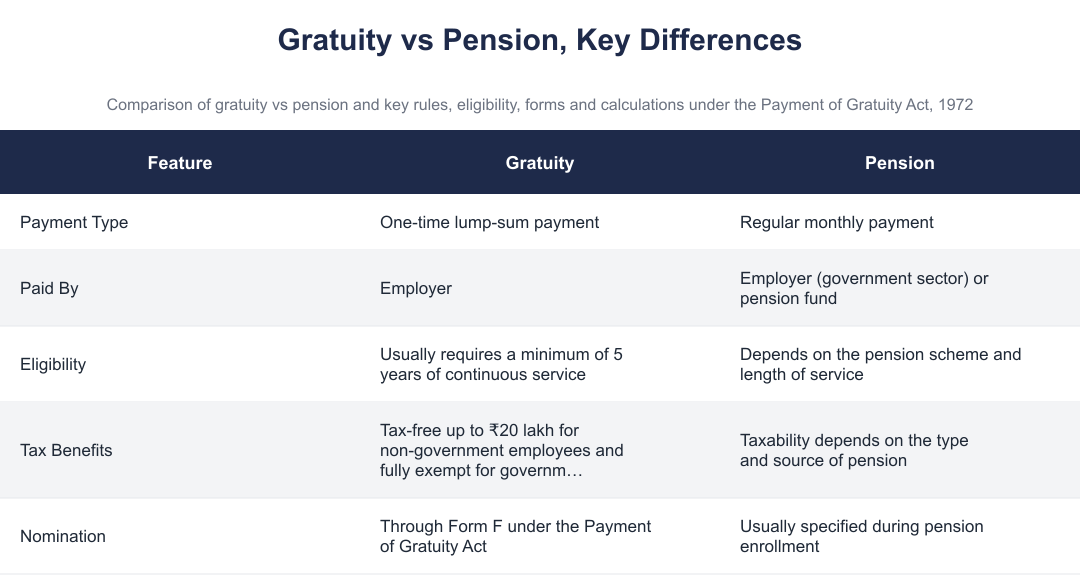
Gratuity is a statutory lump-sum payment made by an employer to an employee in recognition of long-term service. The Payment of Gratuity Act, 1972 provides the legal framework for this benefit and sets out how gratuity is to be calculated and administered.
Because gratuity is governed by statute, both employers and employees must follow the Act’s provisions when determining entitlement and computing the amount payable. The law establishes the basic principles, what counts as wages for calculation, how many days of wages are paid per year of service, and specific exceptions to general eligibility rules.
Payment of Gratuity Act, 1972
The Payment of Gratuity Act, 1972 is the statutory instrument that governs gratuity in India. It prescribes the fundamentals of entitlement, computation and the circumstances under which an employer may withhold or forfeit gratuity.
Because the Act is the controlling law, employers must apply its definitions and procedures when handling gratuity claims. Key provisions relate to eligibility periods, the wage components considered for calculation, and permitted grounds for forfeiture, all of which are derived from the Act’s framework.
Eligibility Criteria for Gratuity
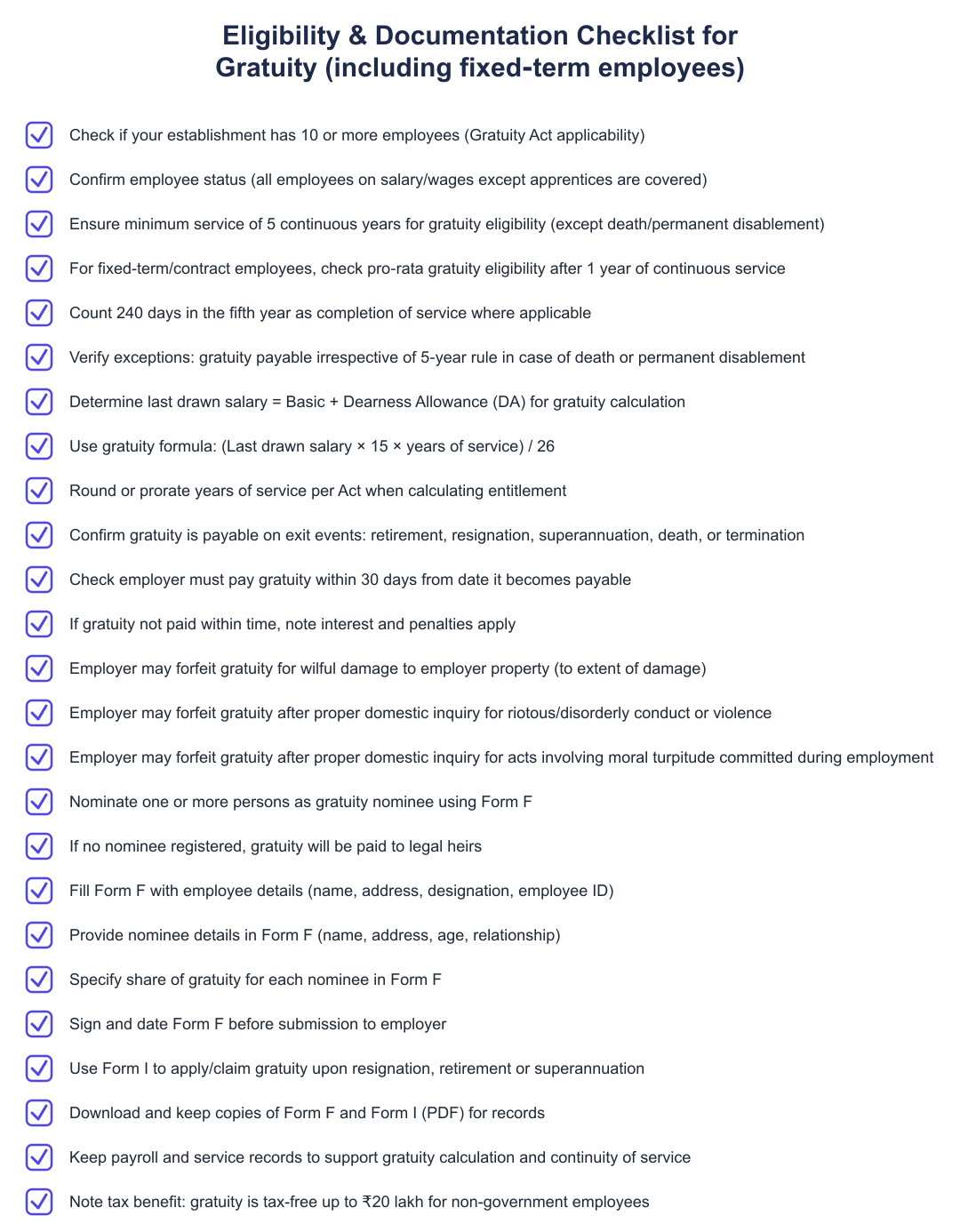
Under the governing law, employees must generally complete five years of continuous service in an organisation covered by the Act to be eligible for gratuity. This five‑year minimum is the standard rule determining entitlement.
There are important exceptions to the five‑year requirement. The eligibility condition does not apply in cases of death or permanent disablement, in such circumstances, employees (or their nominees) can claim gratuity even if the five years of service have not been completed.
How Gratuity Works in India, Calculation Steps
Identify the last drawn salary to be used for computation; for gratuity the wage considered comprises basic salary plus dearness allowance (DA) only.
Count the number of completed years of continuous service with the employer; the statutory formula uses completed years for the calculation.
Use the gratuity formula: 15 days' wages for every completed year of service, where '15' is the number of days’ salary allocated per year.
Multiply the daily wage (based on last drawn basic + DA) by 15 and then by the number of completed years to arrive at the gratuity payable.
When can an Employer Forfeit Gratuity?
The Act permits an employer to forfeit gratuity, in whole or to the extent of damage, under specific misconduct-related circumstances. Forfeiture is not arbitrary: the law identifies particular grounds on which an employer may withhold payment.
Recognised grounds for forfeiture include wilful damage or loss caused to the employer’s property (the gratuity may be forfeited to the extent of the damage), termination for riotous or disorderly conduct or violence, and termination for an act involving moral turpitude committed during the course of employment. Notably, where moral turpitude is alleged, a proper domestic inquiry is a necessary procedural safeguard before forfeiture.
Nomination, Legal Heirs and Gratuity Forms
Employees may designate a nominee to receive gratuity in the event of their death. If an employee has not registered any nominee, the gratuity is payable to the employee’s legal heirs in accordance with applicable succession rules.
The Act contemplates administrative forms and processes to record nominations and to claim gratuity, which facilitate a clearer transfer when a claim arises. Employers and employees should ensure nominations are registered and records maintained so that payments can be made promptly to the correct person.
Gratuity is a statutory lump-sum benefit governed by the Payment of Gratuity Act, 1972. Entitlement generally requires five years of continuous service, except in cases of death or permanent disablement. The amount is calculated using 15 days’ wages per completed year of service, with wages defined as basic salary plus dearness allowance. Employers may forfeit gratuity in narrowly defined misconduct circumstances, and nominations or legal‑heir rules determine recipients on an employee’s death. Understanding these core legal points helps both employees and employers manage gratuity claims correctly and stay aligned with the Act.
Frequently asked questions
What is gratuity and who pays it in India?
Gratuity is a statutory lump-sum payment made by an employer to an employee for long-term service under the Payment of Gratuity Act, 1972. It is typically paid by the employer at the time of retirement, resignation, death or permanent disablement and applies to establishments with 10 or more employees and their staff (excluding apprentices). The payment is calculated based on last drawn salary (basic + dearness allowance) and years of service, and must be paid within 30 days of becoming payable, failing which interest and penalties may apply. For government employees gratuity rules may differ but they generally receive fully exempt gratuity benefits under applicable rules.
Who is eligible for gratuity and what is the 240-day rule?
You are eligible for gratuity after completing generally 5 years of continuous service in an organisation covered by the Act, though the 5-year requirement is waived in case of death or permanent disablement. The 240-day rule means that if you have worked 240 days in the fifth year it may be treated as completing the fifth year for gratuity calculation (useful where a full calendar year of service was not completed). Fixed-term/contract employees became eligible for pro-rata gratuity after just 1 year of continuous service from the changes effective 21 November 2025. Exceptions, like death or disability, allow immediate eligibility irrespective of completed years.
How is gratuity calculated in India (what is the formula)?
Gratuity is calculated as: (Last drawn salary × 15 × Number of years of service) ÷ 26, where last drawn salary means basic salary plus dearness allowance and 15 represents days’ wages per year while 26 is taken as working days in a month. For example, an employee with a last drawn salary of ₹40,000 and 10 years’ service would get (40,000 × 15 × 10) ÷ 26 ≈ ₹2,30,769. Part years are counted as completed years only when statutory rules (like the 240-day rule) allow; for fixed-term employees pro-rata calculation applies as per recent amendments. Remember that the Act’s definition of wages and minimum wage inclusion (now a minimum of 50% of CTC effective from 21 November 2025) can affect the base salary used.
Is gratuity taxable and are there any exemptions?
Gratuity received by non-government employees is tax-free up to ₹20 lakh under the Income Tax Act, whereas gratuity received by government employees is fully exempt subject to applicable rules. Any gratuity amount exceeding ₹20 lakh for non-government employees is taxable as per the recipient's income tax slab rates. To claim exemption properly you should maintain documentation such as employer certificate and Form 10 (if required) when filing income tax returns.
When can an employer forfeit or deduct gratuity?
An employer can forfeit gratuity only in limited cases: for wilful damage or loss to the employer’s property (to the extent of damage), termination for riotous or disorderly conduct, or for acts involving moral turpitude proven after a proper domestic inquiry. Minor misconduct, ordinary resignation or poor performance do not entitle an employer to forfeit gratuity. Forfeiture must be proportional (only to the extent of proven damage) and employers must follow due process; arbitrary deductions or denial can be challenged legally.
What is a gratuity nominee and how do I nominate someone?
A gratuity nominee is the person you designate to receive your gratuity in case of your death, and nomination must be made using Form F under the Payment of Gratuity Act. Form F requires employee details, nominee name(s), address, age, relationship and the share of gratuity allotted to each nominee, and must be signed and dated by the employee. If no nominee is registered, the gratuity is paid to the legal heirs as per succession laws, which can delay payment, so keeping Form F updated (after marriage, birth of children, etc.) is important.
What are Form F and Form I and when do I use them?
Form F is the nomination form employees use to name one or more persons to receive gratuity on their death, while Form I is the application form to claim gratuity on resignation, retirement, superannuation, death or disablement. You must submit Form F during employment to register a nominee, and submit Form I (with required proofs like service certificate, death certificate if applicable, and bank details) to the employer when claiming gratuity; employers may require additional supporting documents as per internal procedures. Both forms are prescribed under the Act, and correctly filled forms speed up processing and avoid disputes or delays.
How do I fill Form F correctly, what details are mandatory?
To fill Form F correctly, you must enter mandatory employee details (name, address, designation, employee ID), full details of nominee(s) including name, address, age and relationship, specify the share of gratuity for each nominee, and sign and date the form. Ensure the nominee’s age is accurate (affects succession) and shares add up to 100% if multiple nominees are entered; unclear or incomplete entries can lead to rejections or payment delays. Keep a copy of the submitted Form F and inform HR immediately of life events (marriage, birth of children) so the nomination reflects current intent.
When must an employer pay gratuity and what happens if they delay payment?
An employer must pay gratuity within 30 days from the date it becomes payable (for example, date of retirement, resignation, or death), and failure to do so attracts interest and penalties under the Payment of Gratuity Act. Delayed payments may incur statutory interest and can invite prosecution or fines against the employer if non-payment persists; employees can file a claim before the controlling authority or labor court. To avoid delays, submit Form I with all required documents promptly and follow up with HR, and keep records of communications and notices served.
Need help staying Payroll compliant?
MoneyGence's AI Finance OS tracks your compliance, wallet share, and finances in one place, built for agencies and growing businesses.
Get started with MoneyGence