Gratuity Calculator: Instant Gratuity Amount & 2026 Rules
This guide explains how gratuity is calculated in India for employees covered under the Payment of Gratuity Act, 1972 and how practices differ for employees not covered by the Act. You will learn the legal basis for the standard gratuity formula, what “last drawn salary” and the 15-days multiplier mean, how the divisor (26 versus 30) affects the payout, who is eligible, and practical considerations such as rounding of the final year of service. Knowing these rules helps salaried employees and employers estimate expected gratuity payouts, understand eligibility, and spot when company policy may deliver a different outcome than the statutory method. The guide also explains when the Act applies, when the five-year qualifying period does not apply, and why covered employees typically receive a higher statutory payout compared with common non‑statutory approaches. Use this to check a calculator’s inputs and to interpret its output correctly.
How To Use the Gratuity Calculator?
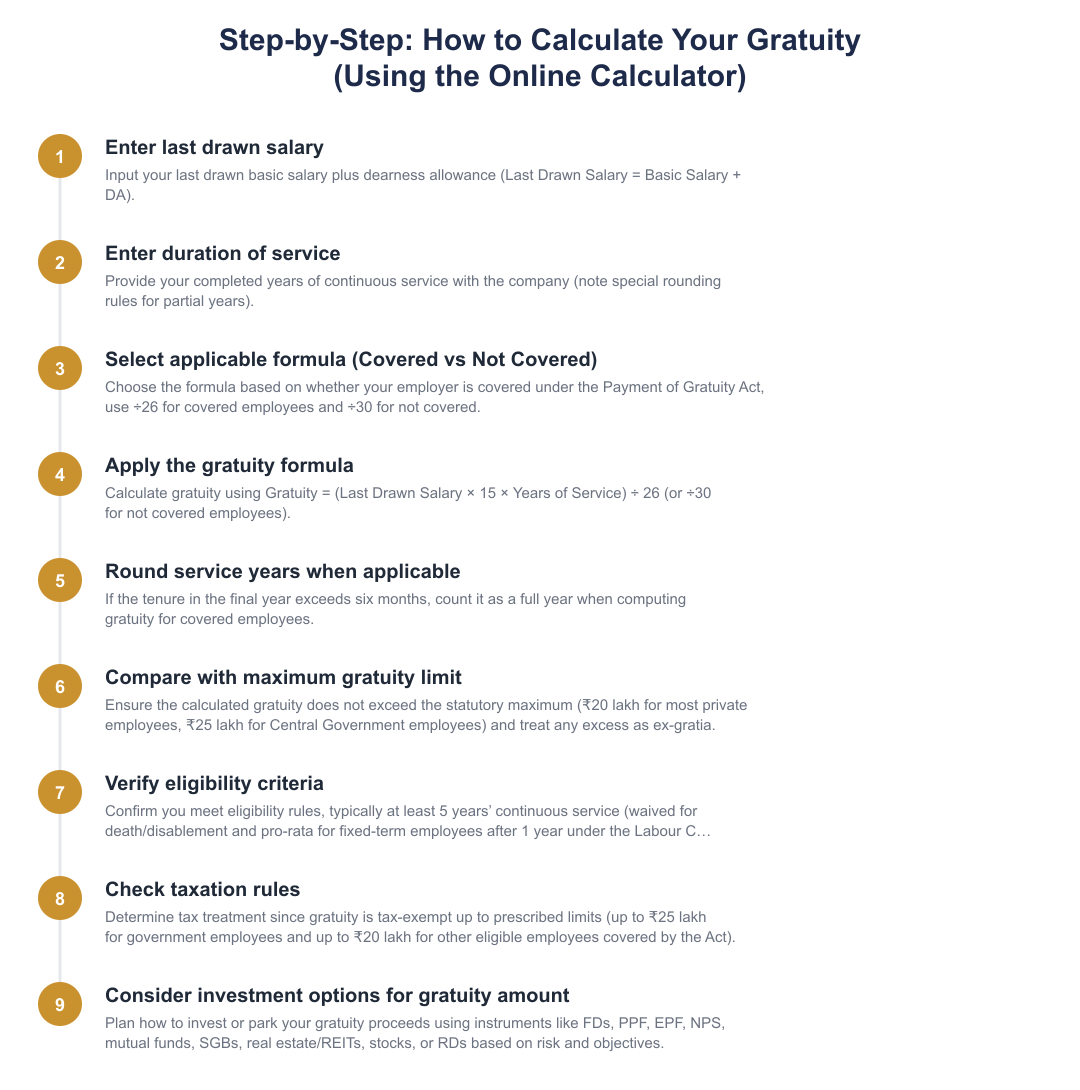
A gratuity calculator needs three core inputs based on the statutory formula: the last drawn salary (basic salary plus dearness allowance), the completed years of service, and whether the employer is covered by the Payment of Gratuity Act, 1972. The calculator then applies the appropriate divisor depending on coverage to produce an estimated gratuity amount.
Before using a calculator, confirm whether the employer is covered by the Act (the Act applies to employers with ten or more employees). Also check whether the employee’s final year of service exceeds six months, if so and the employee is covered under the Act, the final year is rounded up and used in the years-of-service input.
Formula For Calculating Gratuity
For employees covered by the Payment of Gratuity Act, 1972 the statutory formula is: (Last Drawn Salary × 15 × Years of Service) ÷ 26. The Act explicitly treats the 15 as representing 15 days’ wages per year of service, and the divisor 26 represents the average working days in a month (excluding Sundays) used for calculation.
Last Drawn Salary, for the purpose of this calculation, is defined as the sum of Basic Salary and Dearness Allowance (DA). These definitions ensure the formula focuses on regular fixed cash pay components rather than variable allowances or other benefits.
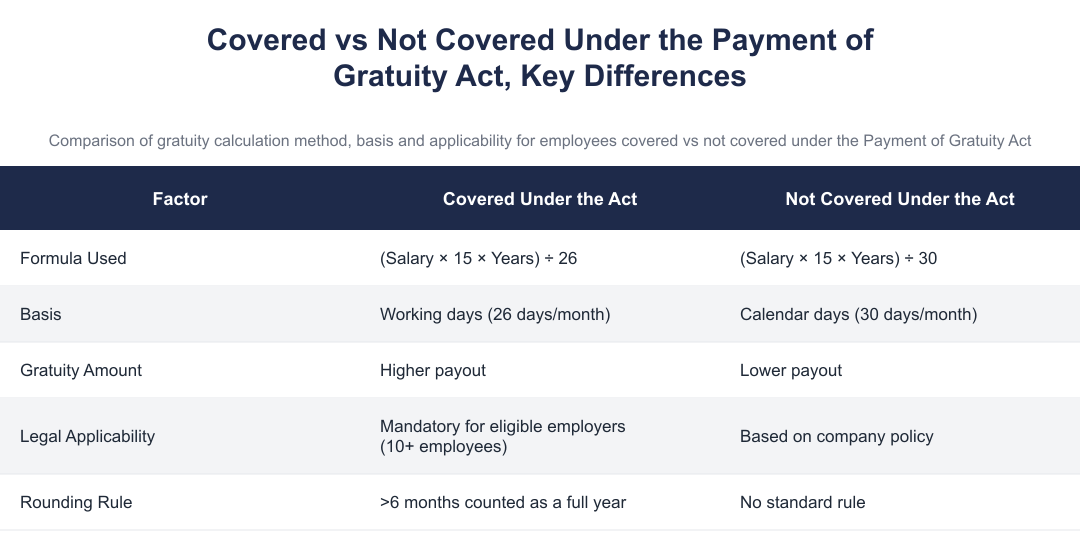
Comparison: Covered vs Not Covered, Key calculation differences
| Factor | Covered Under the Act | Not Covered Under the Act |
|---|---|---|
| Formula Used | (Last Drawn Salary × 15 × Years of Service) ÷ 26 | (Last Drawn Salary × 15 × Years of Service) ÷ 30 |
| Basis | Working days (26 days/month, excluding Sundays) | Calendar days (30 days/month) |
| Rounding Rule for Final Year | If final year exceeds six months, it is rounded up and counted as a full year | No standard rule |
| Legal Applicability | Mandatory where Payment of Gratuity Act applies (employers with 10+ employees) | Based on employer/company policy |
| Typical Outcome | Generally results in a higher payout compared with 30-day basis | Generally results in a lower payout compared with 26-day basis |
For employees covered under the Payment of Gratuity Act:
Check whether the employer is subject to the Payment of Gratuity Act (applies where the employer has ten or more employees).
Use Last Drawn Salary defined as Basic Salary plus Dearness Allowance (DA) as the salary input.
Use completed years of service; if the final year exceeds six months it is rounded up and counted as a full year.
Calculate gratuity as (Last Drawn Salary × 15 × Years of Service) ÷ 26.
For employees not covered under the Act
When an employer is not covered by the Payment of Gratuity Act, gratuity, if paid, is usually governed by the employer’s policy or contractual terms. A commonly used non-statutory basis replaces the 26 divisor with 30, treating a month as 30 calendar days when calculating the gratuity amount.
Because there is no single statutory rounding rule for employees not covered by the Act, practices on counting partial final years and other details vary by employer. This is why covered employees typically receive a higher statutory payout compared with the 30-day approach used by some employers not covered by the Act.
Who is Eligible for Gratuity in India?
Under the statutory framework, employees become eligible for gratuity after completing five years of continuous service, except in cases of death or disablement where the five-year requirement is waived. The Act applies to employers that meet the statutory threshold of ten or more employees.
Gratuity is payable on exit events such as retirement, resignation, death, disablement, or termination (subject to exceptions like certain misconduct-linked terminations). These eligibility and payment triggers define when a gratuity calculator should be used to estimate a payable amount.
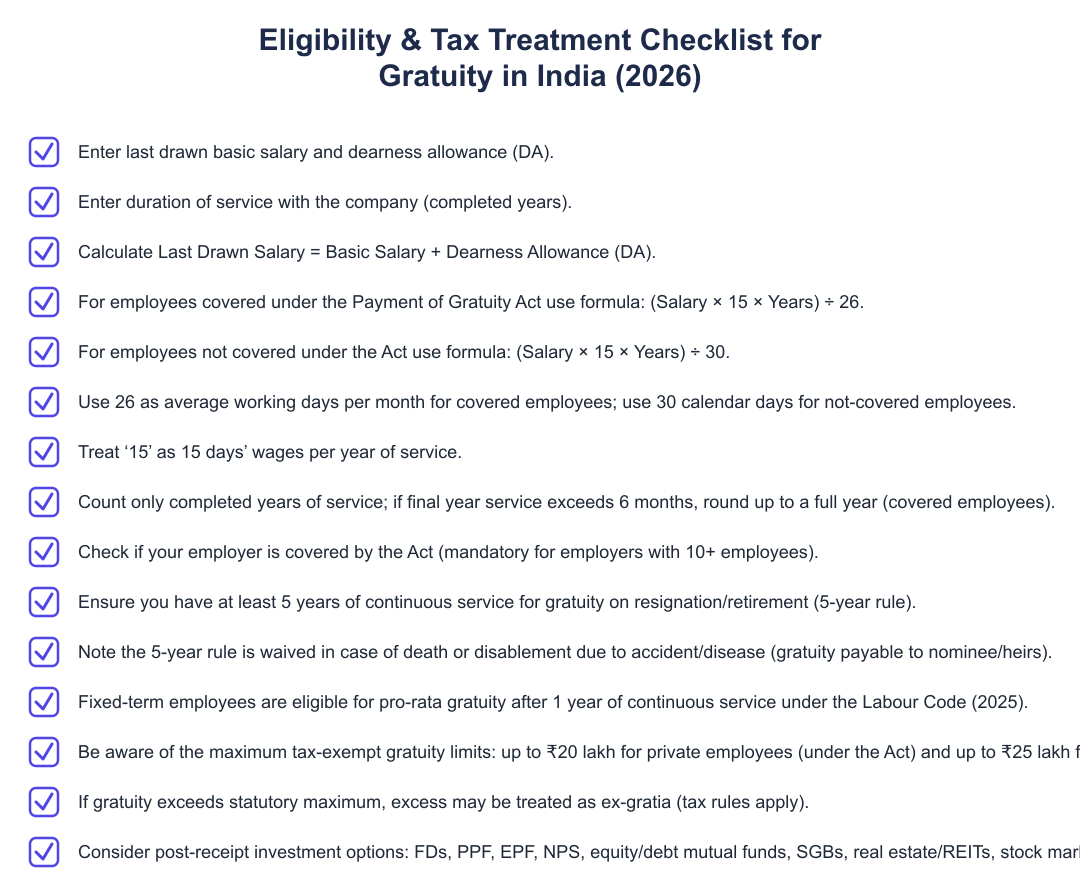
Use the statutory formula and the coverage rules to check any gratuity calculator’s output: verify the salary components, years of service (with rounding where applicable), and whether the employer falls under the Payment of Gratuity Act. Covered employees have a clearly defined method under the Act which typically produces a higher payout than common non‑statutory approaches. For non-covered employees, consult the employer’s policy for precise rules on calculation and rounding.
Frequently asked questions
How do I use the online gratuity calculator to know my payout?
Use the gratuity calculator by entering your last drawn basic salary plus dearness allowance and your completed years of service to get an instant gratuity amount. The calculator applies the appropriate formula (covered or not covered under the Payment of Gratuity Act) and shows years considered after rounding rules, so you see the exact computation. It also accounts for whether your employer is covered (uses 26 days) or not (uses 30 days) and applies the >6 months rule where applicable. The result will also indicate if the computed amount exceeds statutory limits so you can identify any ex-gratia portion.
What is the gratuity formula for employees covered under the Payment of Gratuity Act?
For employees covered under the Payment of Gratuity Act, the gratuity formula is (Last Drawn Salary × 15 × Years of Service) ÷ 26. Last Drawn Salary means Basic Salary + Dearness Allowance (DA), '15' stands for 15 days’ wages per year, and '26' represents average working days in a month (excluding Sundays). Completed years of service are counted, and service beyond six months in the final year is treated as a full year for covered employees. This calculation generally results in a higher payout compared with the 30-day method used for uncovered employees.
How is gratuity calculated if my employer is not covered under the Payment of Gratuity Act?
If your employer is not covered by the Act, gratuity is typically calculated as (Last Drawn Salary × 15 × Years of Service) ÷ 30. Here Last Drawn Salary = Basic + DA, '15' is 15 days’ wages per year, and '30' is calendar days in a month, which yields a lower payout than the 26-day formula. Employers not covered by the Act may follow their own policy on rounding years (there is no statutory rule >6 months) and on eligibility, so actual payout depends on company policy. Always check your employer’s gratuity policy or payslip details to confirm the method applied.
Am I eligible for gratuity after leaving my job before five years?
Generally you are not eligible for gratuity on resignation unless you have completed at least five years of continuous service, but exceptions apply for death or disablement where the five-year requirement is waived. Under the new Labour Code (Code on Social Security, 2025), fixed-term employees are eligible for pro-rata gratuity after just one year of continuous service. Also, employers covered by the Act typically apply the five-year rule for resignation, while some organizations may offer better terms in their policy. If you leave due to retirement, superannuation, death, or disability, gratuity is payable regardless of the five-year rule in applicable cases for death/disablement.
When is gratuity paid, on resignation, retirement, death, or termination?
Gratuity is payable on retirement, resignation (if eligible), death, and disablement due to accident or disease, and also on termination subject to policy or law. For resignations, the standard requirement is five years of continuous service (unless covered by special rules or company policy), while death and disablement waive the five-year condition and gratuity is paid to the nominee or legal heirs. Under the Labour Code, fixed-term employees may receive pro-rata gratuity earlier, and employers with fewer than 10 employees may not be statutorily bound but could still pay gratuity under internal policy. Always submit the required claim forms and documents to the employer or controlling authority to trigger payment.
How are years of service rounded when calculating gratuity?
For employees covered by the Payment of Gratuity Act, service beyond six months in the final year is rounded up to the next full year; for example, 10 years and 7 months is treated as 11 years. If the final year’s service is six months or less, it is not rounded up and only completed years are counted. There is no standard statutory rounding rule for employees not covered by the Act, their employer’s policy will determine rounding. The calculator will explicitly show years considered after rounding so you can verify the computation.
What is the maximum gratuity exemption limit for tax purposes in India?
For tax purposes, gratuity received by government employees is fully exempt up to ₹25 lakh, while gratuity received by private-sector employees covered under the Payment of Gratuity Act is exempt up to ₹20 lakh. Any gratuity amount above these ceilings is taxable as per regular income tax rules; for central government employees, a higher ceiling of ₹25 lakh applies. If your employer is not covered by the Act, tax treatment depends on whether the payment qualifies as gratuity under Section 10(10) and company-specific policy; check with a tax advisor to confirm. These limits are the statutory caps for exemption and can change with future government notifications, so verify the current ceiling when filing returns.
Should I invest my gratuity lump sum, and what are good investment options?
Yes, investing your gratuity can preserve and grow the lump sum for retirement or financial goals; common options include FDs, PPF, EPF, NPS, mutual funds (equity or debt), sovereign gold bonds, real estate/REITs, and recurring deposits. Low-risk choices like Fixed Deposits and Debt Mutual Funds suit capital protection, while PPF and EPF offer tax benefits and long-term stability; NPS and Equity Mutual Funds are better if you seek higher long-term returns and can tolerate market risk. Consider your risk profile, liquidity needs, tax implications, and time horizon, for example, PPF has a 15-year lock-in under Section 80C, whereas FDs and RDs offer shorter tenors. Diversifying across instruments can balance risk and returns; consult a financial advisor for a plan tailored to your retirement goals.
Has anything changed for fixed-term employees and gratuity under recent labour law updates?
Yes, under the Labour Code (Code on Social Security) introduced in 2025, fixed-term employees are eligible for pro-rata gratuity after one year of continuous service instead of the earlier five-year requirement. The amendment ensures that fixed-term workers receive a fair share of gratuity based on actual tenure, calculated on a pro-rata basis using the applicable formula (26 or 30 days depending on coverage). This change only affects fixed-term employment status and does not eliminate other eligibility criteria like employer applicability; check whether your employer is covered by the Payment of Gratuity Act to know which day-basis applies. Employers should update their policies and payroll systems to reflect this change and the gratuity calculator accounts for it when you enter employment type and tenure.
Need help staying Calculators compliant?
MoneyGence's AI Finance OS tracks your compliance, wallet share, and finances in one place, built for agencies and growing businesses.
Get started with MoneyGence