Form 26QB: How to Download & Fill TDS Challan for Property
This guide explains how taxpayers interact with Form 26QB when TDS arises on the purchase or sale of immovable property. You will learn what the form is for, what information it typically contains, how to obtain and complete it, considerations to keep in mind before submitting, and common compliance pitfalls to avoid. Understanding Form 26QB is important because it links the buyer’s obligation to deduct tax at source with the seller’s ability to claim credit for tax already paid, timely and correct use of the form prevents later disputes, mismatches in tax credit records, and potential penalties. The guide is written for buyers, sellers, tax advisers and accountants who handle property transactions. It focuses on practical steps and documentation, what fields to expect on the form, and how the online filing mechanism generally works. Where the law leaves room for choices (for example, instalment payments or transactions involving multiple sellers), the guide highlights the practical consequences so that you can plan cash flows and reconciliations. If you are preparing to complete Form 26QB for an upcoming property transaction, this article will give you a clear mental checklist and explain why each detail matters in the TDS ecosystem.
What Is Form 26QB?
Form 26QB is the online mechanism used to report and pay tax deducted at source in connection with the transfer of certain immovable property. It acts as both a challan for payment and a statement of details about the transaction: who paid, who received the payment, transaction dates, and payment particulars. Because it serves dual roles, accuracy in every field is important, the information you enter is later used to generate a tax credit for the seller and to reconcile payments on the tax authority’s systems.
In practical terms, the form is designed to be used by the buyer or the person responsible for deducting tax at source. It bridges the cash flow moment when tax is deposited with the revenue department and the record-keeping that enables the seller to claim credit. Filing the form correctly prevents mismatches in public tax records and reduces the likelihood of follow-up notices or manual corrections.
Contents of Form 26QB
The form typically requests basic identity details for the buyer and seller, such as names and tax identification numbers, along with contact information. It also captures transaction-specific data: sale agreement dates, total consideration, and how payments were made. There are sections dedicated to the tax amount deducted and the date of its deposit, since those entries determine when the seller receives credit for the tax withheld.
Beyond those core entries, the form includes fields that allow the filer to indicate whether the payment was made in instalments or as a lump sum, and to specify the property address. Accurate entry of these items is important because they are used to generate receipts and payment acknowledgements that the seller will use in their returns and for reconciliation on government portals.
Form 26QB Due Date
There is a statutory timeline by which Form 26QB must be completed and the associated tax deposited after the tax has been deducted. Adhering to that timeline is important to avoid potential late payment consequences and to ensure the seller’s tax credit is reflected promptly. Buyers should plan their cash flows so the tax can be remitted within the required window after deduction.
Practically, this means incorporating the withholding and deposit process into the overall transaction timetable. When a sale is agreed, the buyer should identify the point at which tax becomes payable and ensure that the person handling payment has access to the necessary information and funds. Failing to meet the deadline can trigger administrative or financial outcomes that are best avoided.
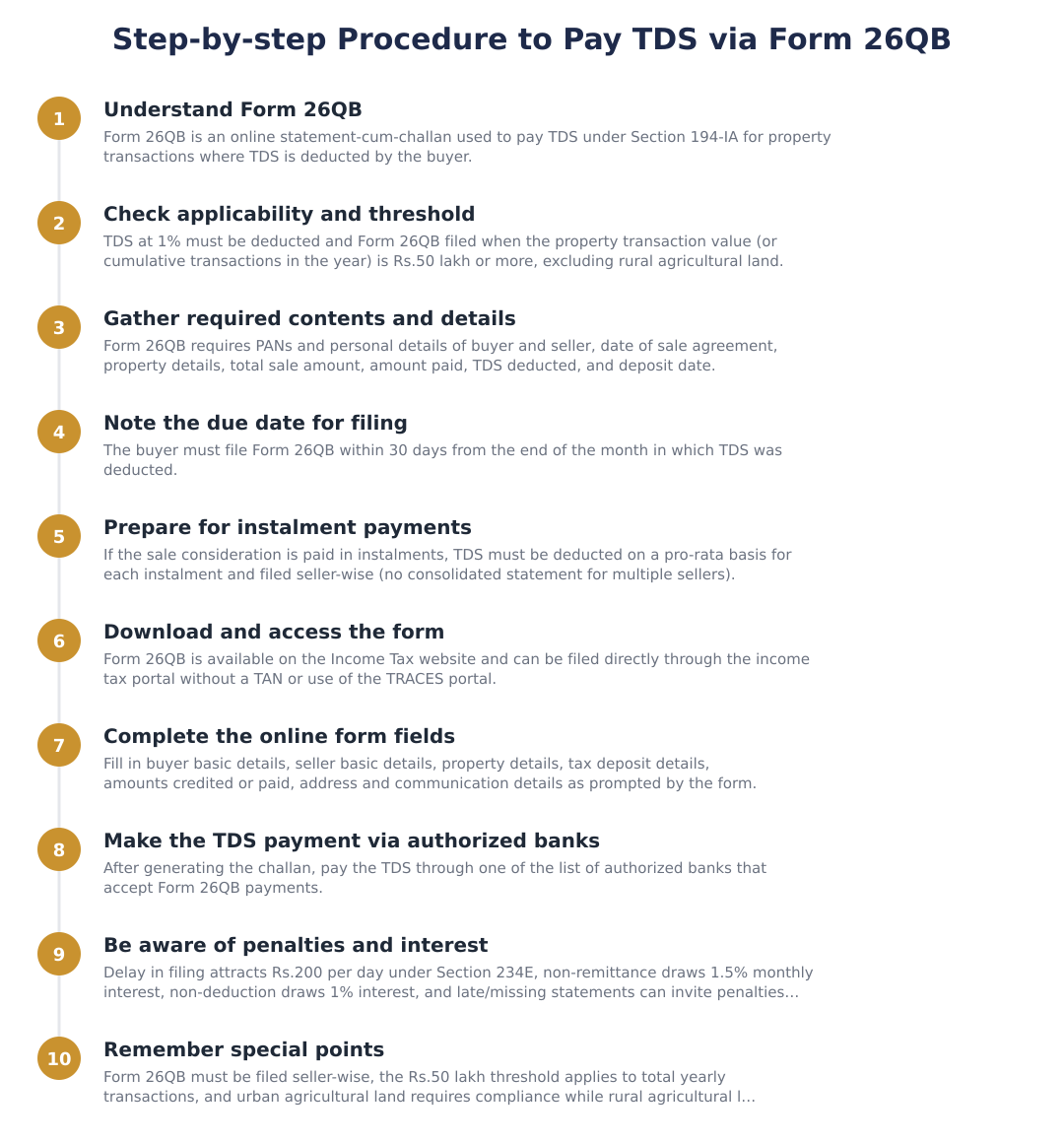
Procedure To Pay TDS Through Form 26QB
The payment process generally follows an online workflow: the buyer fills the web form with transaction and identity details, submits it to generate a challan/receipt, and then uses the generated challan to make payment through an authorised channel. Once payment is made, an acknowledgement or payment reference number is issued, which should be retained for records and shared with the seller so they can claim credit.
From a practical perspective, ensure the PANs and names of both parties are entered exactly as they appear on their tax records, small discrepancies often cause mismatches when the seller attempts to verify credit. After payment, reconcile the challan number or payment reference against bank statements and maintain screenshots or PDF copies of the final acknowledgement for future reference.
List of Authorized Banks for TDS Payment
Payments made using the form are accepted through designated banks and payment channels that have been authorised by the tax administration. These authorised channels facilitate online and branch collections and ensure that payments reflect correctly in the government’s tax systems. Using an authorised channel is essential; payments outside the approved routes may not be accepted or may lead to complications in credit posting.
Before making the payment, confirm the currently authorised banks and electronic channels on the tax authority’s official website or through an updated advisory. When transacting through a bank branch, keep the payment receipt and any bank-provided transaction identifier; when using online banking, download and store the payment confirmation PDF.
How To Download Form 26QB?
The standard method to get the form is via the income tax department’s online portal where the form is hosted as an interactive web page and as a downloadable acknowledgement or challan PDF after submission. The portal guides the user through input fields and generates a payment challan once the form is completed and validated.
If you prefer to retain a copy before submission, check whether the portal offers a preview or printable version. After submitting and completing payment, download and save the generated challan or payment acknowledgement file; this document is the taxpayer’s primary evidence of deposit and is necessary for reconciling the seller’s tax credits.
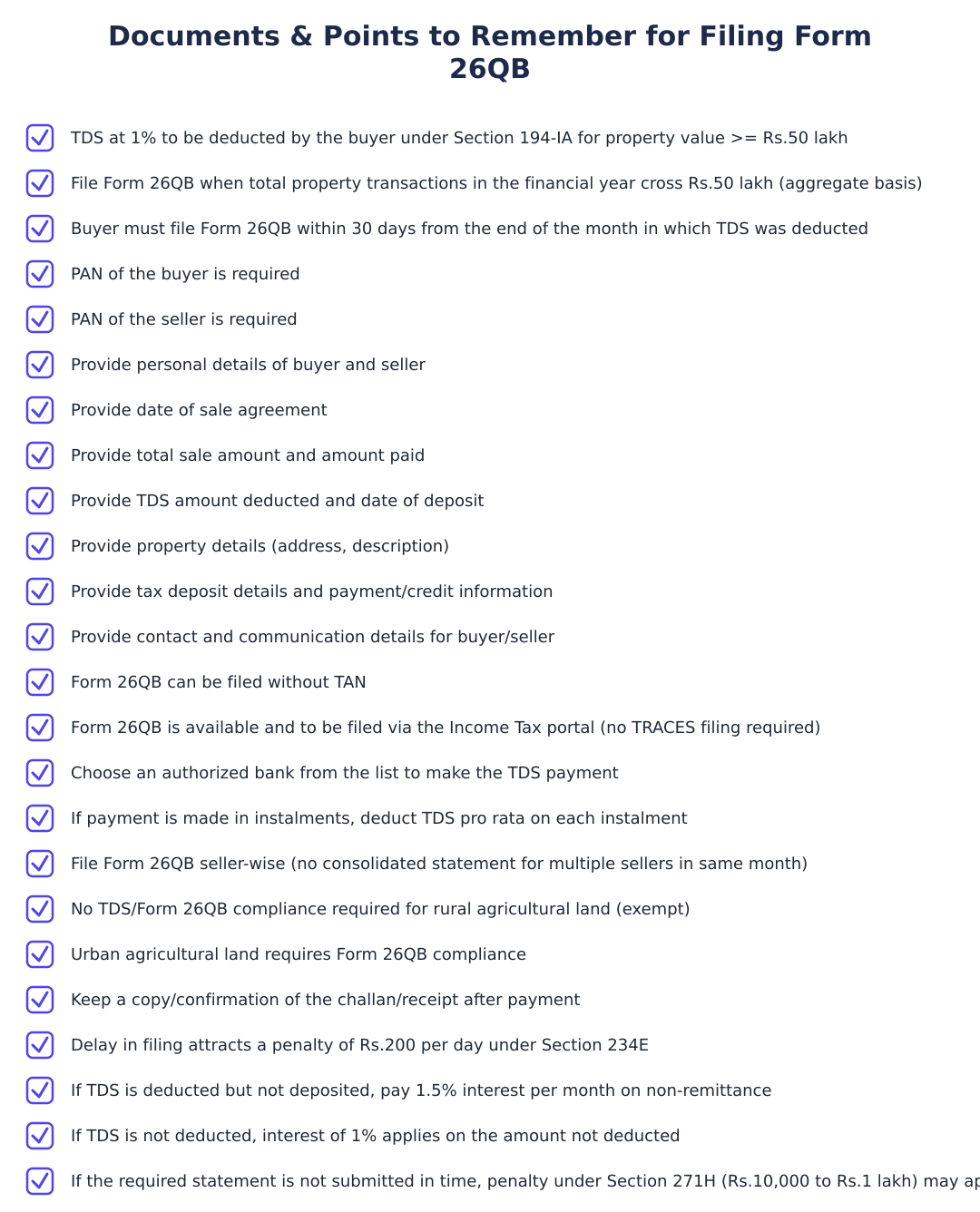
Points to Remember for Form 26 QB - TDS Statement
Enter PANs and names exactly as they appear on official tax records to avoid mismatch issues; mismatches are a common cause of processing delays and require corrective action. When multiple instalments or multiple sellers are involved, treat each seller and each instalment carefully according to how the rules treat aggregation and transaction-wise reporting, since reporting requirements may differ by circumstance.
Maintain a clear paper trail: sale agreement copies, bank proof of payment, screenshots of the submitted form and final challan. These documents help in future reconciliations and are invaluable in case the seller’s tax credit does not appear as expected in their tax accounts.
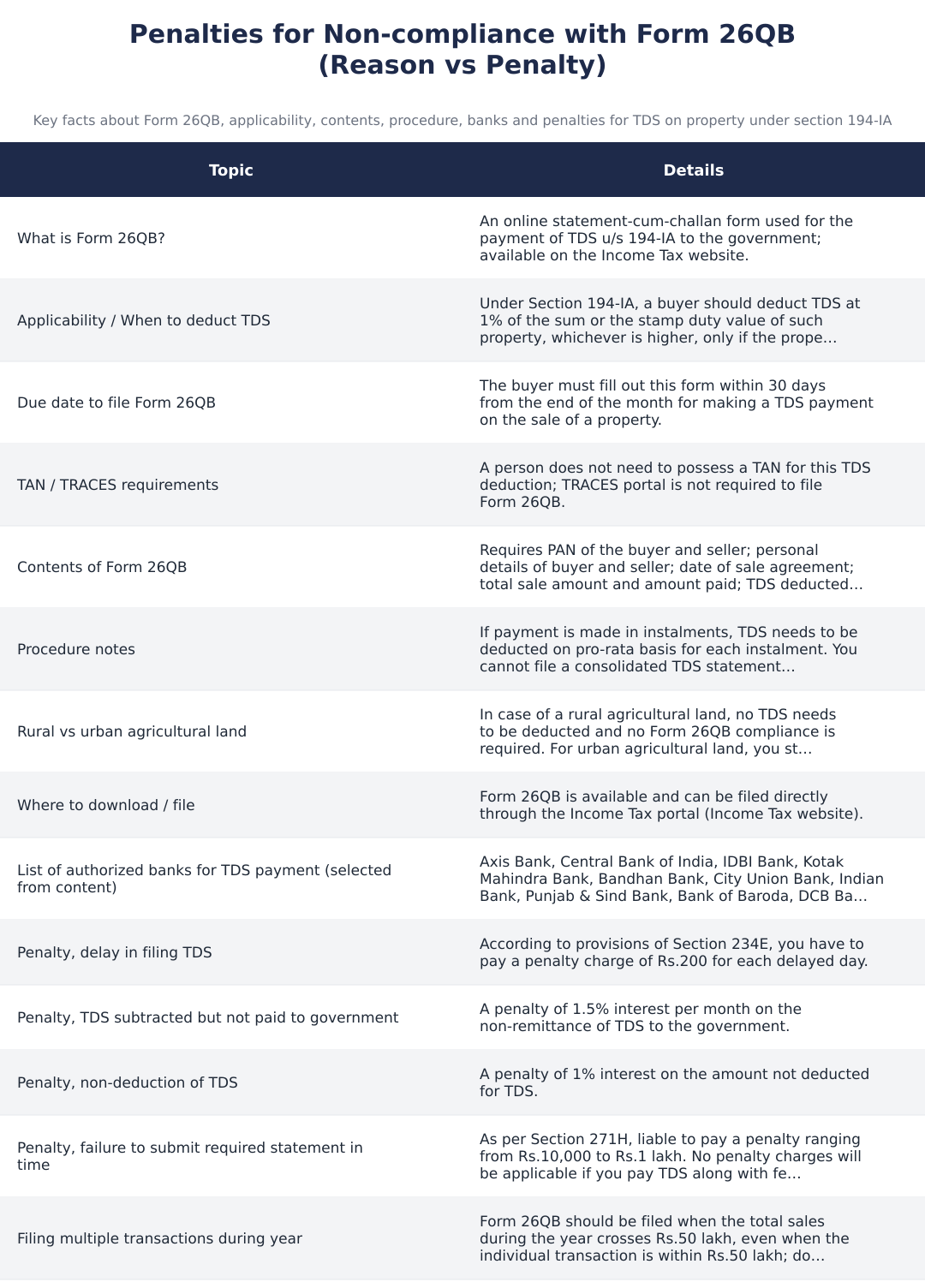
Penalty Charges Associated With Form 26QB
There are administrative and financial consequences for late filing, non-deduction, or non-payment of withholding tax, which may include interest and penalties under the relevant tax laws. The risk of such consequences is a strong reason to prioritise correct and timely compliance, and to consult a tax adviser promptly if you miss a deadline or discover an omission.
If a penalty is levied, it is typically calculated under the applicable statutory provisions based on the nature of the default, whether late deposit, non-deduction, or failure to furnish the required statement. When faced with a notice, respond promptly and gather payment receipts and submission evidence to support any rectification or dispute resolution.
Form 26QB PDF Download
After completing the online form and making the payment, the portal commonly provides a downloadable PDF of the challan and acknowledgement. Save multiple copies in secure digital and physical locations so the seller and any advisors can access them when needed for returns or reconciliations. The PDF should include the payment reference number and other identifying details that link it to the transaction.
If you do not receive or cannot download the PDF immediately after payment, check the acknowledgement section of the portal and contact your bank or the portal’s helpdesk. Retain all correspondence and transaction identifiers until the seller confirms that tax credit has been posted in their account.
Completing Form 26QB is a key compliance step when tax must be withheld on property transactions. Although the online process is designed to be straightforward, attention to detail, especially correct identity data, transaction specifics, timely payment, and documentation, reduces the risk of reconciliation problems and penalties. If you are unsure about any aspect of a transaction or the filing process, consult a qualified tax professional to ensure compliance and avoid costly administrative issues.
Frequently asked questions
Do I need to deduct TDS when I buy a property in India?
Yes, if the total consideration for the property (or total transactions with the same seller during the year) is Rs.50 lakh or more you must deduct TDS at 1% under section 194-IA. The buyer is liable to deduct 1% of the sale value or the stamp duty value, whichever is higher, and deposit it with the government using Form 26QB. This applies even if the Rs.50 lakh threshold is crossed cumulatively during the financial year, and no TAN is required for the buyer to deduct or deposit this TDS. Rural agricultural land is specifically excluded, but urban agricultural land is covered and attracts TDS where the threshold is met.
What is Form 26QB and when do I file it?
Form 26QB is the online statement-cum-challan used to deposit TDS deducted under section 194-IA on purchase of immovable property and to generate the TDS challan/receipt. The buyer must fill and pay through Form 26QB within 30 days from the end of the month in which TDS was deducted, for example, TDS deducted on 10 March must be paid by 30 April. The form captures buyer and seller PANs, sale agreement date, total sale amount, TDS amount and deposit date, property and contact details, and is available on the Income Tax e-filing portal; TRACES is not required for this filing. You must file seller-wise (no consolidated statement for multiple sellers) and pro-rate TDS when payment is made in instalments.
How do I download or get the Form 26QB challan/receipt after payment?
You can download the Form 26QB receipt from the Income Tax e-filing portal by logging in and navigating to e-File → e-Pay Taxes → Payment History where TDS on Sale of Property (code 800) entries appear. If you have already paid using Form 26QB, the payment history entry will let you download the challan/validated Form 26QB statement and receipt for your records. Keep this receipt safe because it contains the BSR code, challan number and TAN information needed to ensure the seller can claim credit for TDS in their income tax return.
Which banks accept TDS payments for Form 26QB?
TDS payments made through Form 26QB can be remitted via a list of authorised banks which include major public and private sector banks such as State Bank of India, HDFC Bank, ICICI Bank, Axis Bank, Punjab National Bank, Bank of Baroda and others. The full list of authorised banks includes Axis, Bandhan, Bank of Baroda, Bank of India, Bank of Maharashtra, Canara Bank, Central Bank of India, City Union Bank, DCB Bank, Federal Bank, HDFC Bank, ICICI Bank, IDBI Bank, Indian Bank, Indian Overseas Bank, IndusInd Bank, Jammu & Kashmir Bank, Kotak Mahindra Bank, Karur Vysya Bank, Punjab & Sind Bank, Punjab National Bank, RBL Bank, South Indian Bank, State Bank of India, UCO Bank, Union Bank of India, among others. Use the Income Tax portal or your bank’s TDS/e-tax payment option to complete the deposit and obtain the challan/receipt for Form 26QB.
What are the due dates and penalties for late filing or non-payment of TDS under Form 26QB?
You must file Form 26QB and deposit TDS within 30 days from the end of the month in which TDS was deducted; failure to do so attracts penalties and interest under various sections. A late filing fee of Rs.200 per day applies under Section 234E for delayed filing, interest at 1.5% per month is payable for TDS that has been deducted but not remitted to the government, and 1% interest applies on the amount not deducted; additionally Section 271H can levy a penalty of Rs.10,000 to Rs.1,00,000 for failure to file required statements on time, though this may be waived if TDS, interest and statement are filed within a set period. To avoid heavy costs, deposit the TDS promptly, pay any applicable interest, and submit the Form 26QB statement as soon as possible.
Can I file one consolidated Form 26QB if I purchased properties from multiple sellers in the same month?
No, Form 26QB must be filed seller-wise and you cannot file a consolidated statement for multiple sellers in the same month. Each transaction that attracts TDS under section 194-IA requires a separate Form 26QB entry with the specific seller’s PAN and transaction details, even if multiple purchases occur in the same month. This means you must generate and pay separate challans for each seller; failing to do so can cause mismatch issues for seller TDS credit and lead to penalties or disputes when the seller claims the credit.
Do I need a TAN or TRACES access to file Form 26QB?
No, you do not need a TAN or access to the TRACES portal to file Form 26QB; buyers can file and pay TDS directly through the Income Tax e-filing portal. Form 26QB was designed specifically so non-TAN holders (individual buyers) can deposit tax deducted under section 194-IA without registering for TAN and without using TRACES for challan generation. Ensure you accurately enter buyer and seller PANs and all transaction details on the e-filing portal so the seller can claim the TDS credit in their income tax return.
What details do I need to fill in Form 26QB to avoid mismatches or rejection?
You must provide accurate buyer and seller PANs, the date of sale agreement, total sale amount and amount paid, property address and description, TDS amount and deposit date, and contact details in Form 26QB to ensure processing without mismatches. Any wrong PAN, incorrect sale amount or incorrect challan details may prevent the seller from getting TDS credit and can cause processing delays or show as mismatch in Form 26AS; always verify PANs against official documents and keep your payment receipt. If payment is by instalments, compute TDS pro rata for each instalment and file Form 26QB for each instalment to reflect the actual deduction and deposit dates.
How is TDS calculated when the property value is paid in instalments?
When the property is paid in instalments you must deduct TDS on a pro-rata basis for each instalment and deposit it using Form 26QB at the time of each payment. The 1% rate applies to the instalment amount or to the stamp duty value component relevant to that instalment, and you should file separate Form 26QB entries for each instalment payment to a seller. Keep records showing instalment amounts and dates so the seller can reconcile the TDS credits in their tax records and Form 26AS.
Need help staying TDS compliant?
MoneyGence's AI Finance OS tracks your compliance, wallet share, and finances in one place, built for agencies and growing businesses.
Get started with MoneyGence