Form 16C TDS Certificate on Rent | Challan 26QC Guide
This guide explains Form 16C, the TDS certificate issued when TDS is deducted on rent under the special provision that applies to certain resident individuals and HUFs. You will learn who must deduct TDS under this provision, when the deduction is triggered, how to pay TDS using Challan 26QC, and how to obtain the Form 16C certificate for the payee. The practical takeaways include the condition that triggers the deduction, the statutory form and challan to use, and the official portal to retrieve the certificate. Knowing these steps helps landlords and tenants comply with the TDS requirement on rent, ensures the payee gets the correct certificate for claiming credit, and reduces the risk of documentary or compliance gaps in routine landlord–tenant transactions. Where the rule applies specifically to individuals and HUFs not covered by a tax audit, this guide concentrates on the mechanics and sources you will use to complete the transaction properly.
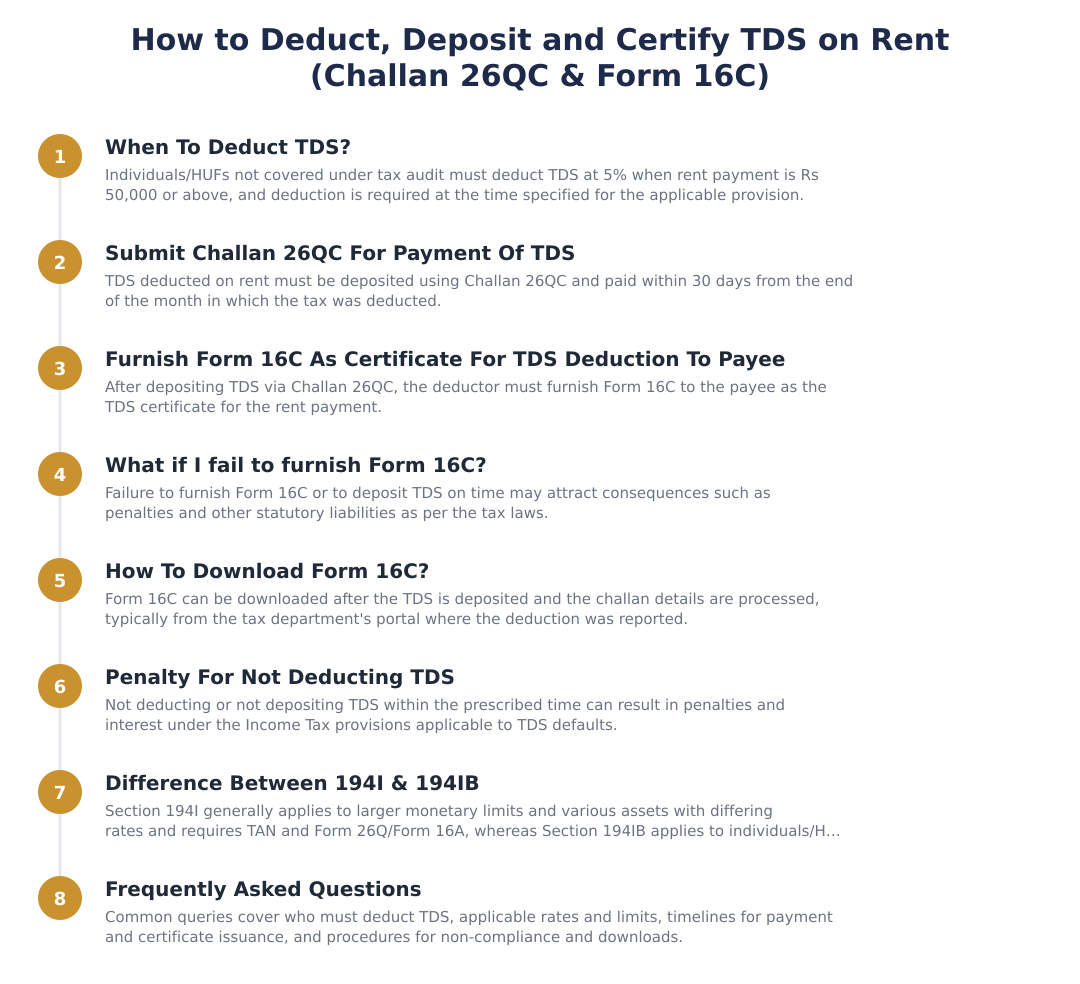
When To Deduct TDS?
A specific provision requires certain resident individuals and Hindu Undivided Families (HUFs) to deduct tax at source on rent payments in defined circumstances. The trigger for this obligation is tied to the monthly rent amount: when the rent payable in a month is Rs. 50,000 or more, these payers must deduct TDS under the applicable provision.
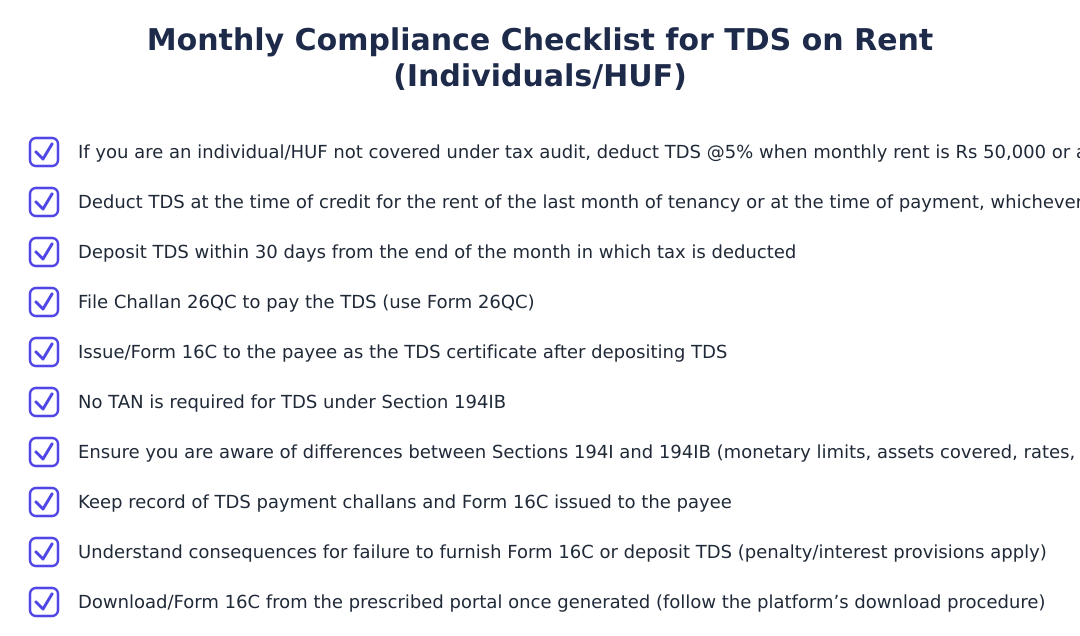
Practically, this means that if you are an individual or HUF who is not subject to a tax audit and you pay monthly rent meeting or exceeding that Rs. 50,000 threshold, you must deduct tax at source at the prescribed rate and follow the prescribed compliance flow for payment and certification.
Submit Challan 26QC For Payment Of TDS
Confirm you are an individual/HUF not covered by tax audit and that monthly rent is at or above Rs. 50,000; compute TDS at the prescribed rate applicable under this provision.
When TDS is required under this route, the tax must be paid using Challan 26QC as the statutory challan for this category of rent deduction.
After payment, retain the Challan 26QC acknowledgement, this acknowledgement is necessary to link the payment to the subsequent certificate issuance and for retrieval on the official portal.
Furnish Form 16C As Certificate For TDS Deduction To Payee
After depositing TDS via Challan 26QC, the payer must provide a TDS certificate to the payee. The statutory certificate issued in this workflow is Form 16C. Form 16C serves as the landlord’s evidence that tax has been deducted and paid to the government on their rent income under this specific provision.
Form 16C is the formal document the payee will use to claim credit for the tax deducted when filing their return. It is therefore important the payer issues or facilitates access to this certificate promptly once the challan has been processed.
How To Download Form 16C?
The official TRACES portal is the mechanism used to register and download Form 16C. To retrieve the certificate, the payee or payer will need the PAN of the recipient and details from the Form 26QC acknowledgement.
Using the PAN and the challan/acknowledgement information on TRACES allows you to locate and download the issued Form 16C for record-keeping and tax-filing purposes. Keep the PAN and acknowledgement details handy when accessing TRACES to avoid delays.
What if I fail to furnish Form 16C?
Form 16C is the prescribed certificate connected to the Challan 26QC payment route. Failing to provide the certificate to the payee means the payee will not have the formal evidence of tax deduction necessary for claiming credit; it can also create practical compliance complications for both parties.
If you encounter difficulties generating or issuing Form 16C, use the TRACES portal (with PAN and 26QC acknowledgement) to obtain the electronic certificate. Maintain all payment acknowledgements and documentation until the certificate is successfully delivered to the payee.
Difference Between 194I & 194IB
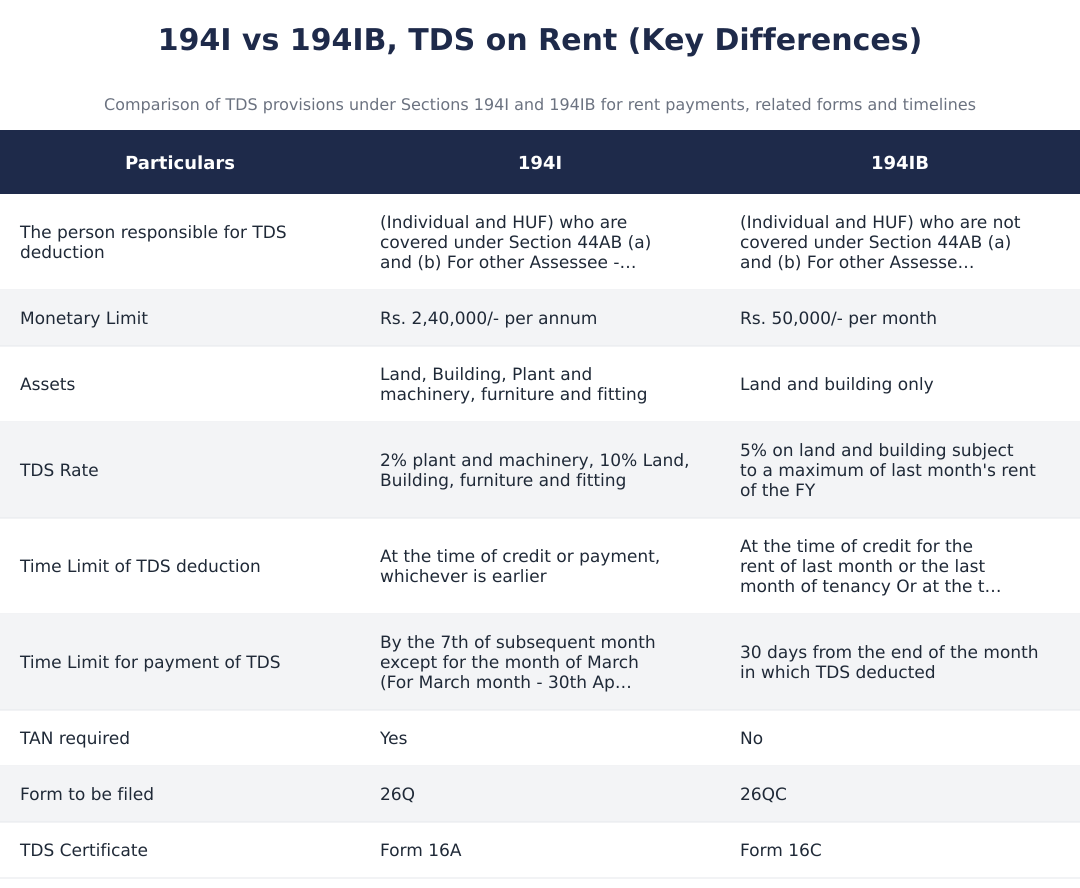
Section 194IB is the specific provision that applies to resident individuals and HUFs who are not subject to a tax audit and requires TDS on rent when monthly rent is Rs. 50,000 or above. Under this route, the mechanics involve payment via Challan 26QC and issuance of Form 16C as the certificate.
Section 194I is a separate provision that governs TDS on rent more broadly. The key distinguishing point to note from the provisions covered here is that 194IB is the tailored mechanism for the particular class of payers (individuals/HUFs not under tax audit) with the Rs. 50,000 per month monetary trigger and its own procedure (26QC and 16C). For fuller details on how the two sections differ in scope and applicability in other scenarios, consult a tax specialist or official guidance.
Frequently Asked Questions
Who must deduct TDS under this route? Individuals and HUFs who are not covered under a tax audit and who pay monthly rent of Rs. 50,000 or more are required to deduct TDS under this provision.
Which challan and certificate are used? TDS on rent for this category is administered via Challan/Form 26QC for payment and Form 16C as the TDS certificate. The TRACES portal is used to register and download Form 16C using the recipient’s PAN and the Form 26QC acknowledgement details.
In summary, when monthly rent is Rs. 50,000 or more and the payer is an individual or HUF not subject to a tax audit, TDS must be deducted under the special provision and paid through Challan 26QC, with Form 16C issued as the certificate. Use the TRACES portal with the recipient’s PAN and the 26QC acknowledgement to download the certificate and keep all records safe for the payee’s tax filing and your compliance needs.
Frequently asked questions
Who is required to deduct TDS under Section 194IB (rent) when the landlord is an individual or HUF?
You must deduct TDS at 5% under Section 194IB if you are an individual or HUF (not subject to tax audit under Section 44AB) and the monthly rent paid is Rs 50,000 or more. This requirement applies only to rent for land or building (not plant and machinery) and the deduction is on the rent amount subject to a maximum of the last month's rent of the financial year. No TAN is required for such deductors and the deducted tax must be deposited using Challan 26QC. If the payee is a business or the payer is covered under Section 44AB, Section 194I (with different rates and rules) may apply instead.
When should I deduct TDS on rent under Section 194IB?
TDS under Section 194IB must be deducted at the time of credit of the rent for the last month of the financial year or the last month of tenancy, or at the time of payment, whichever is earlier. For recurring monthly rent, this effectively means deducting when you credit or pay the rent for the relevant month; for the last month or on vacation, it is the last month's rent that triggers the deduction. The threshold for deduction is Rs 50,000 or more in a month and the rate is 5% on rent for land and building.
How and when do I pay the TDS deducted under Section 194IB?
The TDS deducted under Section 194IB must be deposited within 30 days from the end of the month in which the tax was deducted using Challan 26QC. For example, if you deducted TDS on rent in June, you must deposit it by 30 July using Form 26QC and furnish details such as payer PAN and landlord PAN while paying. Late deposit attracts interest and potential penalties, so timely filing and payment are important.
Do I have to issue Form 16C to the landlord after deducting TDS and how soon?
Yes, after furnishing Form 26QC and paying the TDS, you must issue Form 16C as the TDS certificate to the landlord; it should generally be issued within 15 days of filing Form 26QC. Form 16C is evidence of tax deducted and contains details of tax deposited and the challan, and landlords use it to claim credit while filing their income tax returns. You can download or generate Form 16C from the TRACES portal once Form 26QC is processed.
What happens if I fail to furnish Form 16C to the landlord on time?
If you fail to issue Form 16C to the landlord within 15 days of furnishing Form 26QC, you could be liable to pay a penalty of Rs 100 for each day of delay. This monetary penalty is in addition to any interest or late fee for delayed TDS deposit and can accumulate quickly, so timely issuance is important. The penalty is levied per day of delay from the due date until the certificate is actually furnished.
How can I download Form 16C from TRACES?
You can download Form 16C from the TRACES portal by registering or logging in with PAN as user id, providing the acknowledgment number of Form 26QC and the assessment year, and requesting the download; the certificate will appear in the Downloads section. The steps are: register on TRACES with PAN and verification details if not already registered, log in, enter PAN and Form 26QC acknowledgment details, and then download or print Form 16C from the requested downloads. Keep the downloaded Form 16C handy for recordkeeping and to provide to the landlord as proof of tax deduction.
What penalties or consequences apply if I do not deduct or pay TDS on rent under 194IB?
If you fail to deduct TDS under Section 194IB or fail to deposit it on time, you may face interest on the late payment, penalties for non-deduction or late deposit, and disallowance issues while claiming rent expense; specific penalties include interest under Sections 201(1A) and prosecution or fines in severe cases. Additionally, late issuance of Form 16C attracts Rs 100 per day delay after furnishing Form 26QC, and tax authorities may treat non-deduction as tax collectable from the payer. It is therefore important to deduct when required, deposit via Challan 26QC within 30 days from month-end, and furnish Form 16C timely to avoid liabilities.
What are the key differences between Sections 194I and 194IB for TDS on rent?
Section 194I applies broadly to rent for land, building, plant and machinery, furniture and fittings with higher annual monetary limits (Rs 2,40,000 per annum) and requires TAN, while Section 194IB specifically targets individual/HUF payers not covered by tax audit for monthly rent of Rs 50,000 or more and does not require TAN. TDS rates differ: under 194I rates vary (2% for plant and machinery, 10% for land, building, furniture and fittings in general), while 194IB mandates a flat 5% on rent for land and building subject to a maximum of the last month's rent. Time limits and forms also differ: 194I uses Form 26Q, Form 16A, and payment by 7th of the following month (30 April for March), whereas 194IB uses Form 26QC, Form 16C, and payment within 30 days from month-end.
If my landlord does not provide PAN, how does that affect TDS under Section 194IB?
If the landlord does not provide PAN, the payer must still deduct TDS but at a higher rate as prescribed for PAN non-furnishing (typically higher than the standard 5%), and comply with deposit and reporting via Form 26QC; failure to collect PAN can lead to default rate implications and compliance issues. It is advisable to obtain the landlord’s PAN before making the rent payment so you can deduct at the normal 5% rate and correctly furnish Form 26QC and Form 16C. When PAN is missing, statutory higher TDS rates or provisions under the Income Tax Act for non-furnishing of PAN will apply, and the payer should document the attempt to obtain PAN.
Need help staying TDS compliant?
MoneyGence's AI Finance OS tracks your compliance, wallet share, and finances in one place, built for agencies and growing businesses.
Get started with MoneyGence