Form 16B Guide: TDS Certificate for Property Sale | Download TRACES
This guide explains Form 16B, the TDS certificate issued when immovable property is sold, and how buyers can download it from TRACES. You will learn who must deduct tax, the rate and threshold that trigger TDS under the law, how the payment and reporting are done, what to do if the buyer does not have a TAN, and the exact steps to generate and download Form 16B from the TRACES portal. For anyone involved in property deals, buyers, sellers, and tax practitioners, knowing these points matters because TDS at source affects cash flows, compliance timelines, and the evidence sellers need to claim credit for tax deducted. This guide uses only the statutory positions and official TRACES procedures: it summarises Section 194-IA requirements, the 1% TDS rate based on the higher of sale consideration or stamp duty value, the Rs 50 lakh threshold, the special treatment if the seller withholds PAN, the role of Form 26QB, and the TRACES download workflow. By the end you will be able to identify when TDS is applicable, how the buyer should submit the return-cum-challan, and how to obtain Form 16B as proof of TDS deposited on property sale transactions.
TDS Deduction and Form 16B
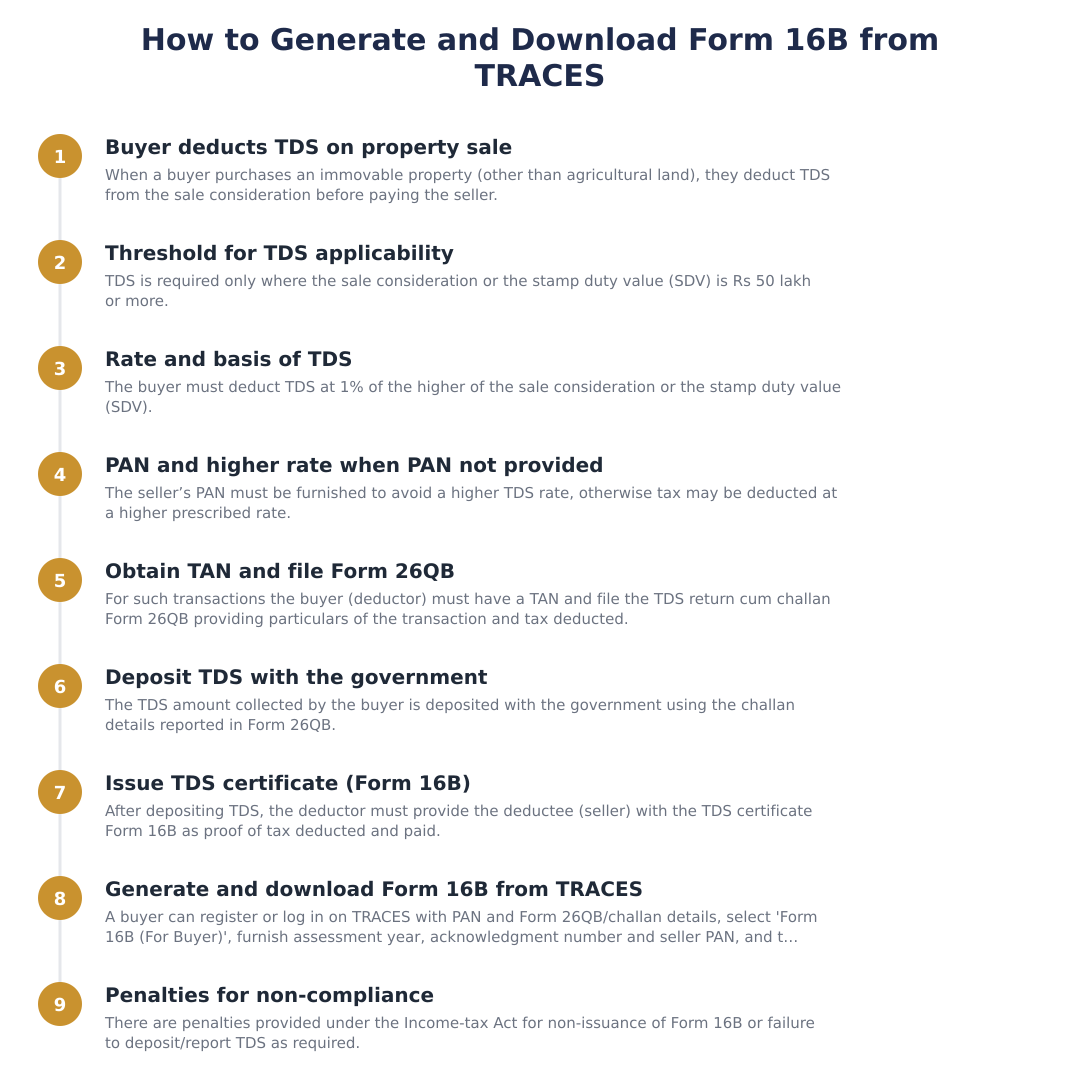
TDS on transfer of immovable property is governed by Section 194-IA of the Income-tax Act. Under this provision, when a buyer purchases an immovable property (other than agricultural land) and the transaction meets the statutory threshold, the buyer must deduct tax and issue a TDS certificate to the seller.
Form 16B is the TDS certificate issued by the buyer to the seller for the TDS made on the sale of house property. The TDS amount collected by the buyer is required to be deposited with the government, and Form 16B serves as the seller’s evidence of tax deducted at source on the transaction.
Nature of TDS: Rate, Threshold and Deposit
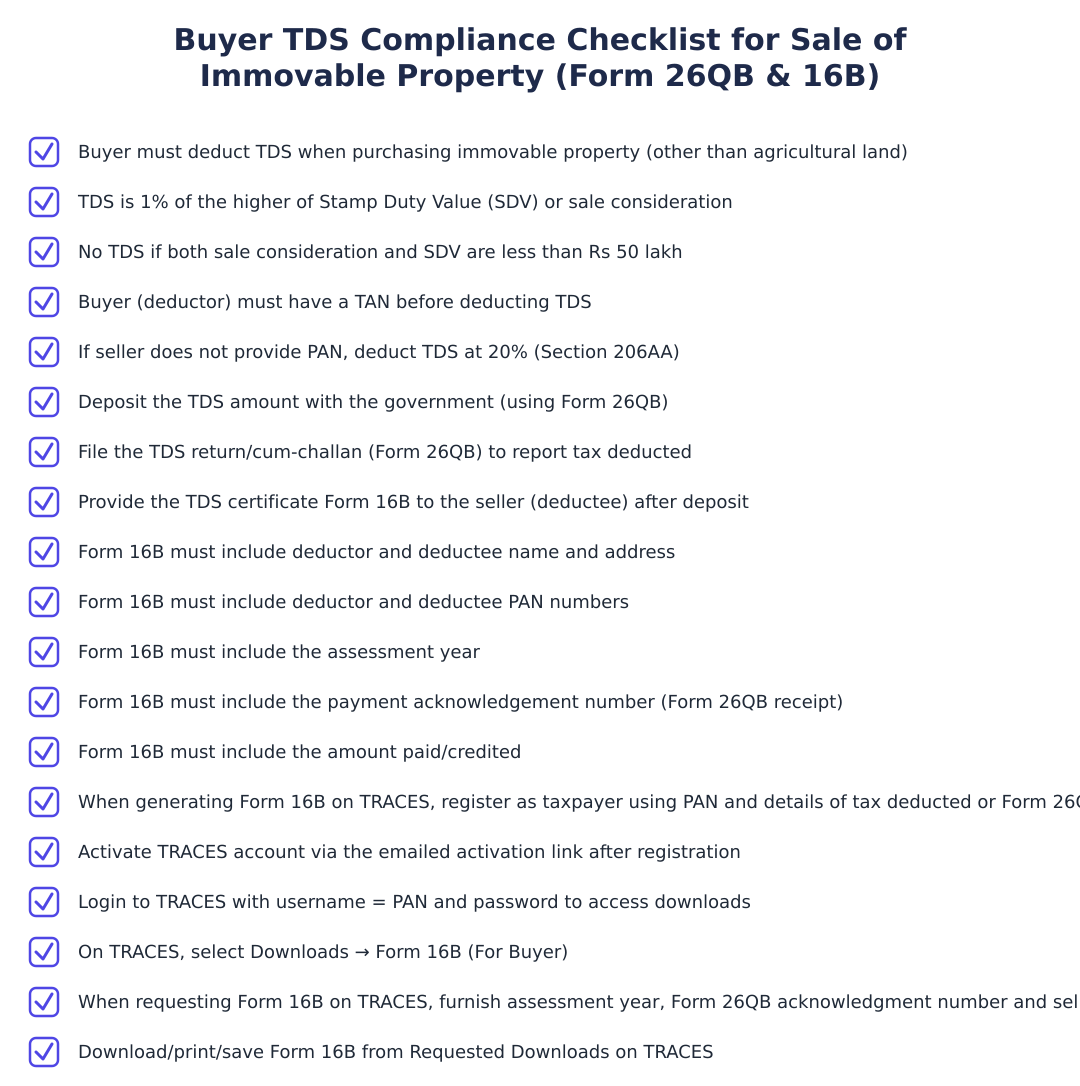
The rate of TDS under Section 194-IA is 1% of the higher of the Stamp Duty Value (SDV) or the sale consideration. This means the buyer must compute the higher of these two figures and deduct 1% of that amount as tax at source.
TDS under Section 194-IA is not required if both the sale consideration and the stamp duty value are less than Rs 50 lakh. Once TDS is deducted, the buyer must deposit the TDS amount with the government and provide the seller with Form 16B as the certificate of deduction.
TAN Requirement and One-off Transactions
For transaction-related TDS under Section 194-IA, obtaining a Tax Deduction and Collection Account Number (TAN) is generally mandatory for deductors. TAN is the usual identifier for entities who regularly deduct TDS and file TDS returns.
However, there is an exception for one-off property transactions: deductors under Section 194-IA are allowed to file the TDS return without TAN by using a separate return-cum-challan (Form 26QB). This mechanism enables buyers who do not have TAN to comply by submitting details through Form 26QB for the specific property transaction.
Form 26QB and Filing Obligations
The TDS return cum challan filed by the deductor for property transactions under Section 194-IA is called Form 26QB. This form is used to deposit the TDS for the transaction and to provide the necessary particulars of the deductee and payment.
In addition to depositing the tax, the deductor must file TDS returns quarterly providing particulars of deductees, nature of the payment, tax deducted, rate, and related details. Filing these returns and depositing the tax are essential steps before the buyer can generate the TDS certificate (Form 16B) for the seller.
Procedure to Generate and Download Form 16B from TRACES
Register on TRACES using PAN and details of tax deduction (challan or Form 26QB) or login if already registered; the process uses PAN as the username.
After login, go to the Downloads tab and select 'Form 16B (For Buyer)'.
Furnish the assessment year, the acknowledgement number of Form 26QB and the PAN of the seller to locate the certificate.
Form 16B will be made available under requested downloads; it can then be printed or saved by the buyer.
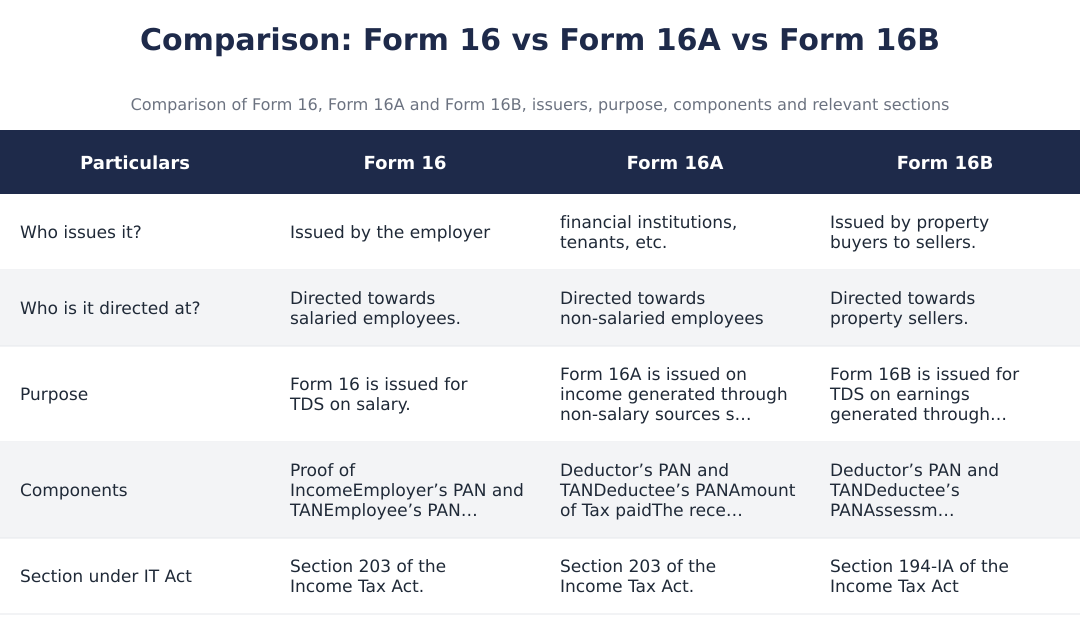
Difference Between Form 16, Form 16A, and Form 16B
| Particulars | Form 16 | Form 16A | Form 16B |
|---|---|---|---|
| Who issues it? | Issued by the employer | Issued for TDS on non-salary incomes | Issued by property buyers to sellers |
| Purpose | TDS on salary | TDS on non-salary income | TDS on sale of immovable property |
| Governing provision or context | TDS on transfer of immovable property is governed by Section 194-IA |
Seller PAN Not Furnished and Related Treatment
If the seller does not provide their PAN to the buyer, the buyer must still deduct TDS, but the rate of deduction changes. In such cases the applicable provision is Section 206AA and TDS is deducted at the rate of 20%.
This treatment under Section 206AA is distinct from the 1% rate under Section 194-IA and underscores the importance for sellers to furnish PAN to ensure TDS is deducted at the correct lower rate.
Frequently Asked Questions
Who issues Form 16B?, Form 16B is issued by the buyer (deductor) to the seller (deductee) as the TDS certificate for tax deducted on the sale of immovable property.
Can Form 16B be downloaded online?, Yes. After depositing TDS via Form 26QB and registering or logging in on TRACES using PAN and related details, the buyer can select 'Form 16B (For Buyer)', provide the assessment year, Form 26QB acknowledgement and seller PAN, and download the certificate.
Form 16B is the official proof a seller needs to claim credit for TDS deducted on sale of immovable property under Section 194-IA. Buyers should ensure correct computation (1% of the higher of SDV or sale consideration where applicable), deposit the TDS via Form 26QB, file required returns, and download Form 16B from TRACES. Where the seller’s PAN is not provided, a higher withholding rate under Section 206AA applies. Follow the TRACES workflow to obtain the certificate after compliance steps are completed.
Frequently asked questions
What is Form 16B and who issues it?
Form 16B is the TDS certificate issued by a buyer to a seller for tax deducted on the sale of immovable property. It is issued when TDS has been deducted under Section 194-IA on the sale consideration (or higher stamp duty value) of a property transaction; the certificate records deductor and deductee PANs, assessment year, Form 26QB acknowledgment and the amount paid/credited. The buyer (deductor) must provide this certificate to the seller (deductee) after depositing the TDS with the government, and it serves as proof that tax has been deducted and credited. You can later download Form 16B from the TRACES portal using the Form 26QB acknowledgement details.
How much TDS must be deducted on sale of a property and when does it apply?
TDS on sale of immovable property under Section 194-IA is 1% of the higher of the sale consideration or the stamp duty value (SDV). This deduction is required when either the sale consideration or the SDV of the property is Rs 50 lakh or more; if both values are below Rs 50 lakh, TDS under this provision is not required. The buyer must deduct tax at the time of payment or at the time of credit to the seller, whichever is earlier, and deposit it with the government. If the seller does not provide PAN, tax must be deducted at the higher rate specified under Section 206AA (20% as per the guidance on PAN absence).
What information does Form 16B contain?
Form 16B contains key details such as the deductor's and deductee's names and addresses, their PAN numbers, the assessment year, the payment acknowledgement number (Form 26QB receipt), the amount paid/credited and a verification section. It essentially mirrors the particulars provided when filing the TDS return-cum-challan (Form 26QB) and serves as the official certificate of tax deducted at source on property sale. This certificate helps the seller claim the TDS credit in their income tax return against the tax deposited by the buyer. Keep the Form 26QB acknowledgement handy because it is required to generate Form 16B on TRACES.
How do I generate and download Form 16B from the TRACES portal?
You can generate and download Form 16B from TRACES by registering or logging in with your PAN and the relevant details (tax deducted details or Form 26QB/challan details) and then using the Downloads > Form 16B (For Buyer) option. After selecting assessment year, providing the Form 26QB acknowledgement number and the seller's PAN, the requested Form 16B becomes available in the requested downloads section and can be printed or saved. New users must register on TRACES with PAN and verification code and activate the account via the emailed activation link before they can download certificates. Ensure the Form 26QB acknowledgement is correct because it is required to fetch the certificate.
What is Form 26QB and how is it related to Form 16B?
Form 26QB is the TDS return-cum-challan that the buyer files and uses to deposit TDS for property transactions under Section 194-IA, and its acknowledgement number is required to generate Form 16B. Form 26QB records particulars of the deductor and deductee, the nature of payment, tax deducted, and the challan details and serves as the payment evidence that the Income Tax Department uses to credit the seller's TDS. Once Form 26QB is filed and the challan is processed, the buyer can use the Form 26QB acknowledgement to request and download Form 16B from TRACES. Form 26QB also provides an exception allowing deductors without TAN to file and deposit TDS for property transactions.
What happens if the buyer does not have a TAN for TDS on property sale?
If the payer (buyer) does not possess a TAN, they can still deposit TDS for property transactions by using Form 26QB because an exception has been provided for Section 194-IA deductors. Individuals involved in one-off property purchases often cannot feasibly obtain a TAN, so the dedicated Form 26QB allows them to file the TDS return and make the payment without quoting a TAN. However, quoting TAN is otherwise mandatory for deductors in general and must be used in other TDS communications with the Income-tax (TDS) department. Always retain the Form 26QB acknowledgement as proof of deposit since it is needed to generate Form 16B.
When and how should the buyer deposit the TDS amount?
The buyer must deposit the TDS amount with the government at the time of deduction using the TDS return-cum-challan mechanism (Form 26QB) and pay via the specified challan (ITNS 281 for TDS payments). TDS should be deposited at the earlier of the time the amount is credited to the seller's account or the time it is paid, and the Form 26QB filing is the prescribed way to both deposit and report this tax under Section 194-IA. After depositing, the buyer will get an acknowledgement number which is required to generate Form 16B on TRACES. Keep the challan/acknowledgement safe as evidence in case of future queries or reconciliation.
What are the penalties for not issuing or not filing Form 16B?
A deductor who fails to issue the TDS certificate (Form 16B) or does not file the required TDS return may be liable to penalties under the Income-tax Act, and other consequences such as interest on delayed TDS deposit can apply. The page outlines that penalties can be imposed for non‑issuance or non‑filing but does not list specific penalty amounts, so affected parties should consult the Income-tax Act or a tax advisor for precise monetary penalties and legal provisions. To avoid penalties, buyers should deduct 1% TDS where applicable, deposit it through Form 26QB, and promptly generate and issue Form 16B via TRACES. Retaining all acknowledgements and challan details helps defend against any penalty assessments.
How is Form 16B different from Form 16 and Form 16A?
Form 16B is specifically the TDS certificate issued by property buyers to sellers for TDS on sale of immovable property, whereas Form 16 is issued by employers for TDS on salary and Form 16A is issued for TDS on non-salary income like interest, rent or professional fees. The components differ: Form 16B includes deductor/deductee PAN, assessment year and Form 26QB acknowledgement, Form 16 contains employer and employee PAN/TAN and salary details, and Form 16A contains deductor/deductee PANs and TDS payment details for non-salary payments. The legal sections also differ in practice: Form 16 and 16A arise under Section 203 processes, while Form 16B arises from TDS under Section 194-IA specific to property sales. Use Form 16B when you are dealing with TDS on a property sale; the other forms apply to different income sources.
Need help staying TDS compliant?
MoneyGence's AI Finance OS tracks your compliance, wallet share, and finances in one place, built for agencies and growing businesses.
Get started with MoneyGence