Form 122 TDS: Unified Salary Declaration to Prevent Excess TDS
This guide explains how a single salaried-employee declaration can centralise control over tax deduction at source on salary and why getting that declaration right matters for both employees and employers. You will learn what such a declaration typically covers, how it helps in aligning payroll deductions with a taxpayer’s overall income profile, common pitfalls to avoid, and practical best practices for preparing and submitting the declaration. For employers, the guide outlines how a clear, complete declaration minimises payroll rework and reduces the risk of under- or over-deduction of tax. For employees, it explains how a properly completed declaration helps to ensure take-home pay is accurate and reduces surprises at the time of annual tax reconciliation. The aim is to equip readers with the conceptual understanding needed to treat the declaration as a tool for tax accuracy and administrative efficiency, rather than just a formality. Whether you are an HR professional, payroll staff, finance manager, or an employee preparing your year-end paperwork, this guide provides the context and practical pointers to handle a salary tax declaration thoughtfully and effectively.
What a single salary declaration is and why it exists
At its core, a single salary declaration is an employee’s statement of relevant income and deductions that informs how tax should be deducted from their salary. The declaration brings together information that affects tax computation, so payroll can apply the correct deduction rules during the year rather than waiting until year-end reconciliations.
Employers use the declaration to reconcile payroll withholding with the employee’s wider tax position. A comprehensive declaration helps employers estimate the correct amount to deduct, while incomplete or late declarations can lead to administrative work, corrective payments, or adjustments later in the process.
What employees should typically include
Employees should think of the declaration as a summary of all items that influence their taxable salary. This generally includes details about other income sources, anticipated tax-deductible expenses, claims for allowances or reliefs, and any deductions they expect to claim during the year. Providing complete and accurate estimates helps the employer align monthly withholding to the employee’s projected liability.
It is also important for employees to update the declaration if their situation changes during the year, for example, if they change jobs, receive a significant non-salary payment, or expect new deductible expenses. Timely updates reduce the chance of major adjustments when annual tax reconciliation happens.
Employer responsibilities and payroll handling
Payroll teams must treat the employee’s declaration as an input for their withholding calculations while ensuring it is processed consistently across the payroll cycle. This means having clear internal procedures for accepting, validating, and applying declared figures so deductions reflect the employee’s stated position.
Employers should also build a mechanism for employees to submit revisions and for payroll to document any assumptions made when declarations are incomplete. Good record-keeping and communication with employees reduce disputes and streamline year-end tax processes.
Common mistakes to avoid
Underestimating or omitting income from other sources is a frequent cause of mismatch between actual tax liability and deducted tax. Employees should ensure they consider all relevant income streams when preparing the declaration to avoid shortfall later.
Another common issue is not updating the declaration after material changes in employment or financial circumstances. Both employees and employers benefit from clear timelines and channels to submit updated information so payroll can adjust deductions in a timely manner.
Practical best practices
Treat the declaration as a living document: encourage employees to review it at key points during the year and provide a simple process for submitting updates. Clear guidance and examples from HR can help employees estimate figures more accurately.
From an employer standpoint, standardise the form fields and validation checks so the declared information is consistent and usable for payroll calculations. Also, maintain an audit trail of submissions and changes to resolve queries efficiently and to demonstrate due diligence in withholding.
A well-prepared single salary declaration simplifies tax withholding, reduces surprises for employees at year-end, and lowers administrative burden for employers. Clear communication, timely updates, and consistent payroll practices turn the declaration into an effective control for accurate salary tax deductions.
Frequently asked questions
What is Form 122 and why was it introduced?
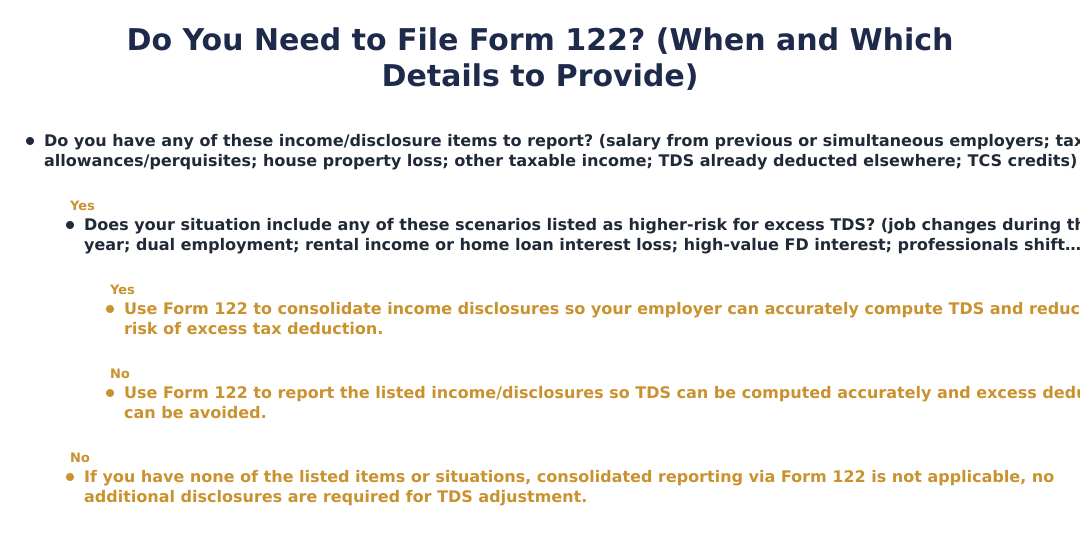
Form 122 is a single consolidated declaration form for employees to report all income and tax credits so employers can accurately deduct TDS on salary. It was introduced to replace multiple separate disclosures (like separate declarations for previous employer salary, perquisites, and other income) and to reduce incidents of excess tax deduction by enabling unified reporting of salary from previous or simultaneous employers, taxable allowances and perquisites, house property loss, other taxable income, and TDS/TCS credits. By giving the employer a complete picture of an employee’s taxable position for the year, Form 122 helps calculate correct monthly TDS and minimize the need for refunds at year-end. The form also standardises the information required, such as name, PAN, address, residential status and relevant tax year, making compliance easier for both taxpayers and employers.
What information do I need to put in Form 122?
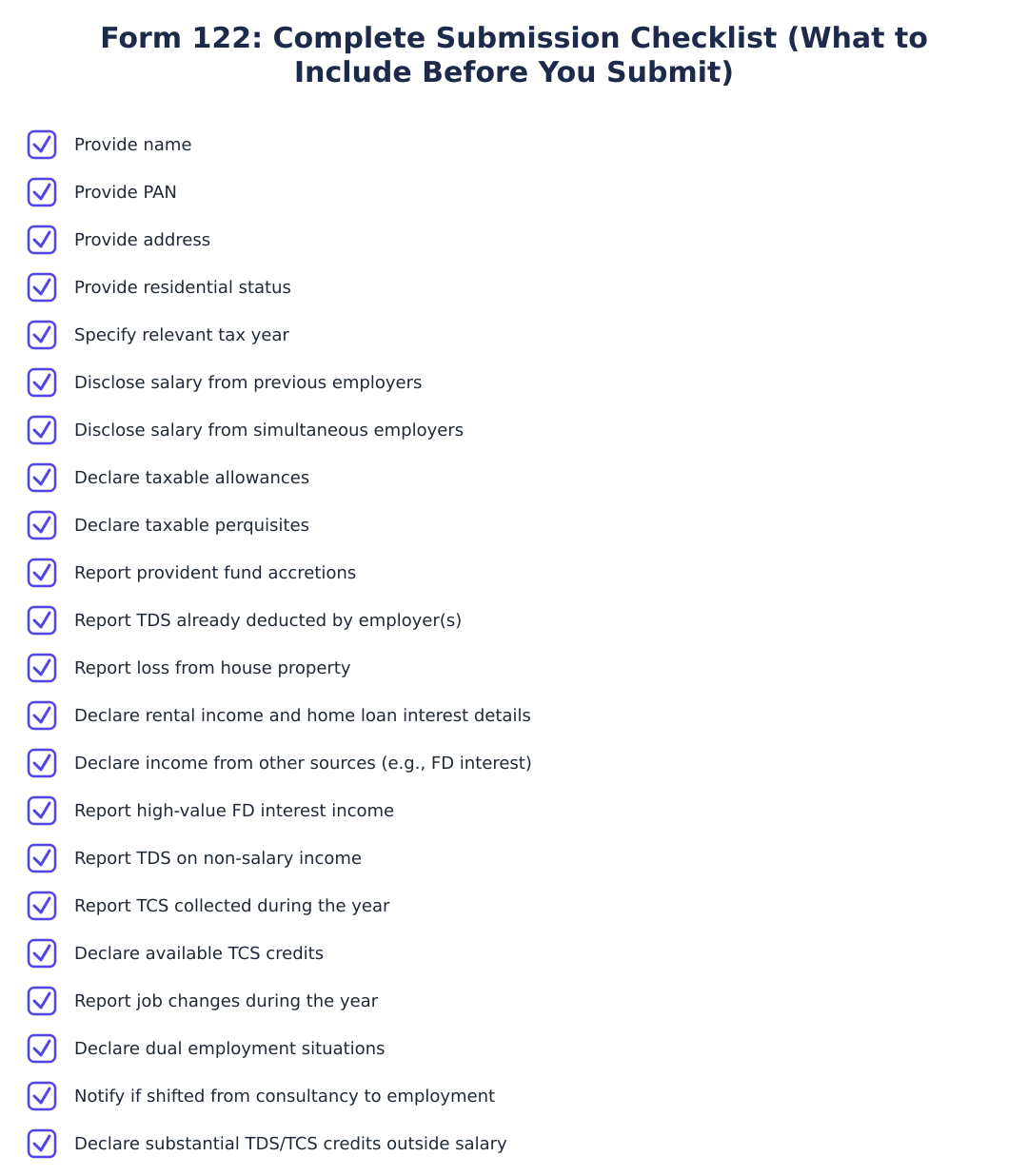
You must provide personal details and a consolidated statement of income and tax credits in Form 122, including name, PAN, address, residential status and the relevant tax year. The income details include salary from previous or simultaneous employers, taxable allowances and perquisites, provident fund accretions, and TDS already deducted by other employers; non-salary entries include income from house property (including losses), other taxable income, and TDS/TCS credits available during the year. The form also asks for specifics like dates of employment changes and amounts already withheld so the current employer can compute accurate TDS. Accurate and complete disclosure is essential because the employer will rely on these entries to calculate monthly deductions and avoid excess withholding.
How does Form 122 help when I switch jobs during the year?
Form 122 helps by allowing you to report salary already received and TDS deducted by your previous employer so the new employer can factor these into the current year’s TDS computation. You should disclose the salary and TDS shown on your previous employer’s Form 16 or payslips so the new employer can avoid double or excess tax deductions across the year. This is particularly useful when you have overlapping employment periods or when tax on earlier salary would otherwise not be considered by the new employer’s monthly TDS calculation. If you join late in the financial year, reporting past salary and deductions through Form 122 reduces the chance of a large refund claim later.
How do I report income from house property or home loan loss in Form 122?
You report loss from house property and related details in Form 122 so your employer can adjust TDS based on the net taxable income for the year. Include the amount of deductible interest on home loan and the computed loss from house property for the relevant tax year; these figures reduce your taxable income and therefore the monthly TDS liability. If the loss is large, declaring it helps lower monthly TDS and prevents excess deduction; however, employers may rely on your declaration and not demand documentary proof immediately, though they can ask for supporting documents later. Remember that certain rules (like set-off limits and carry-forward provisions) for house property loss apply under the Income Tax Act and should be considered when declaring amounts.
Can I include TCS credits and non-salary TDS in Form 122?
Yes, Form 122 allows you to include TCS credits and TDS already deducted on non-salary income so your employer can consider these while computing net TDS liability. Disclose the exact amounts of TDS/TCS shown in Form 26AS or certificates received during the year; these credits offset your overall tax liability and reduce the incremental TDS your employer must deduct from salary. Including these entries prevents over-withholding when you have substantial non-salary tax credits such as TCS on high-value transactions or TDS on FD interest. Keep the supporting evidence (Form 26AS, bank certificates) handy in case the employer requests verification.
What should professionals or consultants who become employees declare in Form 122?
Professionals or consultants who shift to employment should declare prior consultancy income, any provisional TDS paid, and other taxable receipts in Form 122 so the employer can factor them into the year’s total tax computation. This includes income earned before joining as an employee, TDS deducted on that income, and expected non-salary receipts for the remainder of the year; failing to disclose such amounts can lead to excess deduction from salary. Declaring prior professional income also helps the employer estimate annual taxable income and apply correct tax slabs and exemptions when computing monthly TDS. If you expect recurring consultancy payments or have receivables, mention them explicitly so monthly withholding reflects the real annual tax position.
What happens if I under-declare or over-declare information in Form 122?
If you under-declare income or tax credits in Form 122, your employer will deduct lower TDS and you may face a tax liability and interest at filing time; if you over-declare deductions or losses, you might pay less TDS during the year but may need to justify claims and could face penalties if declarations are false. Employers generally rely on employee declarations to compute TDS but can request supporting documents; incorrect declarations can result in reassessment of tax liabilities and interest under the Income Tax Act. To avoid disputes and interest, ensure figures are accurate and backed by documentation (Form 16, Form 26AS, loan statements) and update the form if material information changes during the year. If you discover an error after submission, inform your employer promptly so TDS can be corrected going forward or necessary adjustments made at year-end.
When should I submit Form 122 to my employer and can I update it?
You should submit Form 122 at the start of employment or as soon as material information (like previous salary or additional income) becomes available during the tax year, and you can update it if your income or tax-credit situation changes. Employers use the declaration to compute monthly TDS, so early submission helps ensure correct withholding; typical practice is to provide it along with joining formalities or at the beginning of the financial year. If you change jobs mid-year, gain new sources of income, or receive additional TDS/TCS credits, immediately update the employer with a revised Form 122 so future deductions are adjusted. Timely updates reduce the likelihood of excess TDS and the need for large refunds when filing the income tax return.
Will my employer still ask for proofs if I submit Form 122?
Yes, while Form 122 consolidates declarations, employers may still request supporting documents (like Form 16 from previous employers, Form 26AS, home loan interest certificates or TDS certificates) before accepting certain claims for TDS computation. The employer relies on your declared figures but has the right to verify material items that reduce taxable income, especially large deductions or losses, to avoid future disputes with tax authorities. Some employers may provisionally accept declarations and demand proof only if amounts are unusually high or flagged during payroll checks; others may require documentation at submission. Keep original certificates and electronic records ready so you can validate the figures you declared when asked.
Need help staying Income Tax compliant?
MoneyGence's AI Finance OS tracks your compliance, wallet share, and finances in one place, built for agencies and growing businesses.
Get started with MoneyGence