FEMA Compliance Guide – Foreign Exchange Management Act, 1999
This guide explains FEMA compliance under the Foreign Exchange Management Act, 1999 (FEMA) and what businesses and resident individuals in India must know about reporting and regulatory obligations. You will learn what FEMA covers, who it applies to, the principal categories of transactions it regulates, the common statutory returns and transactional forms used for reporting, and the practical consequences of non-compliance. The focus is on practical clarity: which transactions fall under capital-account vs current-account treatment, which statutory filings are typically required when foreign investment or cross-border transactions are involved, and how the Reserve Bank of India (RBI) and authorised banks fit into the compliance chain. Understanding these basics helps businesses structure foreign investments and cross-border arrangements in line with Indian law and avoid enforcement risks. This guide is aimed at company secretaries, finance teams, foreign investors, and professional advisors who must ensure accurate reporting of foreign liabilities and assets, route transactions through authorised channels, and seek required approvals for restricted sector transactions. The information is based solely on the provisions and notifications that define FEMA’s scope and common reporting mechanisms under RBI rules.
What is FEMA Compliance?
FEMA compliance refers to meeting the regulatory and reporting requirements set out under the Foreign Exchange Management Act, 1999. FEMA replaced the earlier Foreign Exchange Regulation Act (FERA) and is the principal law that governs how foreign exchange transactions involving residents in India are conducted and reported.
Under FEMA, the Central Government and the Reserve Bank of India (RBI) have powers to regulate and supervise payments or receipts made to any person outside India. The statute establishes the legal framework for permitting, restricting, or supervising cross-border flows so that foreign exchange is managed in a structured manner.
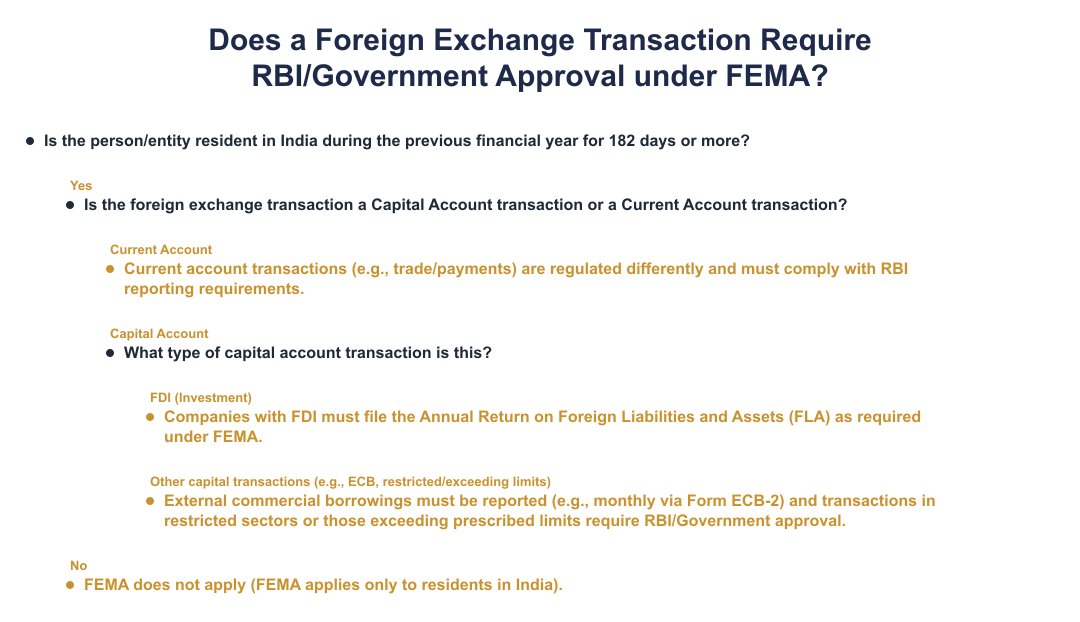
A key feature of FEMA is that it classifies foreign exchange transactions into two broad categories, Capital Account and Current Account, which helps determine the nature of permissions, reporting and regulatory treatment applicable to each transaction.
Who must comply: residency and scope
FEMA applies to Indian residents in India. The application criteria include being resident in India during the previous financial year for 182 days or more. This residency test determines whether a person or entity is subject to FEMA’s regulatory regime.
The scope of FEMA covers cross-border transactions such as foreign investments into India, external commercial borrowings, and overseas direct investments by Indian residents. The law aims to facilitate external trade and help maintain stable foreign exchange markets while providing a mechanism for regulatory oversight.
Common statutory forms and report types used under FEMA
| Form / Report |
|---|
| FC-GPR (Foreign Currency - Gross Provisional Return) |
| FC-TRS (Foreign Currency - Transfer of Shares) |
| ODI (Overseas Direct Investment) |
| LLP-I (Limited Liability Partnership reporting) |
| CN (Convertible Notes) |
| ESOP (Employee Stock Options Plan reporting) |
| DI (Downstream Investment) |
| DRR (Depository Receipts) |
| InVi (Investment Vehicle that has issued its units to a person resident outside India) |
| Annual Return on Foreign Liabilities and Assets (FLA) for companies with FDI |
Mandatory compliances and approvals
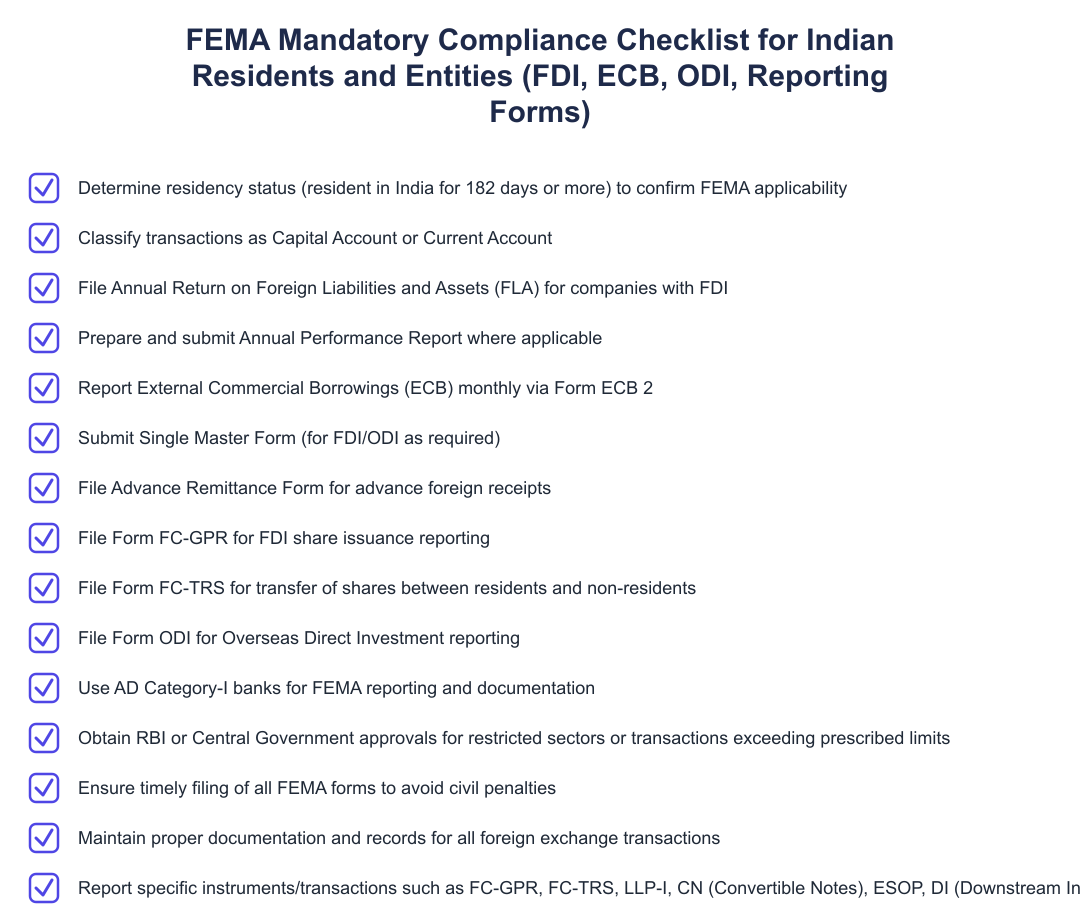
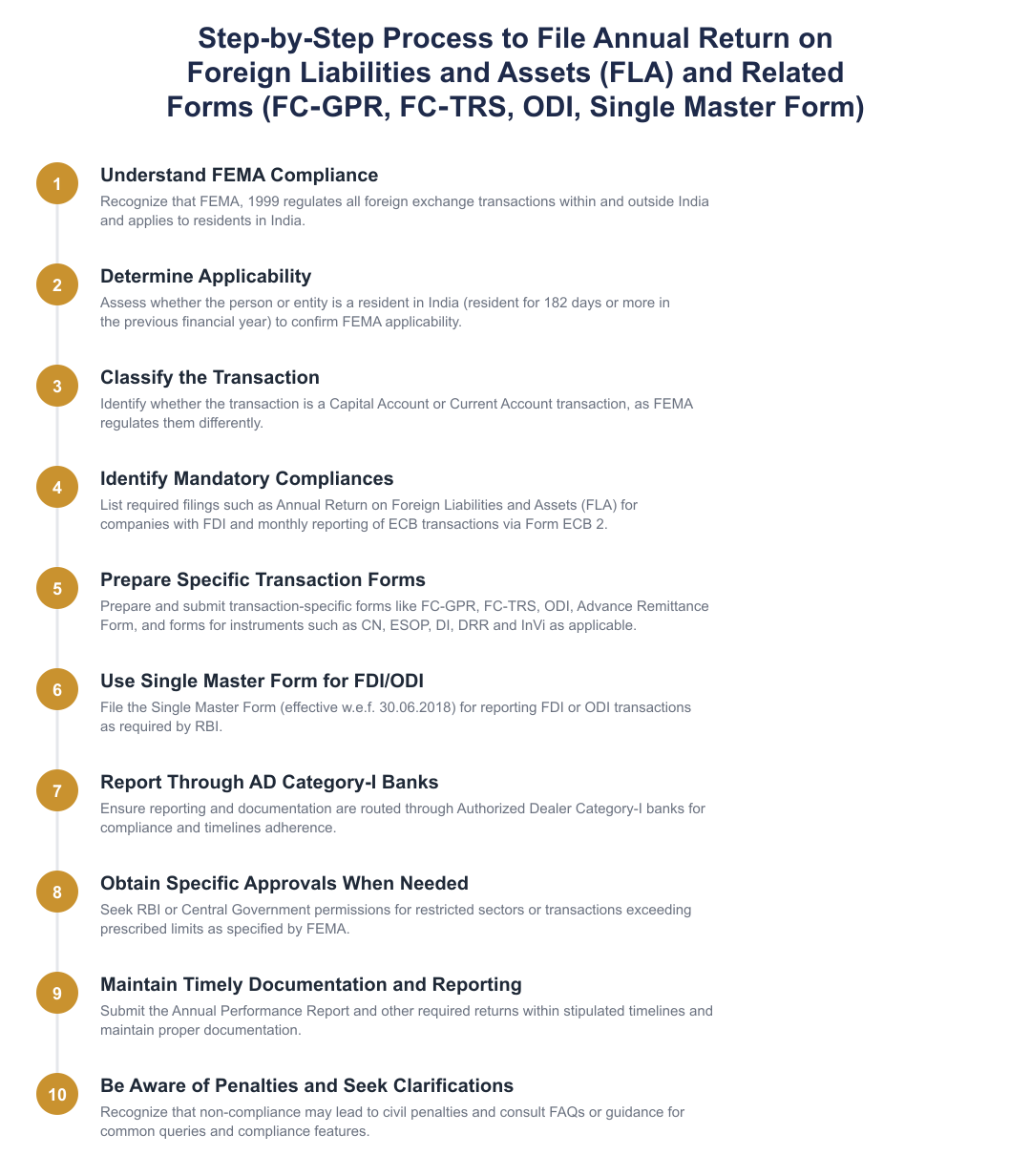
Companies that receive foreign direct investment (FDI) have a statutory obligation to file an Annual Return on Foreign Liabilities and Assets (FLA). This return captures a company’s foreign liabilities and assets and is a cornerstone of compliance for entities with inbound foreign investment.
Certain transactions and sectors are subject to additional control: FEMA and RBI rules require specific approvals where sectors are restricted or transactions exceed prescribed limits. When such approvals are required, they must be obtained from the relevant authority before consummating the transaction.
All transactions that fall under FEMA regulatory scope must comply with RBI’s reporting requirements and are required to be routed and reported through Authorised Dealer (AD) Category-I banks. These authorised banks act as reporting intermediaries and help ensure that transactional data reaches the regulator in the prescribed form.
Consequences of non-compliance and practical implications
Non-compliance with FEMA’s reporting and approval requirements can attract civil penalties and enforcement actions. That risk underscores the importance of timely and accurate filings and of following prescribed processes for permissions in restricted cases.
Practically, businesses should have internal controls to identify transactions that are capital account in nature (for example, investments and financial positions) versus current account transactions (such as trade-related receipts and payments), because the classification affects the regulatory and approval pathway under FEMA.
Because FEMA’s framework involves multiple stakeholders, the Central Government, RBI, and authorised banks, organisations often coordinate closely with their bankers and legal or compliance advisors to ensure correct form filing and to determine whether any prior approvals are necessary.
Frequently Asked Questions
Q: Does FEMA apply to Indians living abroad? A: FEMA applies only to Indian residents in India; the residency test includes being resident in India during the previous financial year for 182 days or more. Therefore, Indian citizens residing outside India are not within FEMA’s application on that basis.
Q: Which authority supervises foreign exchange transactions? A: FEMA authorises the Central Government to impose restrictions and supervise payments or receipts made to persons outside India, and the Reserve Bank of India administers reporting and regulatory mechanisms under the Act.
Q: What are typical reporting channels? A: Transactions that fall under FEMA must comply with RBI’s reporting requirements and be routed/reported through Authorised Dealer (AD) Category-I banks. Various transaction-specific forms (listed above) are used to report different types of foreign investment and cross-border transactions.
FEMA governs cross-border currency and investment flows for Indian residents, dividing transactions into capital and current account categories and requiring specific filings and approvals in defined situations. Companies with FDI must file an Annual Return on Foreign Liabilities and Assets, and many transactions are reported through authorised banks using prescribed forms. Because non-compliance can lead to civil penalties, businesses should maintain robust processes, work with their AD Category-I banks, and seek required approvals where transactions fall in restricted sectors or exceed prescribed limits.
Frequently asked questions
What is FEMA compliance and who needs to follow it in India?
FEMA compliance means following the rules of the Foreign Exchange Management Act, 1999 that regulate all foreign exchange transactions in India; it applies to persons and entities resident in India (residency usually being 182 days or more in the previous financial year). FEMA covers cross-border payments, receipts, foreign investments, external commercial borrowings (ECB) and overseas direct investments (ODI), and requires specific reporting and permissions for certain transactions. Non-resident Indians who are resident outside India typically fall outside FEMA but residents, Indian companies, LLPs and other entities carrying out foreign exchange transactions must comply. Compliance often involves filing specified forms with the Reserve Bank of India (RBI) or authorised dealer (AD) Category-I banks within stipulated timelines.
What are the mandatory filings under FEMA that companies with foreign investment must do?
Mandatory FEMA filings for companies with foreign investment typically include the Annual Return on Foreign Liabilities and Assets (FLA), submission of FC-GPR or FC-TRS for share issuance/transfers, and other transaction-specific filings such as ODI and Single Master Form where applicable. Companies receiving FDI must file the FLA annually with RBI if they have foreign investment, and must also report FDI inflows via FC-GPR for issuance of shares or FC-TRS for transfer of shares within the prescribed timelines. Additionally, entities involved in overseas direct investment must file Form ODI and those availing external commercial borrowings must report ECB transactions regularly, usually monthly via ECB reporting forms.
What is the Annual Return on Foreign Liabilities and Assets (FLA) and who must file it?
The Annual Return on Foreign Liabilities and Assets (FLA) is a mandatory annual return that Indian companies with foreign direct investment must file with the RBI to report foreign equity and liabilities. It captures details of foreign investments, FDI inflows, foreign liabilities and assets as at the end of the financial year and must be filed by companies that have received foreign investment during the year. The filing timelines are set by RBI and non-filing can attract penalties, so companies should coordinate with their AD Category-I bank or authorised reporting entity to ensure timely submission. The FLA helps RBI monitor foreign investment positions and compliance with FEMA limits and sectoral caps.
What is the Annual Performance Report (APR) under FEMA and when is it required?
The Annual Performance Report (APR) is a report required under FEMA for certain overseas direct investments (ODI) to provide RBI with the investee company's yearly performance and compliance details. It must be filed by Indian entities that have made ODI to inform RBI about financial results, changes in shareholding, and other material developments in the overseas entity. APR timelines and exact content are prescribed by RBI and non-compliance can lead to action, so entities should file APRs through their authorised AD Category-I bank or directly with RBI as required. The APR ensures continued regulatory oversight of Indian outward investments under FEMA norms.
How do I report External Commercial Borrowings (ECB) under FEMA?
You must report External Commercial Borrowings (ECB) under FEMA by submitting monthly ECB returns (such as Form ECB 2 or other prescribed reporting) to the RBI through your authorised AD Category-I bank, and by complying with sectoral caps, end-use restrictions and maturity requirements. ECBs also require adherence to prescribed limits, recognized lenders, and purpose restrictions; some ECBs need prior approval while others are under the automatic route depending on the amount and lender type. Timely monthly reporting is mandatory to allow RBI to monitor external debt, and failure to report or breaches of ECB conditions can attract penalties and remedial directions. Your AD Category-I bank usually helps collate documentation and submit reports to RBI on your behalf.
What is the Single Master Form (SMF) and when should it be used?
The Single Master Form (SMF), effective from 30.06.2018, is the consolidated online form mandated by RBI for reporting foreign investment transactions such as FDI, ODI, and other cross-border investments to simplify reporting and centralize information. Investors and Indian entities must use the SMF to report fresh FDI inflows, issuance of shares, and other specified foreign investment transactions through authorised AD Category-I banks within the timelines prescribed by RBI. The SMF replaces several earlier forms and helps RBI track compliance, sectoral limits and inflows; incorrect or delayed SMF filing can result in compliance notices or penalties. AD Category-I banks typically assist filers in submitting the SMF and ensuring the correct transaction codes (like FC-GPR/FC-TRS entries) are used.
When should I file FC-GPR and FC-TRS forms and what are they for?
You should file FC-GPR (Foreign Currency-Gross Provisional Return) when issuing shares to a non-resident against consideration in foreign currency or abroad, and file FC-TRS when reporting transfer of shares to or from a non-resident, both within the timelines specified by RBI and through an AD Category-I bank. FC-GPR records the allotment of shares to foreign investors and is necessary for issuance of shares under FDI routes; FC-TRS documents share transfers between residents and non-residents or among non-residents and records changes in foreign shareholding. Timely and accurate filing of these forms ensures compliance with FEMA limits, sectoral caps and pricing guidelines; delays can attract penalties or require regularisation of the transaction. Banks usually require supporting documents (valuation, board resolutions, share certificates) to process these filings.
Do Indian residents need RBI permission for all capital account transactions under FEMA?
No, Indian residents do not need RBI permission for all capital account transactions; FEMA classifies transactions into current account and capital account, and many capital account transactions are permitted under automatic routes while restricted or large-value transactions require prior RBI or government approval. For example, routine current account payments (like trade) are generally allowed, but certain capital account activities such as investments beyond prescribed limits, dealings in foreign exchange, or transactions in restricted sectors require specific RBI approvals. The need for permission depends on the transaction type, sectoral caps, thresholds and whether an automatic route exists; AD Category-I banks can advise on whether a specific transaction needs prior approval. Non-compliance with approval requirements can lead to civil penalties and directions for regularisation.
What are the consequences of non-compliance with FEMA reporting and filing requirements?
Non-compliance with FEMA reporting and filing requirements can attract civil penalties, directions from RBI for regularisation, and potential restrictions on future foreign exchange transactions; penalties can be substantial depending on the breach. RBI may demand repayment, levy fines or initiate enforcement actions for late or incorrect filings such as missing FLA returns, delayed FC-GPR/FC-TRS/ODI filings, or ECB reporting lapses. To avoid penalties, entities should file through AD Category-I banks within prescribed timelines, maintain proper documentation and seek remedial regularisation promptly if an omission occurs. Repeated or serious non-compliance can also lead to reputational damage and difficulties in obtaining future approvals or foreign funding.
Need help staying Compliance compliant?
MoneyGence's AI Finance OS tracks your compliance, wallet share, and finances in one place, built for agencies and growing businesses.
Get started with MoneyGence