FEMA Compliance Checklist: RBI, FDI, ODI & ECB Guide
This guide gives a practical compliance checklist for businesses and individuals who deal with cross‑border transactions under Indian foreign exchange law. You will learn what areas typically require attention, how to build internal processes to manage approvals and reporting, what documentary records to maintain, and how to work with banks and regulators to reduce risk. The aim is to convert high‑level legal obligations into an operational checklist you can use to assess readiness, train staff, and prepare for reviews. While this article does not replace professional advice for a particular transaction, it will help you identify the usual touchpoints where errors occur and what controls to prioritise. Understanding these touchpoints matters because foreign exchange and outward/inward transactions attract regulatory scrutiny; early process design and disciplined recordkeeping make compliance routine rather than reactive. The guide assumes basic familiarity with international payments and corporate finance and is targeted at finance teams, company secretaries, compliance officers, promoters of startups with foreign investors, and resident individuals engaged in cross‑border investments or receipts. Note: references to the governing law use the formal name of the statute where relevant.
What is the governing law and why it matters
FEMA refers to the Foreign Exchange Management Act, 1999. This statute provides the legal framework that governs foreign exchange transactions, cross‑border capital flows and related permissions in India. For any resident or entity engaged in receiving funds from abroad, investing outside India, or entering into foreign currency contracts, understanding the broad remit of this law is the starting point for compliance design.
In practice, compliance under the foreign exchange regime affects several business processes: contract negotiation (especially payment terms and currency clauses), bank instructions for inflows/outflows, corporate approvals for foreign investments, documentation for inbound investment, and regular internal reporting. Treating the law as an operational input, not only a legal checklist, helps teams reduce delays and avoid preventable breaches.
Core areas to include in your FEMA/RBI compliance checklist
Map all cross‑border touchpoints across the business: inward receipts from non‑residents, outward remittances, investments abroad by residents, loans or borrowings in foreign currency, and hedging arrangements. For each touchpoint, identify the authorisation/notification requirement, the internal approval chain, and the bank or regulatory interaction that must occur before or after the transaction.
Ensure the checklist captures: whether prior approval or reporting is required for a given transaction; the documents to be collected and retained by the company; timeframes for any post‑transaction reporting; the role of the authorised dealer bank (usually the bank handling the forex transaction); and the person or function accountable for filing or following up. Making these items explicit reduces ambiguity during transactions and audits.
Documentation and recordkeeping, practical controls
Create standard document packs for common foreign exchange events: an inward investment pack, an outward investment pack, import‑payment pack, remittance pack for royalties or fees, and loan/borrowing pack. Each pack should list the mandatory documents to be obtained from the counterparty, board resolutions or authorised signatory approvals, invoices and contracts, bank acknowledgements, and any certificate or declaration required by the bank.
Implement retention and indexing rules so that documents supporting a specific transaction are retrievable during routine internal review or regulatory inspection. Having a control log that records the transaction date, approving person, bank references and filing status helps maintain traceability and demonstrates governance.
Operating with banks and the regulator, who to involve and when
Designate a small number of authorised dealer banks to handle your foreign exchange needs and formalise service protocols with them. Banks are typically the operational gateway for permissions and reporting; clear communication channels and documentation standards with your banking partner shorten turnaround times and reduce rework.
Before initiating a cross‑border transaction, confirm with your bank what declarations, certifications or forms they will require. Establish a standard pre‑transaction checklist that must be completed and approved internally before the treasury or the bank executes the payment or receipt. For post‑transaction compliances, keep a calendar of reporting obligations and assign responsibility for follow‑up with the bank or regulator.
Maintenance of internal processes and training
Embed the compliance checklist into routine workflows: treasury payment runs, investor onboarding, statutory audit preparation and board reporting. Use simple templates and approval matrices so that operational teams know when to pause for compliance checks and which signatories are required.
Conduct periodic training for finance, legal and operations teams on process changes, common deficiencies found in past filings, and lessons from any regulatory guidance. Regular internal review cycles, such as quarterly compliance health checks, will surface gaps early and allow corrective action to be implemented before an external review.
A practical FEMA/RBI compliance checklist is built from mapping transactions, standardising documentation, integrating bank interactions, and embedding clear internal approvals. Begin with a simple list of touchpoints, evolve it into transaction‑specific packs, and review the process regularly with your authorised banks. Where transactions are complex or unfamiliar, seek specialist advice to ensure the correct permissions and reporting routes are followed.
Frequently asked questions
Who must file the Annual Return on Foreign Liabilities and Assets (FLA) and when is it due?
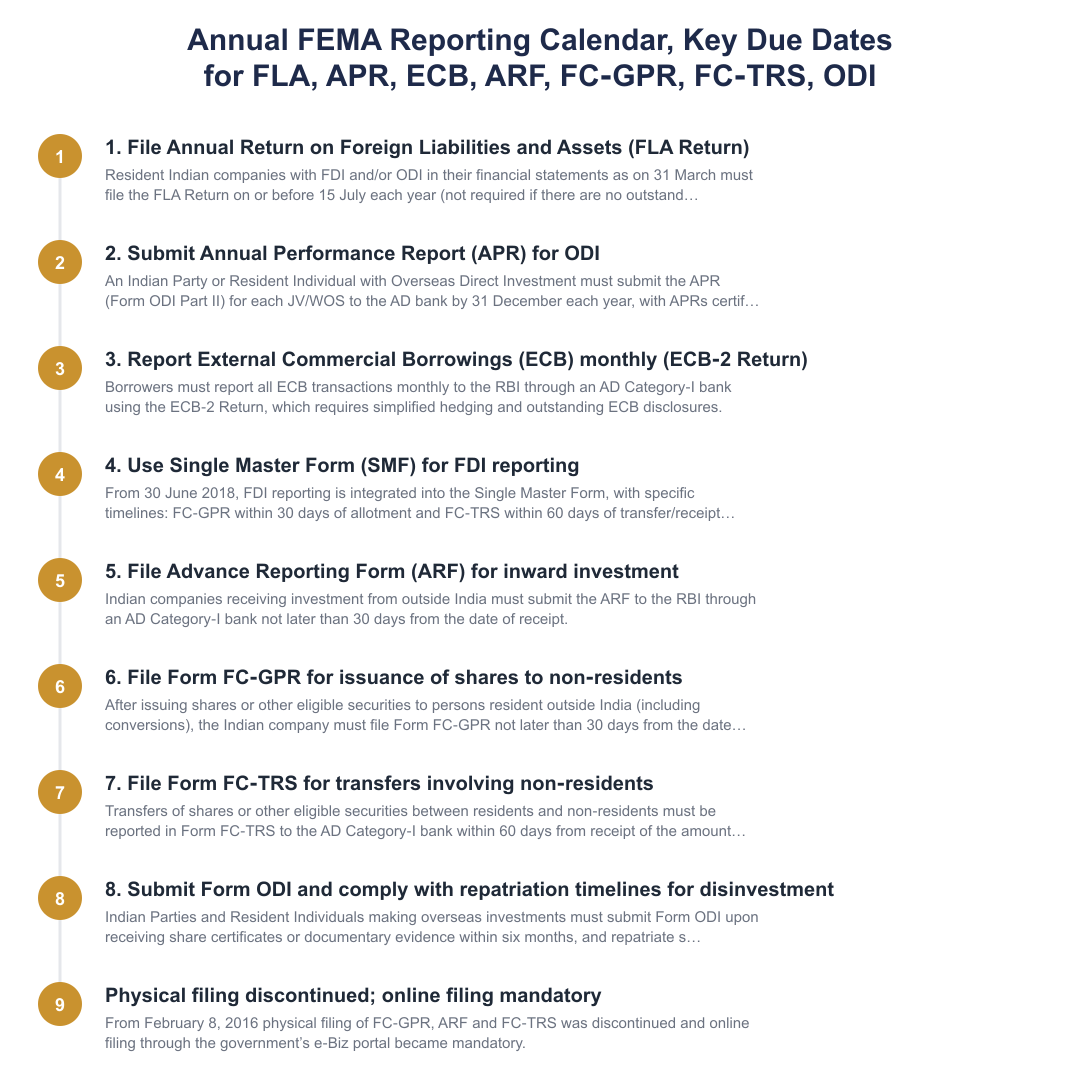
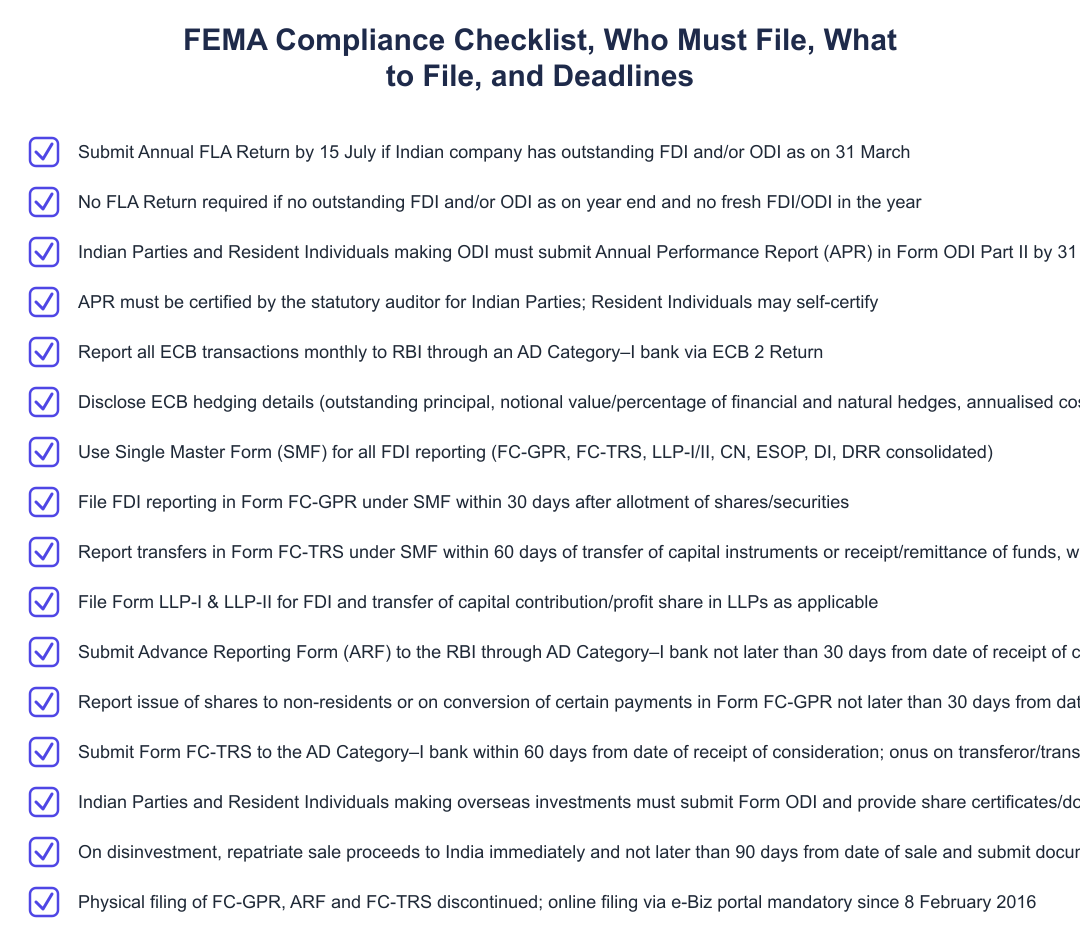
All India resident companies that have received FDI and/or made ODI and therefore hold foreign assets or liabilities in their financial statements as on 31 March must file the FLA Return, and it is due on or before 15 July every year. If the company has no outstanding FDI/ODI as on the reporting date, it need not file; however, if it has outstanding FDI/ODI even without fresh transactions in the latest year, it must still file by 15 July. The return covers all years including the current year and is mandatory for companies showing foreign positions in their balance sheet.
What is the Annual Performance Report (APR) for Overseas Direct Investment and who needs to submit it?
An Indian Party (IP) or Resident Individual (RI) that has made an Overseas Direct Investment (ODI) must submit an Annual Performance Report (APR) in Form ODI Part II to their AD bank for each JV/WOS outside India, and it is due on or before 31 December every year. APRs for Indian Parties must be certified by the statutory auditor, whereas Resident Individuals can self-certify and need not provide auditor certification. The APR tracks the performance of the overseas entity and is required even if the investment is a financial commitment rather than equity.
How often must External Commercial Borrowings (ECB) be reported to the RBI and what is included in the ECB 2 Return?
Borrowers must report all ECB transactions to the RBI monthly through an AD Category‑I bank by filing the ECB 2 Return. The revised ECB 2 Return simplifies hedging disclosure into two baskets, financial and natural, and requires disclosure of outstanding principal and currency, notional value and percentage of outstanding ECB under financial and natural hedges, and the annualised percentage cost of financial hedges for the ECB. Monthly reporting ensures RBI monitoring of external borrowings and associated hedges, and borrowers should coordinate with their AD bank for timely submission.
What is the Single Master Form (SMF) and what FDI reports does it replace?
The Single Master Form (SMF), effective from 30 June 2018, integrates and subsumes multiple FDI reporting forms, FC‑GPR, FC‑TRS, LLP‑I, LLP‑II, CN, ESOP, DI and DRR, into one single master online form for FDI reporting in India. Under SMF, FC‑GPR reporting is required within 30 days after allotment, FC‑TRS within 60 days of transfer or receipt/remittance of funds, and separate LLP and convertible note reporting timelines apply as specified under respective heads. SMF centralises compliance and requires timely online filing through the government e‑Biz portal rather than physical submissions.
What is the Advance Reporting Form (ARF) and when should an Indian company file it?
An Indian company receiving investment from outside India for issue of shares or other eligible securities under the FDI Scheme must file the Advance Reporting Form (ARF) with the Reserve Bank through its AD Category‑I bank not later than 30 days from the date of receipt of funds. ARF reports the amount of consideration received and must be submitted to the concerned RBI Regional Office through the authorised bank. This advance reporting facilitates regulatory tracking of inbound foreign investment prior to subsequent FC‑GPR or SMF filings.
When must Form FC‑GPR and Form FC‑TRS be filed and who bears responsibility for filing?
Form FC‑GPR must be filed by an Indian company not later than 30 days from the date of issue of shares or eligible securities, while Form FC‑TRS for transfer of shares between residents and non‑residents must be submitted to the AD Category‑I bank within 60 days from receipt of the amount of consideration. The onus for FC‑TRS submission lies on the transferor/transferee resident in India; FC‑GPR is filed by the issuing Indian company. Both forms now form part of the Single Master Form framework and should be filed online rather than physically.
What are the reporting requirements and timelines for Overseas Direct Investment (ODI) using Form ODI?
An Indian Party or Resident Individual making an overseas investment must submit Form ODI to the designated AD after receiving share certificates or documentary evidence of investment in the foreign JV/WOS, and do so within 6 months of such receipt. In case of disinvestment, sale proceeds of shares/securities must be repatriated to India immediately on receipt and in any case not later than 90 days from the date of sale, with documentary evidence submitted to the RBI through the designated AD. Form ODI captures initial investment and post‑investment compliance to ensure repatriation and tracking of overseas assets.
Are physical submissions of ARF, FC‑GPR and FC‑TRS still allowed or how are these forms filed now?
Physical filing of ARF, FC‑GPR and FC‑TRS was discontinued from 8 February 2016 and online filing through the government’s e‑Biz portal has been made mandatory. All relevant FDI/ODI/FC‑TRS/FC‑GPR related reports must therefore be submitted electronically via the prescribed portal, and users may need to register as business users to file certain returns like FC‑TRS. This transition to online filing centralises records, speeds processing, and aligns with the Single Master Form regime.
If an Indian company has no fresh FDI/ODI in a year but still has outstanding foreign investment, must it file any annual returns?
Yes, if an Indian company has outstanding FDI and/or ODI as on the end of the reporting year, it must still file the FLA Return by 15 July even if it did not receive any fresh FDI/ODI during the year. The only exception is when the company has no outstanding investment in respect of FDI and/or ODI as on the reporting date; in that case the company need not submit the FLA Return. Hence presence of outstanding foreign liabilities/assets in the balance sheet on 31 March triggers the filing obligation.
Need help staying Compliance compliant?
MoneyGence's AI Finance OS tracks your compliance, wallet share, and finances in one place, built for agencies and growing businesses.
Get started with MoneyGence