ESIC Applicability: Eligibility, Contribution Rates & Coverage
This guide explains the Employees’ State Insurance Corporation (ESIC) and the ESI Scheme: what ESIC is, how the scheme funds and benefits are structured, and the contribution rates that fund employee benefits. You will learn who administers the scheme, the kinds of cash and non-cash benefits available to insured workers, and the current contribution rates after the reduction that took effect on 01/07/2019. Understanding these points matters because the ESI Scheme is a contributory social security mechanism: both employers and employees contribute a fixed percentage of wages to finance medical care and cash benefits such as sickness and maternity support. Knowing the role of ESIC, the nature of benefits, and the contribution structure helps employers comply with obligations and helps employees understand the protections financed by their contributions. This page summarises the statutory administrator, the categories of benefits available under the scheme, how the scheme is financed, and the exact contribution rates in effect after the July 2019 reduction.
Composition of ESIC
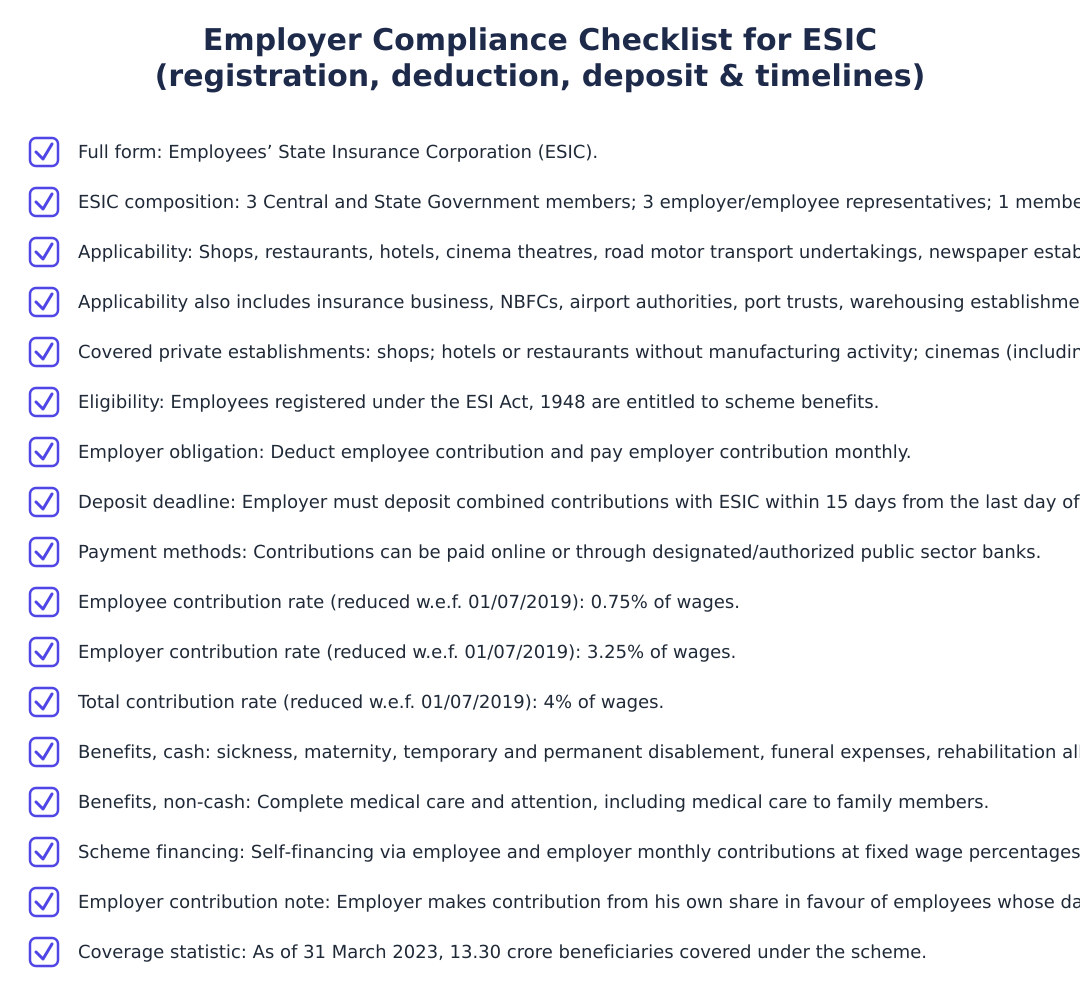
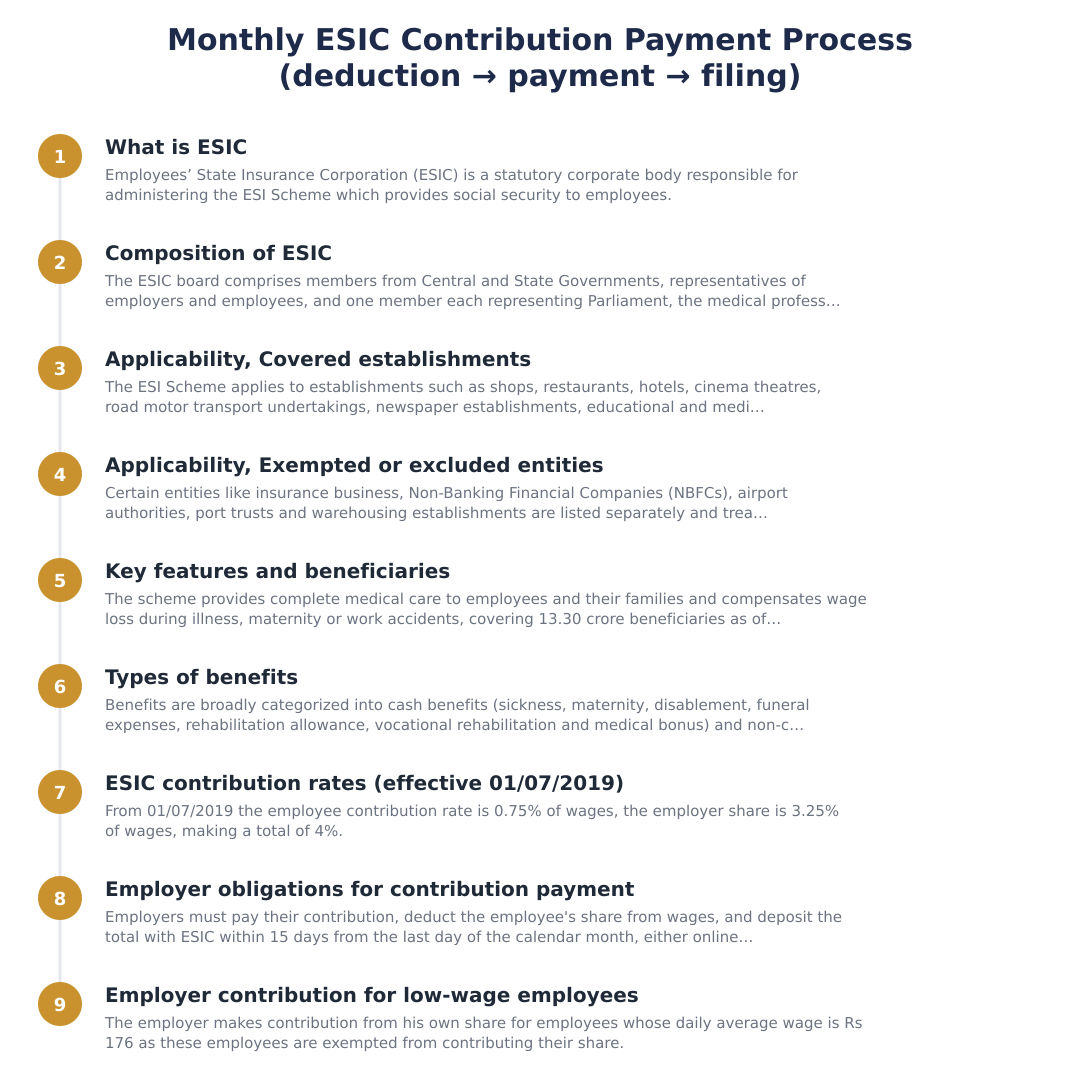
Employees’ State Insurance Corporation (ESIC) is a statutory corporate body responsible for administration of the ESI Scheme. As the statutory administrator, ESIC oversees implementation of scheme provisions and manages the resources and delivery mechanisms that provide benefits to insured persons.
The corporation’s role is to ensure that the scheme operates as a social security safety net, managing funds collected from contributions and arranging for delivery of both cash benefits and medical services under the scheme.
Applicability of the ESI Scheme
The ESI Scheme is a statutory programme governed by the ESI Act, 1948. It applies where the Act’s provisions are invoked and administered by ESIC in accordance with that statute.
Because the scheme is established under the ESI Act, 1948, applicability and specific coverage rules flow from that legislation and the regulations framed thereunder, and ESIC is the authority tasked with administering those provisions.
Features of the ESI Scheme
The ESI Scheme provides two broad categories of benefits to insured persons: cash benefits and non-cash benefits through medical care. Cash benefits include support for sickness, maternity, disablement (both temporary and permanent), funeral expenses, rehabilitation allowance, vocational rehabilitation and a medical bonus.
Non-cash benefits are provided in the form of medical care. The scheme is intended to provide medical attention and related services as part of the social security cover financed by contributions.
Financially, the ESI Scheme is self-financing and contributory in nature. Its funds are primarily built from monthly contributions made by employees and employers at fixed percentages of wages. This contributory model ties the availability of benefits to the collection and management of contribution funds administered by ESIC.
ESIC Contribution Rates
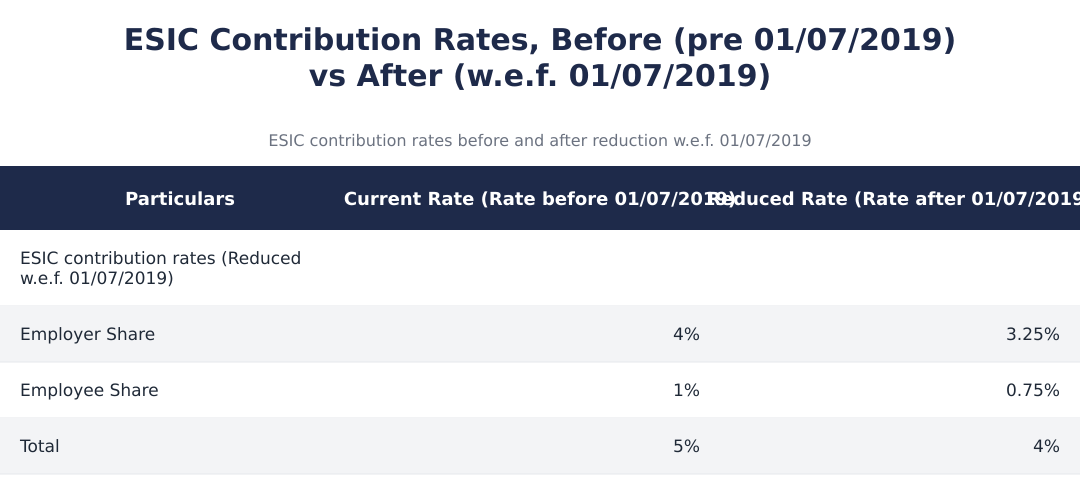
| Particulars | Rate (Reduced w.e.f. 01/07/2019) |
|---|---|
| Employer Share | 3.25% |
| Employee Share | 0.75% |
| Total | 4% |
Frequently Asked Questions
What kinds of benefits does the ESI Scheme provide? The scheme’s benefits are categorised into cash benefits, such as sickness, maternity, disablement (temporary and permanent), funeral expenses, rehabilitation allowance, vocational rehabilitation and medical bonus, and non-cash benefits provided as medical care.
How is the scheme financed? The scheme is self-financing and contributory: funds are primarily generated from monthly contributions by employees and employers calculated as fixed percentages of wages. These contributions are administered by ESIC, which is the statutory corporate body responsible for running the scheme.
In summary, ESIC is the statutory administrator of the ESI Scheme established under the ESI Act, 1948. The scheme funds cash and medical benefits for insured persons through a contributory, self-financing model. The current reduced contribution rates effective from 01/07/2019 are 3.25% for employers and 0.75% for employees, making a combined contribution of 4% of wages.
Frequently asked questions
What is ESIC and what does the ESI Scheme cover?
ESIC (Employees’ State Insurance Corporation) administers the ESI Scheme, which provides cash and non-cash benefits to insured employees and their families. The scheme gives complete medical care and attention, cash benefits for sickness, maternity, temporary and permanent disablement, funeral expenses, rehabilitation allowances, vocational rehabilitation and medical bonuses. It is contributory and self-financing, funded by fixed monthly contributions from employers and employees. As of 31 March 2023, about 13.30 crore beneficiaries were covered under the scheme.
Who is eligible for ESIC coverage under the ESI Scheme?
Employees working in establishments covered by the ESI Act and drawing wages up to the statutory limit are eligible for ESIC benefits. The scheme typically applies to employees in factories, shops, hotels, restaurants, cinemas, road motor transport undertakings, newspaper establishments, educational and medical institutions, and certain contract and casual employees of municipal bodies. Coverage is contribution‑based: employees and employers must pay the prescribed percentage of wages for the employee to be insured. Specific exclusion categories (such as some financial services and certain public authorities) are carved out by the Act and rules.
Which establishments are specifically covered under the ESI Scheme?
The ESI Scheme covers a wide range of establishments including shops, restaurants, hotels, cinema theatres, road motor transport undertakings, newspaper establishments, educational institutions and medical institutions. It also covers contract and casual employees of municipal corporations or municipal bodies as specified under the Act. Coverage depends on the nature of activities and whether the establishment falls within the statutory definitions in the ESI law.
Which establishments are excluded from ESIC coverage?
Certain entities such as insurance businesses, Non‑Banking Financial Companies (NBFCs), airport authorities, port trusts and warehousing establishments are excluded from ESIC coverage. These exclusions are specified in the ESI Act and relevant notifications and mean those employers do not fall under the compulsory contribution framework of ESIC. However, exclusions can vary and some activities closely related to excluded sectors may still be covered depending on the statutory definition.
What are the current ESIC contribution rates for employers and employees?
The current ESIC contribution rates (reduced w.e.f. 01/07/2019) are 3.25% of wages for the employer and 0.75% of wages for the employee, making a total of 4.00%. Prior to 01/07/2019 the combined rate was 5.00% (employer 4% and employee 1%). Contributions are calculated on wages paid and are payable monthly at these fixed percentages to finance the scheme.
Who is responsible for depositing ESIC contributions and by when must they be paid?
The employer is responsible for depositing ESIC contributions: they must deduct the employee share from wages, add the employer share and deposit the combined amount with ESIC within 15 days from the last day of the calendar month in which the contribution falls due. Payment can be made online or through designated authorized public sector banks. Timely monthly deposit is mandatory to ensure continuous coverage and avoid penalties for late payment.
What benefits does an insured person get under the ESI Scheme?
An insured person under the ESI Scheme receives both cash benefits (sickness benefit, maternity benefit, temporary and permanent disablement benefit, funeral expenses, rehabilitation allowance, vocational rehabilitation and medical bonus) and non‑cash benefits through comprehensive medical care. The scheme also provides medical care to family members of the insured person. Cash benefits substitute for loss of wages during illness, maternity or accident-related absenteeism, and medical care aims at restoration of health and working capacity.
How is the ESI Scheme funded and is it contributory?
Yes, the ESI Scheme is contributory and self‑financing, primarily funded by monthly contributions from employees and employers at fixed percentages of wages. Currently the employee contribution rate is 0.75% and the employer contribution rate is 3.25% of wages, collected monthly and deposited with ESIC. These contributions build the fund used to pay cash benefits and provide medical services under the scheme.
How many people are covered under the ESI Scheme and does it include family members?
As of 31 March 2023, the ESI Scheme covered a total of 13.30 crore beneficiaries, and the scheme provides medical care to family members of insured employees. Family coverage means dependents can receive medical treatment through ESIC facilities in addition to the cash benefits payable to the insured employee. The wide beneficiary base reflects both insured workers and their eligible family members under the scheme.
Need help staying Payroll compliant?
MoneyGence's AI Finance OS tracks your compliance, wallet share, and finances in one place, built for agencies and growing businesses.
Get started with MoneyGence