ESI Calculation: How to Compute Employee & Employer Contribution
This guide explains how Employee State Insurance (ESI) contributions are calculated, collected and tracked, and what benefits employees receive under the scheme. You will learn who is responsible for contributing, what part of an employee’s pay is used for ESI deductions, the basic steps an employer follows to register and remit contributions online, and the key employee benefits that flow from ESI membership. Understanding these points matters because correct calculation and timely deposit of ESI contributions protects employees’ access to medical, sickness and maternity benefits, and it keeps employers compliant with the ESI Act. The guide is focused on practical compliance: what gets deducted from pay, who pays, how employers remit contributions online, how employees receive proof of coverage, and the legal consequences of failing to deposit deducted contributions. This is useful for HR teams, payroll professionals and small-business owners who must operate the payroll accurately and ensure workers receive the statutorily mandated social security protections.
Wages as per the ESI Act
Under the ESI framework, the payroll amount used to determine the employee portion of the contribution is the wages paid to the employee. In practice this means payroll teams must identify which components of remuneration constitute 'wages' for the purpose of deduction, because the deduction is applied to the wages paid.
Accurate payroll accounting is therefore important: any misclassification or omission can lead to under‑ or over‑deduction, which affects both employee entitlement and employer compliance. Payroll staff should ensure that the wage figure they use for the ESI deduction reflects the amounts actually paid to the employee in each pay cycle.
Computation of ESI
Contribution towards ESI is a shared obligation: both the employer and the employee make contributions. Employers must therefore compute two separate contribution amounts each payroll period, one that is the employer’s share and one that is the employee’s share, and account for both in payroll records.
Although exact percentage rates and thresholds are not reproduced here, the practical implication is that payroll systems must be configured to calculate and record both parts of the contribution, and to ensure the employee’s portion is actually withheld from wages before remittance.
Employee State Insurance Contribution Collection
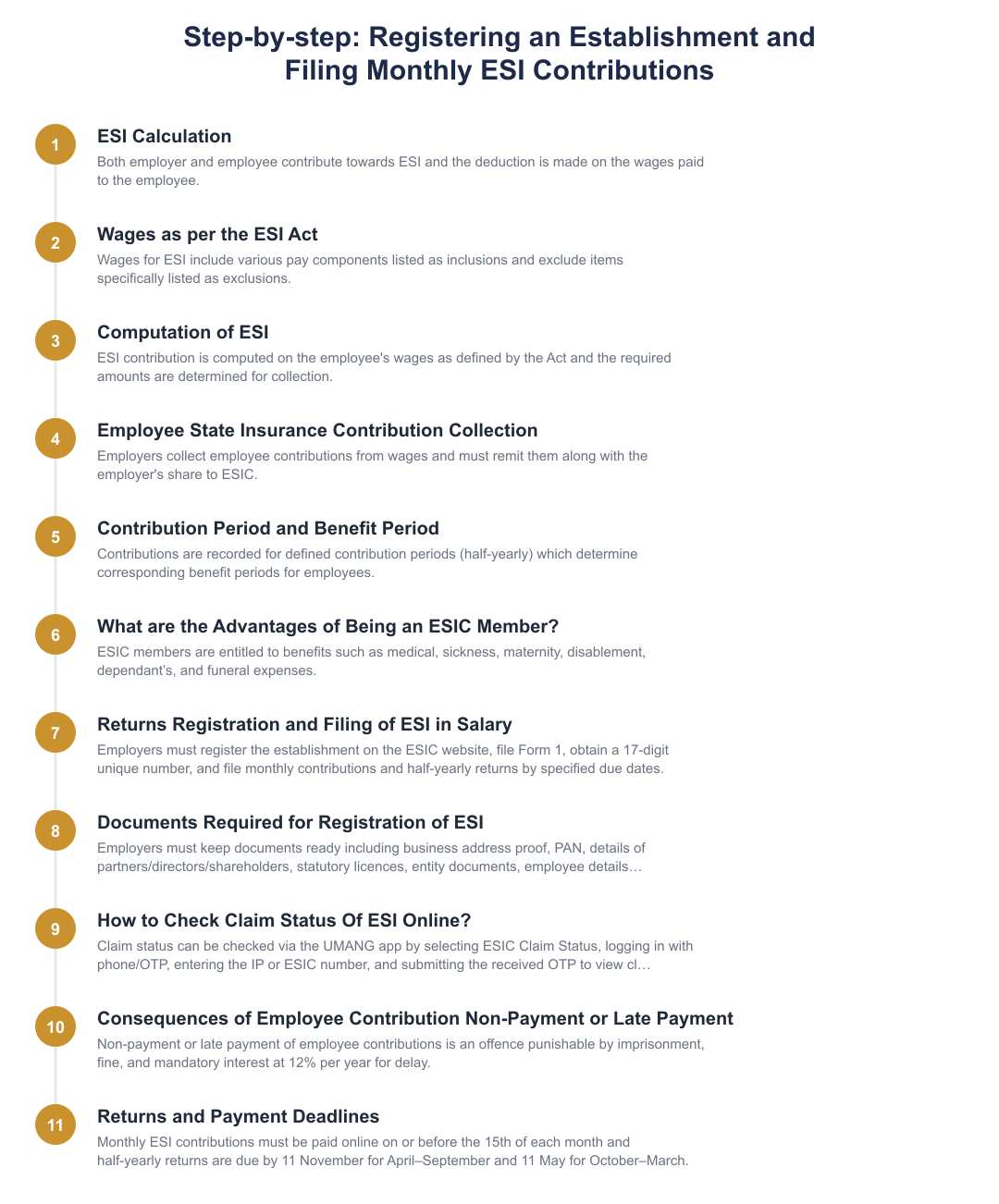
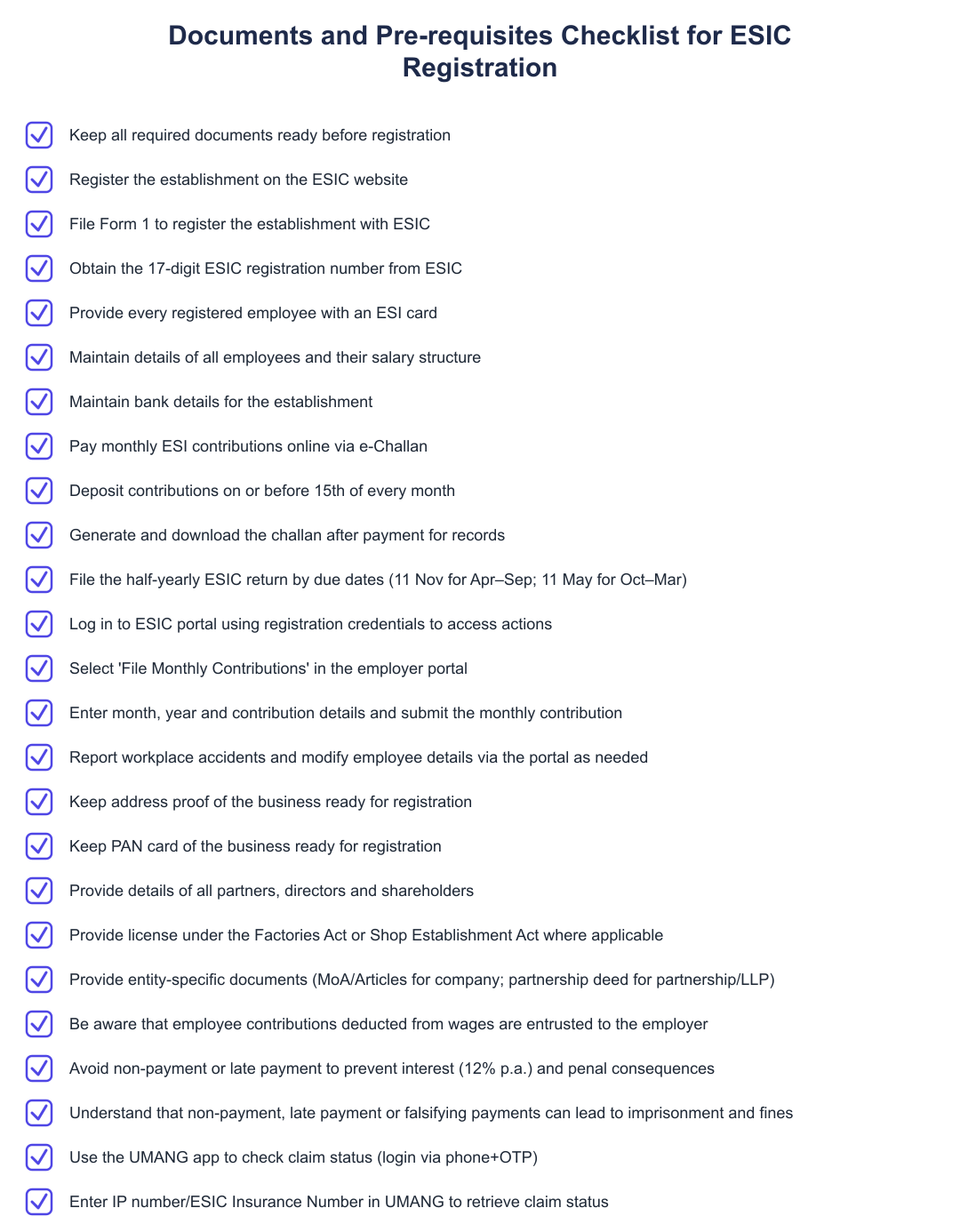
An employer must register on the ESIC website and file Form 1 to register the establishment with ESIC.
Employers must log in to the official ESIC website using the credentials received at registration to perform actions such as modifying employee details, reporting accidents, filing monthly contributions and generating challans.
Employers file monthly contributions through the employer portal and make the payment online.
Employers can pay the monthly ESI contribution amount online on the ESIC website through e-Challan; once payment is complete, the challan can be generated and downloaded for recordkeeping.
What ESI membership gives employees (key benefits)
ESI membership provides a set of social security benefits that protect workers and their families. Among the benefits available are medical care for the employee and dependants, and paid maternity benefits for pregnant women covered under the scheme.
For temporary illnesses, certified sickness benefits are provided at a rate of 70% (in the form of pay) for certified illness lasting up to a maximum of 91 days in any year. These benefits, together with medical and maternity coverage, are the primary employee protections that make accurate contribution and registration essential.
Registration, ESI card and employer responsibilities
When an employer completes registration and files the required Form 1, each registered employee receives an ESI card that records their details. The card functions as proof of coverage and is issued following employer registration.
Beyond registration, employers have ongoing responsibilities: use the ESIC portal with the credentials issued at registration to maintain employee records, file monthly contributions and generate challans. Maintaining accurate employee data and keeping copies of challans helps preserve employees’ access to benefits and provides evidence of compliance.
Consequences of employee contribution non-payment or late payment
Contributions that have been deducted from an employee’s wages are treated as entrusted to the employer for deposit with ESIC. Because the employee’s portion is deducted from pay, the employer bears particular responsibility to ensure those amounts are deposited with ESIC.
Non-payment or late payment of an employee’s contribution that has been deducted from his or her wages is a punishable offence under the ESI Act. Employers should prioritise timely remittance and maintain records of payments (challans) to avoid enforcement action under the Act.
Accurate ESI calculation and prompt deposit are essential for protecting employees’ access to medical, sickness and maternity benefits and for keeping employers compliant with the ESI Act. Employers should register promptly, use the ESIC portal to file monthly contributions and download challans, with payroll teams ensuring wages are correctly identified for deduction and both employer and employee shares are recorded. Proper processes and documentation reduce the risk of non‑payment issues and help employees enjoy the social security protections intended by the scheme.
Frequently asked questions
Who pays ESI contributions, the employer or the employee?
Both the employer and the employee contribute to the Employee State Insurance (ESI) scheme; the employer deducts the employee’s share from wages and also pays the employer’s share. The deduction is calculated on wages as defined under the ESI Act (including basic pay, dearness allowance and many allowances listed under ‘inclusions’) and must be deposited with ESIC by the employer by the 15th of every month. The employer is responsible for collecting the employee portion from wages and depositing the total contribution online via the ESIC portal, and failure to do so attracts interest and penal consequences. For registration and monthly filing the employer must be registered on ESIC and use the 17-digit establishment number issued at registration.
What counts as ‘wages’ for ESI calculation, what is included and excluded?
Wages for ESI include basic pay, dearness allowance and a wide range of specific allowances such as overtime, house rent allowance, conveyance, medical allowance, shift and location allowances, attendance bonus, cash handling allowance, and many more listed under ‘inclusions’. Exclusions from ESI wages include items like washing allowance, annual bonus, incentive/production bonus, gratuity on retirement, commission to agents, service charges, fuel/petrol allowance, and payments on account of leave encashment or strike-related ex-gratia, as enumerated under ‘exclusions’. Only components classified as wages under the ESI Act are subject to contribution; non-wage payments and explicitly excluded items must not be considered in ESI gross wages. Employers should maintain payroll documentation to justify included and excluded components in case of inspection.
How do employers register for ESI and what documents are required?
An employer registers for ESI by creating an account on the ESIC website and filing Form 1 to register the establishment, after which ESIC verifies details and issues a 17‑digit unique establishment number used for all filings. Required documents include address proof of the business, PAN of the business, identity and details of partners/directors/shareholders, a licence under the Factories Act or Shop Establishment Act where applicable, entity-specific documents (e.g., MoA/AoA for companies or partnership deed), details of employees and their salary structure, and bank details. After registration every employee receives an ESI card with their details entered by the employer; employers should keep original documents ready for reference during registration and verification. Employers can then use those credentials to file monthly contributions and generate challans online.
How do you compute ESI contributions and when must they be paid?
ESI contribution is computed on wages payable to employees as per the ESI Act, with the employer deducting the employee share from wages and adding the employer share to make the total depositable amount; this contribution must be paid online to ESIC on or before the 15th of every month. Employers must log in to the ESIC portal, select ‘File Monthly Contributions’, enter month, year and contribution details, submit and then ‘Generate Challan’ to download and retain for records. Additionally, employers must file half‑yearly returns: the April–September return by 11 November and the October–March return by 11 May; adherence to these dates is mandatory to avoid penalties. The employer is the custodian of employee contributions and is legally responsible for timely remittance of the entire amount to ESIC.
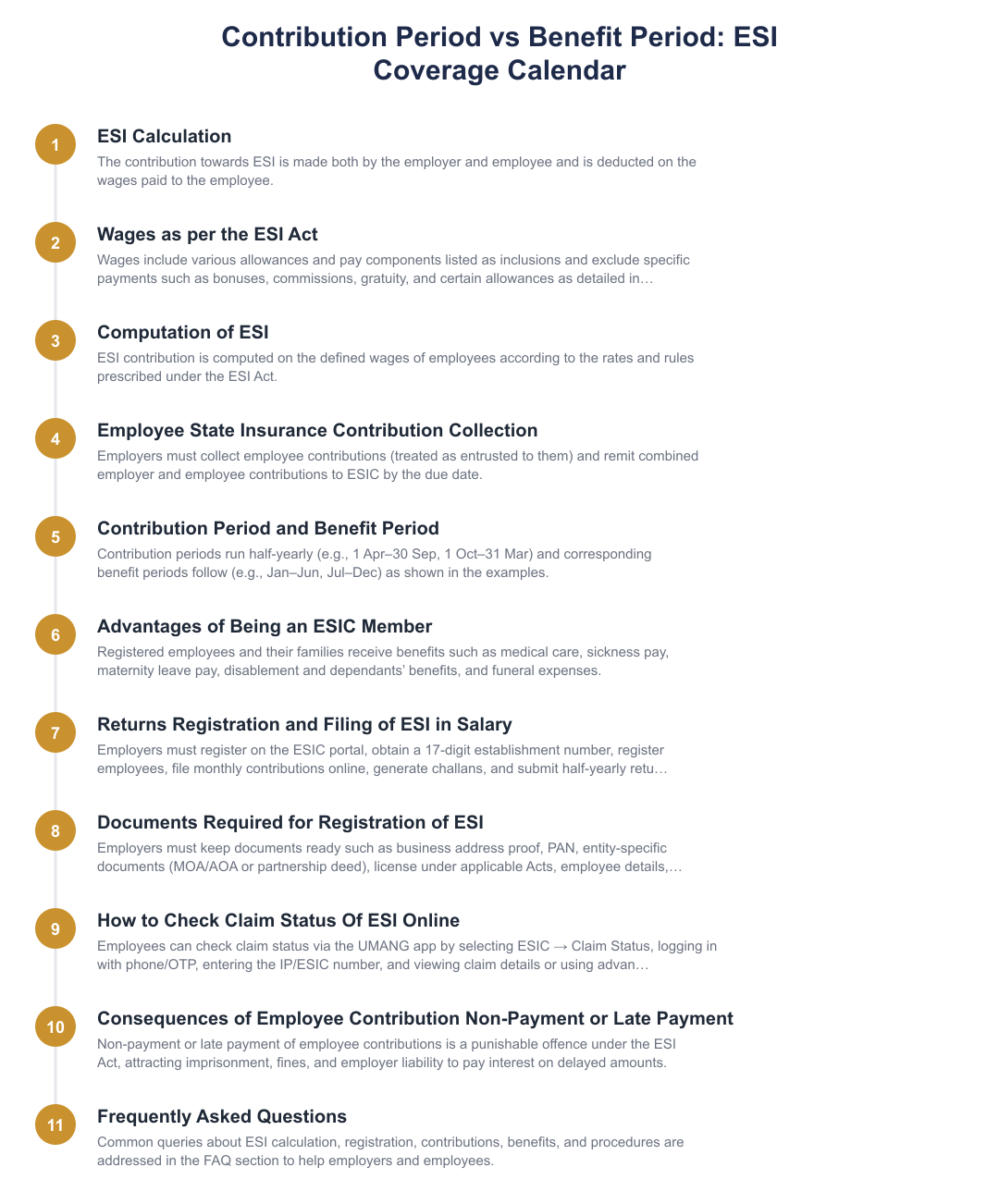
What are the contribution period and benefit period under ESIC?
The contribution period consists of the six‑month blocks during which contributions are collected (for example, 1 April–30 September or 1 October–31 March), while the benefit period is the subsequent six‑month block during which benefits are available (for example, contributions for 1 April–30 September give benefits for 1 January–30 June of the next year). The guide provides examples: if salary revision for an employee is in July 2020, the contribution period is 1 April–30 September 2020 and the corresponding benefit period is 1 January–30 June 2021; if salary revision is in November 2020, contributions for 1 October–31 March 2021 correspond to benefit period 1 July–31 December. Employers must ensure correct contribution recording in the relevant contribution period because entitlement to benefits depends on contributions credited in the correct period.
What benefits do employees and families get under ESIC?
ESIC members receive a range of cash and medical benefits, including sickness benefit at 70% of pay for certified illness up to 91 days a year, comprehensive medical benefits for the employee and family, paid maternity leave for pregnant women, and disablement benefits at 90% of wages for temporary and specified permanent disablement. In case of death due to employment injury, dependents receive 90% of pay monthly for life, and funeral expenses of Rs.15,000 are payable; dependents’ and other benefits like disablement pensions are subject to medical board certification and statutory conditions. These statutory benefits are available provided contributions were made for the relevant contribution and benefit periods and claim procedures under ESIC are followed.
How can employers pay ESI contributions and generate a challan?
Employers pay ESI contributions online through the ESIC website by logging in with registration credentials, selecting ‘File Monthly Contributions’, entering the month, year and contribution details, submitting, and then using the ‘Generate Challan’ option to download the e‑challan. The downloaded challan must be preserved for future reference and inspections as it evidences payment; employers routinely maintain these records as part of compliance. ESIC also allows electronic payment modes through the portal; timely payment by the 15th of each month is mandatory to avoid interest and penal action under the ESI Act.
What happens if an employer delays or fails to pay employee ESI contributions?
Non-payment or late payment of employee ESI contributions is a punishable offence under the ESI Act and can attract imprisonment of up to three years (not less than one year) and a minimum fine of Rs.10,000 for offences like non-payment, late payment or falsifying payments. In addition to criminal penalties, the employer must pay simple interest at the rate of 12% per annum for each day of delay or default in payment, and the employer is held responsible because amounts deducted from employees’ wages are considered entrusted to the employer. Given these severe consequences, employers must ensure timely deposit of both employee‑deducted and employer contributions and maintain proper records to avoid prosecution.
How do employees check the status of their ESIC claims online?
Employees can check ESIC claim status online via the UMANG app by selecting ‘ESIC’ then ‘Claim Status’, logging in with their phone number and OTP, entering their IP number or ESIC Insurance Number and requesting an OTP to view claim details. After submitting the OTP the app displays any claims made and their current status, and provides an advanced search option to filter claim history; this allows insured persons to track reimbursements and benefit payments. This digital route requires the insured person’s phone number to be correctly registered with ESIC and the IP/ESIC number for which claims were filed.
Need help staying Payroll compliant?
MoneyGence's AI Finance OS tracks your compliance, wallet share, and finances in one place, built for agencies and growing businesses.
Get started with MoneyGence