EPF Registration for Employers: Employer Login & Step-by-Step Guide
This guide explains EPF registration for employers: what EPF registration is, why employers must register, how registration protects both employer and employee, and what employers are responsible for after registration. You will learn the practical implications of EPF registration for compliance, inspections and employee welfare, and what employers must keep in mind to avoid additional costs or regulatory issues. Understanding these points matters because EPF is a statutory social security scheme intended to benefit employees during retirement, and employer actions directly affect both legal standing and employees’ future savings. The guide is aimed at HR teams, business owners, and finance professionals who need a clear, compliance-focused view of employer obligations under the Employees’ Provident Fund and Miscellaneous Provisions Act, 1952.
Why EPF Registration is Important for Employers
EPF registration links an establishment to the statutory framework created by the Employees’ Provident Fund and Miscellaneous Provisions Act, 1952. Registering ensures the organisation participates in a formal retirement benefit scheme that secures employees’ future through regular savings and other social security benefits.
For employers, registration is not only a legal formality but a foundational compliance requirement. It establishes obligations for payroll deductions and remittances that must be managed in a timely and auditable manner, and it creates a record trail that regulators and auditors can review.
Avoid Interest And Penalties
Timely EPF registration and ongoing compliance help employers avoid additional costs arising from non-compliance. Late or missed PF payments can attract interest and other financial consequences that increase the employer’s outgo beyond the statutory contribution itself.
Maintaining an organised payroll process and ensuring deductions and remittances are made responsibly reduces exposure to these avoidable expenses and supports predictable cash-flow management for the business.
Audit and Inspections
EPF registration streamlines audits and inspections by producing consistent PF records and evidence of timely payments. Proper adherence to PF rules, including registering when applicable and remitting funds on time, will ensure a smoother audit process and reduce the chance of adverse findings.
Being audit-ready requires systematic record-keeping and administrative controls. When employers maintain clear documentation of PF-related actions, regulatory reviews become straightforward and the business can demonstrate compliance with statutory obligations.
Applicability of EPF Registration for Employers
The Employees’ Provident Fund and Miscellaneous Provisions Act, 1952 governs EPF registration and sets out when establishments fall under the EPF framework. Employers should familiarise themselves with the Act to determine whether and when registration is required for their specific establishment.
Once an employer is covered under the Act, they assume statutory duties that include deducting and paying PF contributions for employees. These responsibilities are ongoing and form part of the employer’s legal and fiduciary obligations toward staff retirement benefits.
Documents Required For EPF Registration
EPF registration requires submission of documentary information that establishes the identity of the establishment and its authorised representatives, and supports the employer’s eligibility and contact information. Employers should prepare records that prove organisational existence, address and the identity of signatories.
Having accurate corporate documents, authorised signatory details and bank-related evidence at hand will expedite registration and help avoid queries. Employers should also keep electronic copies of these documents for ongoing compliance and correspondence with the authorities.
EPF Contribution Rates for Employers
Under the EPF framework, both employers and employees have contribution obligations. Employers are responsible for deducting the employee’s share and ensuring both employer and employee contributions are remitted to the appropriate authority.
Although specific rate details are set by statute and notifications, the practical takeaway for employers is the need to factor these recurring contributions into payroll calculations and cash-flow planning so that employee retirement savings are maintained without interruption.
EPF Registration Process for Employers
Registration for EPF is completed through the government’s prescribed process and requires submission of establishment details and contact information. Employers should follow the official channels to apply for registration and provide complete, accurate information to avoid delays.
The process culminates in an official registration record linking the establishment to EPF obligations. Employers should ensure they understand the post-registration duties, primarily deduction and payment of contributions, and maintain compliance continuously.
Frequently Asked Questions
Q: What is the primary purpose of EPF? A: EPF is a scheme designed to benefit employees during retirement by ensuring regular saving and social security coverage.
Q: Who is responsible for making PF payments? A: Employers are responsible for deducting PF from employees where applicable and for ensuring that both employee and employer contributions are paid to the authority.
EPF registration is a core compliance requirement that protects employees’ retirement savings and reduces regulatory and financial risk for employers. By understanding the statutory basis under the Employees’ Provident Fund and Miscellaneous Provisions Act, 1952, and by maintaining timely deductions and remittances, employers can stay compliant, avoid extra costs, and be better prepared for audits and inspections.
Frequently asked questions
Why should my company register for EPF as an employer?
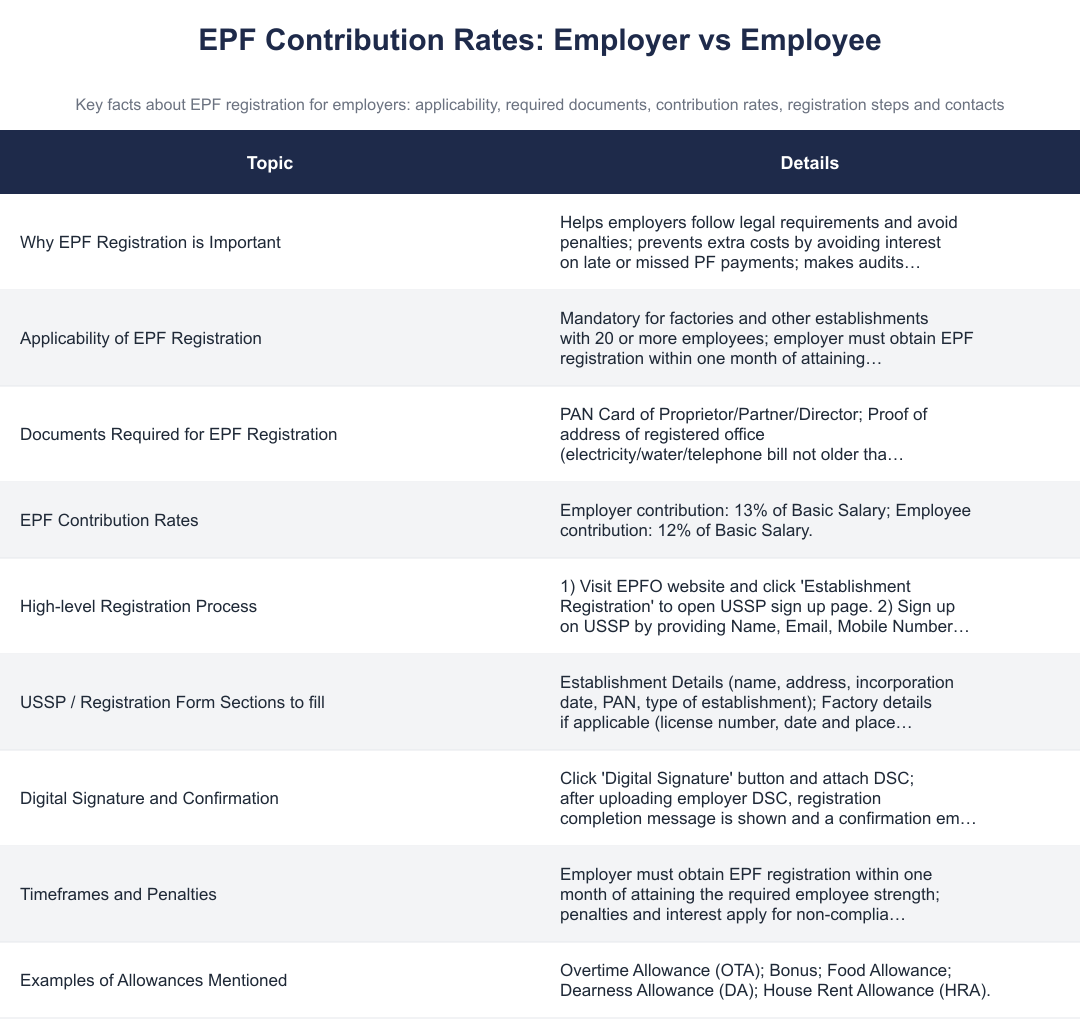
You should register for EPF to comply with law and provide retirement benefits to employees, avoiding penalties and reputational risk. EPF registration ensures timely deduction and remittance of employee and employer contributions (typically 12% employee and 13% employer of basic salary), helps during audits and inspections by maintaining proper records, and protects employees’ future through social security savings. Non-registration when applicable can attract interest, penalties, and adverse findings in statutory audits. Employers also retain obligations even if employee strength later falls below the threshold in many cases.
When is EPF registration mandatory for an employer?
EPF registration is mandatory for factories and establishments that employ 20 or more persons, unless a specific exemption is notified. The employer must obtain registration within one month of reaching the 20-employee threshold; failure to register within that period attracts penalties and interest on unpaid contributions. The Central Government can also notify compulsory applicability to establishments with fewer than 20 employees after giving at least two months’ notice. Once registered, an establishment remains under the Act even if employee strength subsequently falls below the threshold.
What documents do I need to register my establishment for EPF?
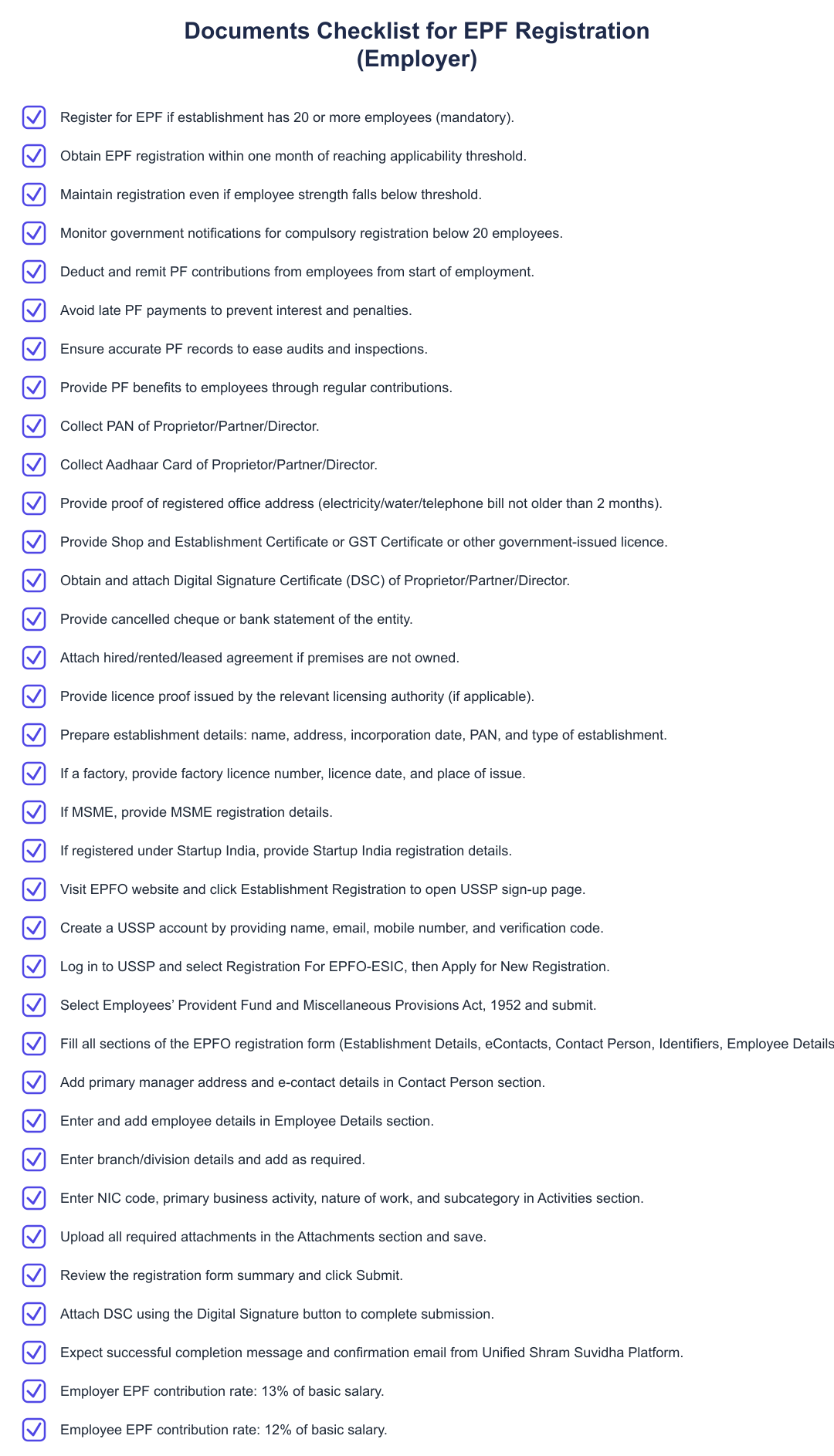
You need identity and address proofs of the proprietor/partners/directors and documents of the establishment such as PAN of the responsible person, Aadhaar, recent utility bill as registered office address (not older than 2 months), and entity proof like GST certificate or Shop and Establishment certificate. Additionally you must provide a cancelled cheque or bank statement of the entity, digital signature of the proprietor/partner/director, hire/lease agreement if premises are rented, and any licence proof issued by the relevant authority. Carrying these documents in digital form is required to upload during the online Unified Shram Suvidha Portal (USSP) registration process.
How much do employers and employees contribute to EPF?
The standard EPF contribution rate is 13% by the employer and 12% by the employee of basic salary. These percentages apply to the basic wage component and certain allowances; some allowances such as overtime allowance, bonus, food allowance, and HRA may be excluded as per rules. Employers should ensure correct computation of the contribution base to remain compliant and avoid interest on short remittances.
How do I start EPF registration online as an employer?
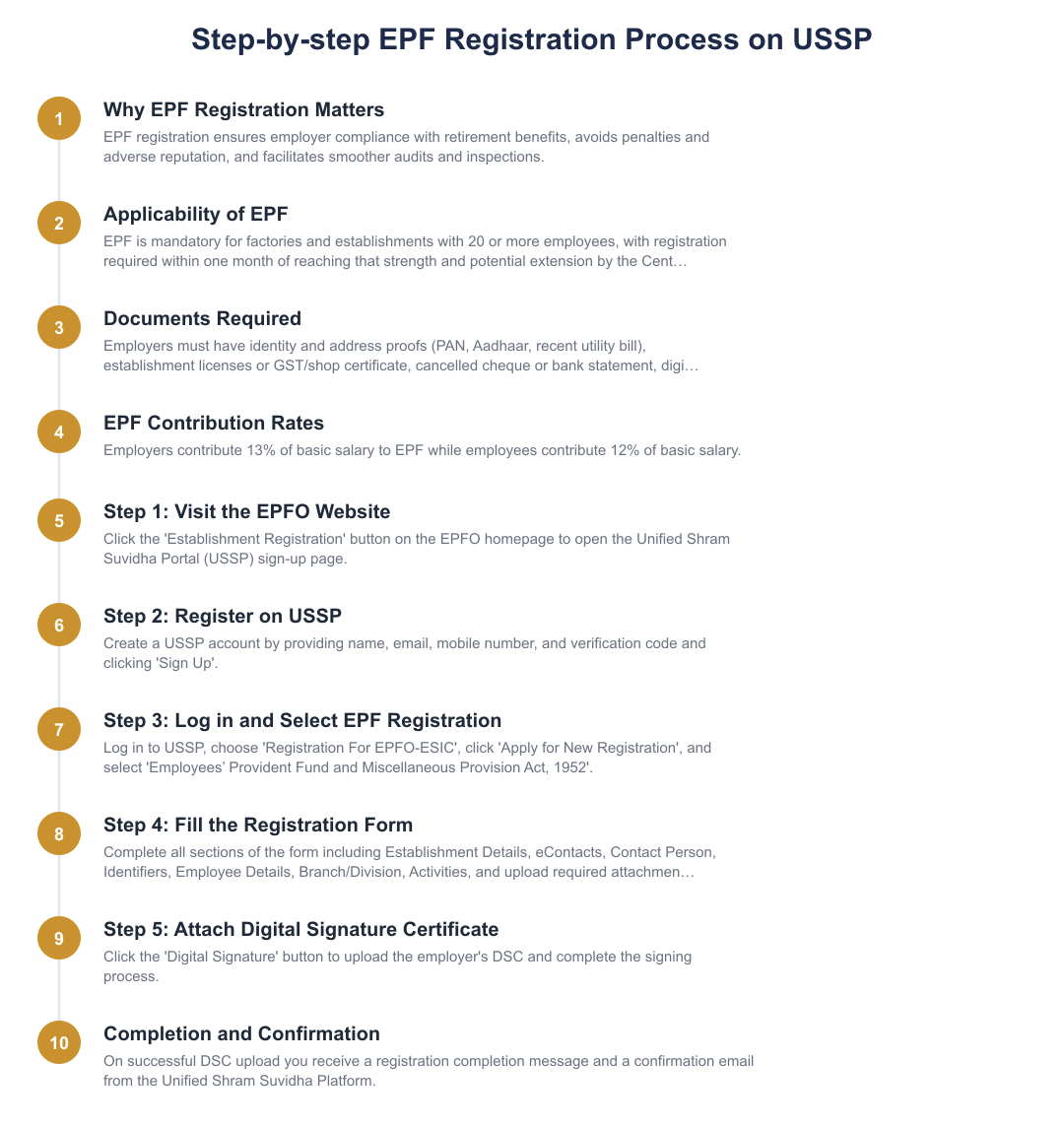
To start EPF registration you must visit the EPFO website and click the 'Establishment Registration' button which opens the Unified Shram Suvidha Portal (USSP) sign-up page. Create a USSP account by providing name, email, mobile number and verification code, then log in and select 'Registration For EPFO-ESIC' → 'Apply for New Registration' and choose 'Employees’ Provident Fund and Miscellaneous Provision Act, 1952.' After that you will fill the registration form sections, establishment details, eContacts, contact person, identifiers, employee details, branch/division, activities, and upload required document attachments before submitting.
What are the step-by-step actions required in the USSP EPF registration form?
In the USSP form you must sequentially fill Establishment Details, add eContacts, add the Primary Manager’s address and email, add other contact persons, enter Identifiers and Employee Details, add Branch/Division information, specify Activities (NIC code and nature of work), upload attachments, review the summary, and then submit the form. Each section requires you to click 'Add' after entering details to save them and use 'Next' to proceed; the summary page shows all entries before final submission. Omitting required fields or attachments will prevent successful submission, so ensure PAN, incorporation date, address proof and other mandatory documents are uploaded.
Do I need a Digital Signature Certificate (DSC) for EPF employer registration?
Yes, you must attach the Digital Signature Certificate (DSC) of the proprietor/partner/director to complete EPF registration submission in the USSP. After uploading the employer’s DSC and signing electronically, the system processes the registration and displays a successful completion message, and you receive an email confirmation from the Unified Shram Suvidha Platform. Without the DSC the registration will not be finalized, so obtain a DSC for the authorized signatory before submission.
What penalties or consequences apply if an employer fails to register or remit EPF on time?
If an employer fails to register when applicable or delays remittance, they can face interest on late contributions, monetary penalties, and adverse findings during audits and inspections. The law requires registration within one month of reaching the applicability threshold and timely monthly contributions; non-compliance can trigger enforcement actions by EPFO and affect statutory audit outcomes. Persistent non-adherence may also damage the employer’s reputation and invite further legal scrutiny.
What happens if my employee count falls below 20 after registration?
Once an establishment is registered under the EPF Act, it generally remains under the Act even if the employee strength later falls below 20, so the employer continues to have PF obligations. The Central Government also has the power to notify continued applicability or exemptions, but in ordinary course registration does not cease simply because strength reduces. Therefore employers must continue deducting and remitting contributions and maintain records until any formal exemption or change of status is granted by authorities.
Need help staying Payroll compliant?
MoneyGence's AI Finance OS tracks your compliance, wallet share, and finances in one place, built for agencies and growing businesses.
Get started with MoneyGence