Enforcement Case Proceedings on GST Portal – Complete Guide
This guide explains what businesses and taxpayers should know about enforcement case proceedings under GST and why understanding them matters. Enforcement proceedings may arise when tax authorities exercise powers such as inspection, search, seizure or arrest; such actions can have operational, financial and reputational consequences for businesses. Knowing the typical flow of a proceeding, how to prepare, what to keep on hand, and how to interact with authorities and advisors helps reduce disruption and protect legal and commercial interests. You will learn: the core types of enforcement actions that can occur; practical steps to prepare for and respond to a notice or on-site action; how to manage records and communications during and after an enforcement event; and answers to frequently asked questions that arise when matters move into enforcement. The guide focuses on practical readiness and sensible next steps rather than procedural minutiae, because the specifics of viewing notices, filing replies or accessing orders can vary by jurisdiction and technology. By the end you will have a clear checklist of priorities to reduce risk and maintain compliance when enforcement proceedings touch your business.
Different types of Enforcement Cases
Enforcement proceedings under GST broadly encompass a set of coercive and investigative actions authorities can take when there are concerns about compliance. The core activities involved in enforcement include inspection, search, seizure and arrest. These are distinct in purpose: inspection and search are investigative, aimed at establishing facts; seizure seeks to secure goods, documents or assets; and arrest is used in more serious situations involving alleged offences.
For a business or taxpayer, understanding these categories matters because each implies different authority, immediate risks and practical steps to take. An inspection or search may be limited in scope and short-term, whereas seizure can interrupt business operations if stock, consignments or documents are taken out of circulation. Arrest, being the most severe, raises both legal and personal implications. Preparing for the possibility of any of these actions, through accurate records, clear delegation of responsibilities and access to professional advice, reduces the chances of escalation and loss.
Preparing for a notice or on-site enforcement action
When enforcement activity is a possibility, the most effective preparation is organisational: maintain up-to-date books, digitised copies of key documents, and a clear internal protocol for responding to officials. Designate a small team or a single point of contact who will interact with enforcement personnel, collect documents, and keep the business leadership informed. This reduces confusion and the risk of inconsistent information being given to authorities.
Be ready to provide records that substantiate transactions, movement of goods, invoices and payments. Even when an action is limited to inspection or a request for information, timely, accurate production of records helps resolve questions quickly. If physical goods are subject to seizure or inspection, ensure you have documentation that establishes ownership, custody and value to facilitate any provisional releases or further discussion with authorities.
How to interact with authorities during inspection, seizure or search
During any enforcement visit, stay cooperative while protecting legal rights. Provide the requested documents promptly and maintain a factual, calm record of what transpires: names and ranks of officials, time and scope of the inspection, items inspected or taken, and any requests made. If goods or documents are seized, ask for a written receipt or memorandum describing exactly what was taken and on what grounds.
If the situation escalates to more invasive measures, such as arrest, ensure that the person involved understands their rights and has access to legal counsel. In all scenarios, preserve copies of documents and logs created at the time of the action. That contemporaneous evidence will be important when corresponding with authorities, filing replies, or seeking the return of seized items.
After an enforcement action: records, replies and seeking remedies
Once an inspection, seizure or other enforcement activity is complete, the immediate priorities are to compile a complete record of the event, prepare any formal replies if notices are issued, and engage professional advice where needed. A well-documented timeline and consistent documentary trail strengthen responses and help in negotiations or appeals, if those avenues are available.
If goods or documents were seized, follow up promptly to understand the status, the grounds for retention and the process for release. Where formal show-cause notices, orders or demands are issued, prepare clear, evidence-based replies addressing the points raised. Professional representation, through a tax practitioner or lawyer, is often critical to ensure technical legal and factual issues are properly framed and to protect commercial interests.
Frequently Asked Questions
What are different types of communications issued under the enforcement proceedings? Authorities can issue a variety of communications at different stages, from requests for information and notices to appear, to orders relating to seizure or release of goods. Each communication serves a different procedural purpose: some seek information, some require presence for hearing, while others effectuate operational action such as seizure. Understanding the type of communication you have received helps determine the appropriate response.
Can a taxpayer view the notice issued to the third party on his portal? Access to notices and communications depends on the channel and permissions used by authorities to serve them. A taxpayer should maintain active and accurate contact details and check all official channels where communications are received. If a communication involves a third party, clarify with your advisor whether you are entitled to see the document and, if necessary, request copies through formal channels.
Is there any limit on the number of replies or counter replies a taxpayer can file? Procedural rules about the number and content of replies, and whether counter replies are permitted, are determined by the applicable law and the specific proceeding. Practically, focus on making timely, complete and well-documented replies that address the issues raised rather than repeatedly filing incremental responses. Seek professional guidance if iterative exchanges with authorities are becoming complex.
What happens once a taxpayer files a reply or counter reply? Filing a reply typically puts the taxpayer’s position on record and triggers the next procedural step by the authority, this could be further queries, a hearing, or a decision based on the materials on file. Maintain proof of filing and copies of all submissions. Continued engagement, through clarifications, hearings or legal representation, may be necessary until the matter is resolved or formally closed.
Enforcement proceedings under GST, encompassing inspection, search, seizure and arrest, are significant events for any taxpayer. Practical preparation, accurate records, a designated response team and timely professional advice are the best ways to manage risk and protect business continuity. When communications arrive or officials visit, focus on cooperation combined with careful documentation and legal support where appropriate; that approach improves the chances of a prompt and favourable resolution.
Frequently asked questions
What are the different types of enforcement cases under GST I might see on the portal?
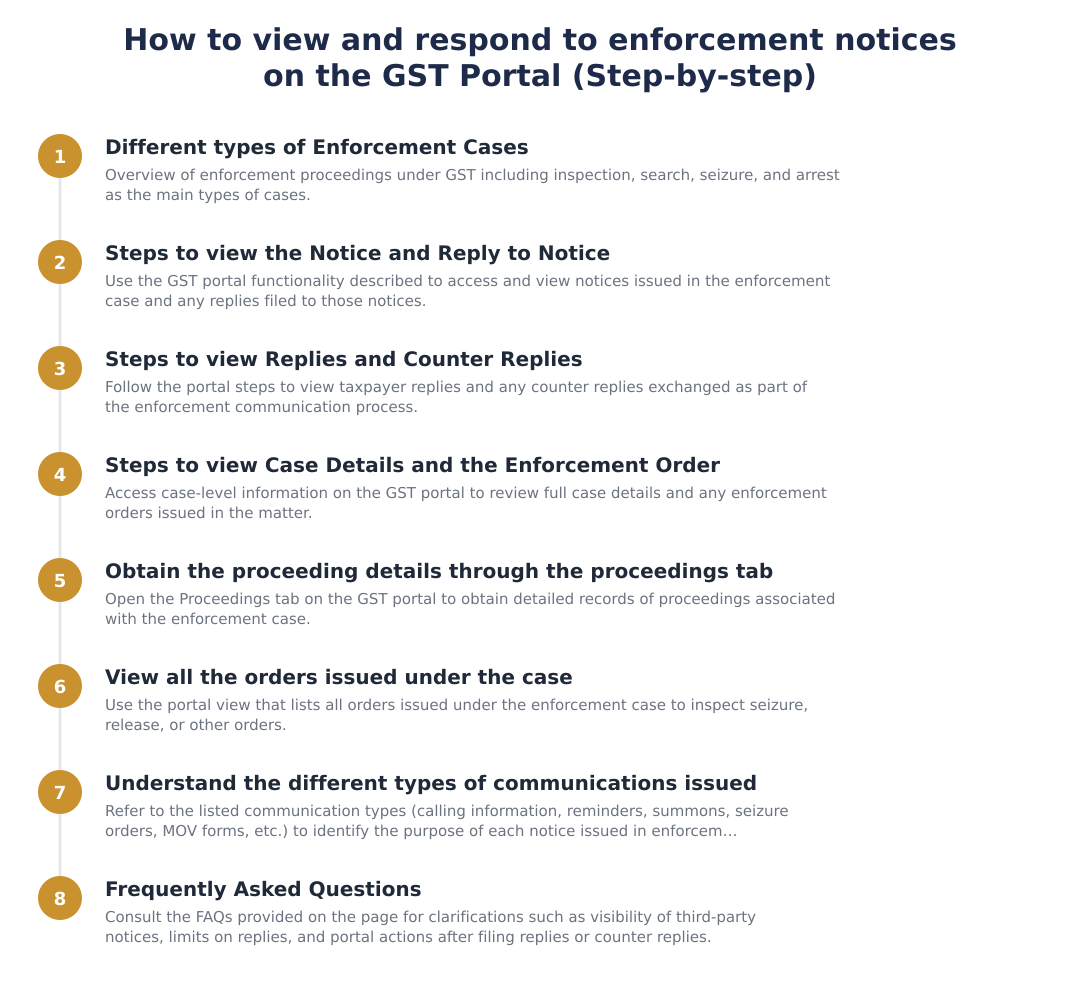
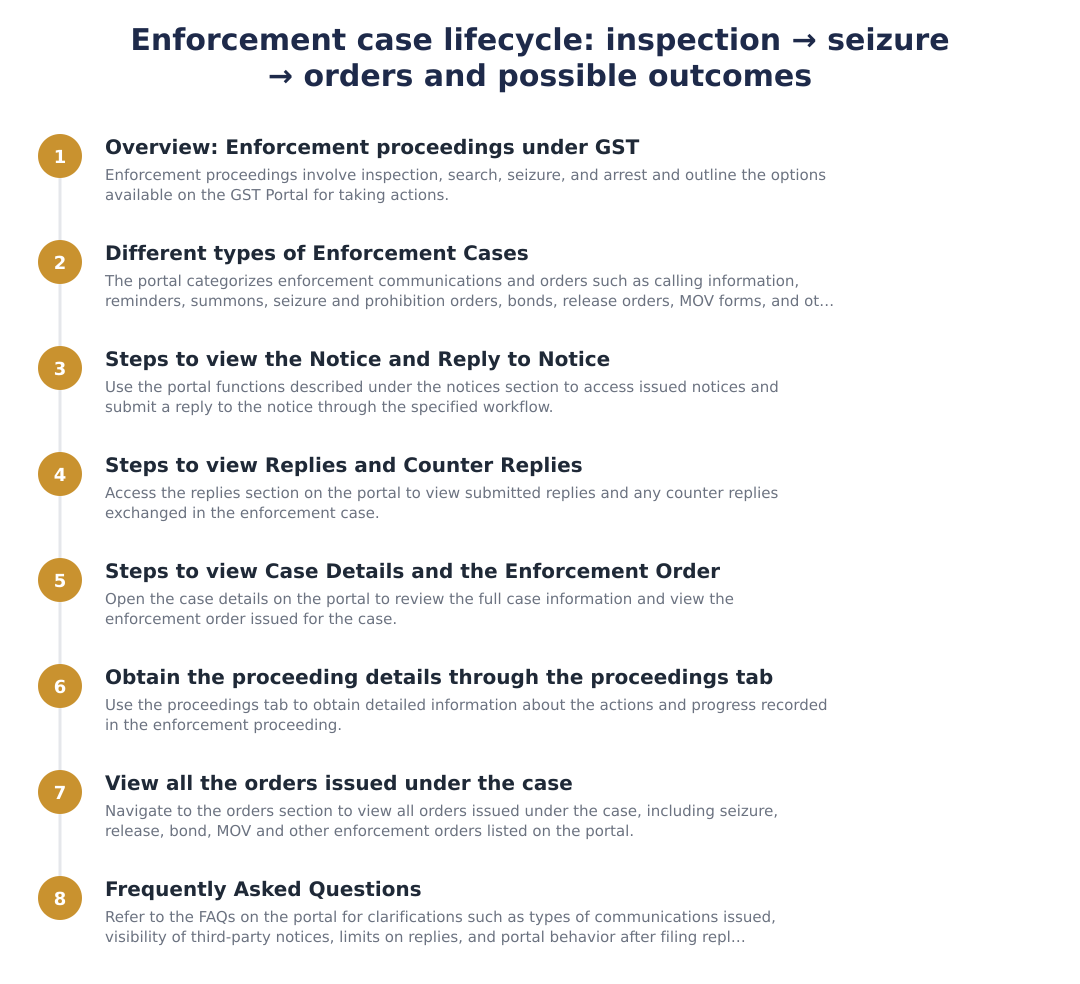
Enforcement cases under GST include inspection, search, seizure and arrest proceedings, and related moving-vehicle (MOV) actions such as detention, physical verification and release. These cases generate a variety of communications and orders, for example detention/seizure memos, GST INS series orders (seizure, prohibition, release, bond), MOV-01 to MOV-11 documents (statements, physical verification reports, release or confiscation orders), summons, personal hearing notices and show-cause notices. Each type has distinct purposes: MOV orders relate to goods in movement, INS orders relate to seizure/prohibition during inspections, and summons/PH/SCN are used to obtain information or require appearance. Knowing the case type helps you expect what documents or actions (bond, security, provisional release, confiscation) may follow on the portal.
How do I view a notice issued to me in an enforcement case on the GST portal?
You can view a notice on the GST Portal by logging in and opening the Enforcement Cases module, then selecting the relevant case and the Notices/Communications tab to download the notice PDF. The portal stores all communications issued under a case (calling information, reminders, summons, detention/seizure memos, show-cause notices, etc.), with dates and reference numbers so you can track deadlines. Notices will indicate the required action (provide information, appear in person, execute bond, pay amounts) and usually state a due date for reply or compliance. If a notice is issued for goods in movement, the corresponding MOV document (e.g., MOV-06 detention order) will also be available in the same case record.
How can I submit a reply to a notice or file a counter-reply on the GST portal?
You submit a reply to an enforcement notice by opening the specific notice in the Enforcement Cases module and using the portal’s Reply/Respond function to attach documents and enter your comments before the stated due date. The portal allows multiple replies and counter-replies tied to the same notice or communication, and you should upload supporting evidence (invoices, transport documents, bonds) as required to strengthen your response. Replies are date-stamped and become part of the case record; you should keep copies and note any personal hearing dates mentioned in subsequent communications. If the notice demanded provisional steps (bond, security or payment), include proof of compliance in your reply to accelerate release where applicable.
Is there any limit on the number of replies or counter-replies I can file on the GST portal?
There is no strict numerical limit on the number of replies or counter-replies you can file for an enforcement case on the GST portal; you may upload successive responses as the case progresses. However, each reply should be meaningful and submitted within timelines set by the officer or the notice to avoid adverse action; repeated repetitive filings without new information may not prevent orders like show-cause or seizure. The portal records every reply and counter-reply with timestamps, so the officer can view the chronology and content of communications when making orders. If a personal hearing is scheduled, focus replies to address the specific issues raised to be effective rather than relying solely on multiple electronic submissions.
What happens on the GST portal after I file a reply or counter-reply in an enforcement case?
After you file a reply or counter-reply, the GST portal records and time-stamps your submission and makes it available to the enforcement officer handling the case for review. The portal also updates the case timeline so both parties can track the sequence of communications; you may receive further communications such as reminders, personal hearing notices, or orders (release, seizure, show-cause) based on the officer’s assessment of your reply. If your reply includes execution of bond, security or evidence of payment, the officer may upload a corresponding order (e.g., GST INS-05 release order or release of security) to reflect provisional or final relief. Keep proof of submission and check the portal regularly for any subsequent notices or hearing dates.
How do I view all replies and counter-replies exchanged in an enforcement case?
To view all replies and counter-replies, open the relevant enforcement case on the GST Portal and go to the Replies/Correspondence tab or the History/Communications section, where every response is listed chronologically with attachments. Each entry shows who filed it (taxpayer, third party, or officer), the document uploaded, time-stamp and any remarks made, enabling you to review the full record before hearings or further submissions. This consolidated view helps you identify missing evidence, repetitive queries, or dates for reminders and subsequent orders. If you believe a reply is missing from the record, immediately confirm successful submission receipts and contact the jurisdictional enforcement officer.
How can I view the enforcement case details and any orders issued against me on the GST portal?
You can view case details and orders by opening the Enforcement Cases module in the GST Portal, selecting the specific case and then checking the Case Details and Orders tabs which list all proceedings, orders and related documents. The portal shows the case status, notices issued, replies filed, proceedings (such as personal hearings), and orders like detention/seizure memos, GST INS series orders, MOV orders and show-cause or confiscation orders, each available for download. Orders include the rationale, the relief or action directed (release, payment, confiscation), and whether any security or bond was accepted or released, so you can act promptly on compliance requirements. Always save copies of orders and note statutory timelines for appeals or compliance mentioned in the order text.
How do I obtain detailed proceedings information and hearing records through the proceedings tab?
The Proceedings tab on the GST portal provides a chronological record of actions taken in a case, such as notices issued, replies received, hearings scheduled, adjournments, and orders passed, enabling you to obtain detailed proceeding notes and dates. Each proceeding entry typically includes the proceeding type (personal hearing, adjournment, inspection), officer observations, any documents uploaded at that stage (statements, physical verification reports), and next steps or directions given by the officer. Use this tab to prepare for hearings by reviewing officer remarks and earlier submissions, and to verify whether procedural steps (service of notices, adjournments) were completed. If a proceeding mentions submission of bond/security or physical verification, the relevant documents or MOV/INS reports will also be accessible from this area.
Does the GST portal show all the orders issued under an enforcement case, and how do I access them?
Yes, the GST portal lists all orders issued under an enforcement case in the Orders or Case Documents section, and you can access and download each order (seizure, release, show-cause, confiscation, release of security, MOV orders) directly from the case record. Each order is uploaded with a reference number, date, the officer’s signature and the operative directions (e.g., seizure details, amount payable, bond conditions), which you must follow within specified timelines. If an order relates to provisional release on bond or security, the portal will also show whether the bond/security was accepted and whether a release order (GST INS-05 or MOV-05) was issued. Keep downloaded copies for compliance and for any appeal or representation you intend to file within statutory periods.
Can a taxpayer view a notice that was issued to a third party on their GST portal?
No, a taxpayer cannot view notices issued specifically to a third party on their own GST portal unless the third-party communication is part of the shared case record and the officer has linked it to the taxpayer’s enforcement case. Notices directed only to a third party (for example a transporter or custodian) may be viewable in the case history if uploaded by the officer, but generally confidential communications intended solely for the third party will not appear on the taxpayer’s dashboard. If you believe a third-party notice is relevant to your case, check the case’s Communications/Replies and Proceedings tabs for any uploaded third-party responses or officer remarks, and request the officer for copies through official channels if necessary. Maintaining records of documents obtained from third parties (bills of lading, transport receipts) and uploading them to your replies helps ensure the officer has the complete picture on the portal.
Need help staying GST compliant?
MoneyGence's AI Finance OS tracks your compliance, wallet share, and finances in one place, built for agencies and growing businesses.
Get started with MoneyGence