Employment Offer Letter Format: Free Template & Sample
An employment offer letter is the first formal written communication from an employer that sets out the key terms of a job offer. This guide explains what an effective offer letter contains, why each element matters, and how a clear letter protects both the employer and the candidate. You will learn which clauses to include so expectations are aligned from day one, what documentation to request at joining, and best-practice drafting tips to reduce misunderstandings and future disputes. Whether you are building a template for repeated hires or preparing a one-off offer, this guide will help you produce a professional, legally sensible document that supports a smooth onboarding process. A well-written offer letter helps convert a candidate into an employee by summarising the role, compensation, key conditions and next steps in plain language. It acts as a reference for what was agreed during recruitment and provides candidates with the information they need to make an informed decision. For employers, it creates a clear audit trail and reduces questions that arise between acceptance and joining. Read on to see the typical sections of an offer letter, what to cover in each section, and practical drafting tips to make your offer concise and enforceable.
Employment Offer Letter Format
A standard offer letter begins with a brief opening that states the employer’s name, the candidate’s name, and a clear statement that this document constitutes an offer of employment. This introduction sets the tone and makes it plain that the document is the formal communication of the job offer rather than informal correspondence.
Following the opening, include a short summary of the role and reporting relationships. This helps the candidate quickly understand the primary purpose of the position and who they will report to, which is useful for setting expectations before the joining date.
Close the introductory section with a deadline for acceptance and the intended start date or an instruction to coordinate a mutually agreeable start date. This creates clarity around timing and helps both parties plan next steps in the onboarding process.
Details mentioned in the Employee Offer Letter:
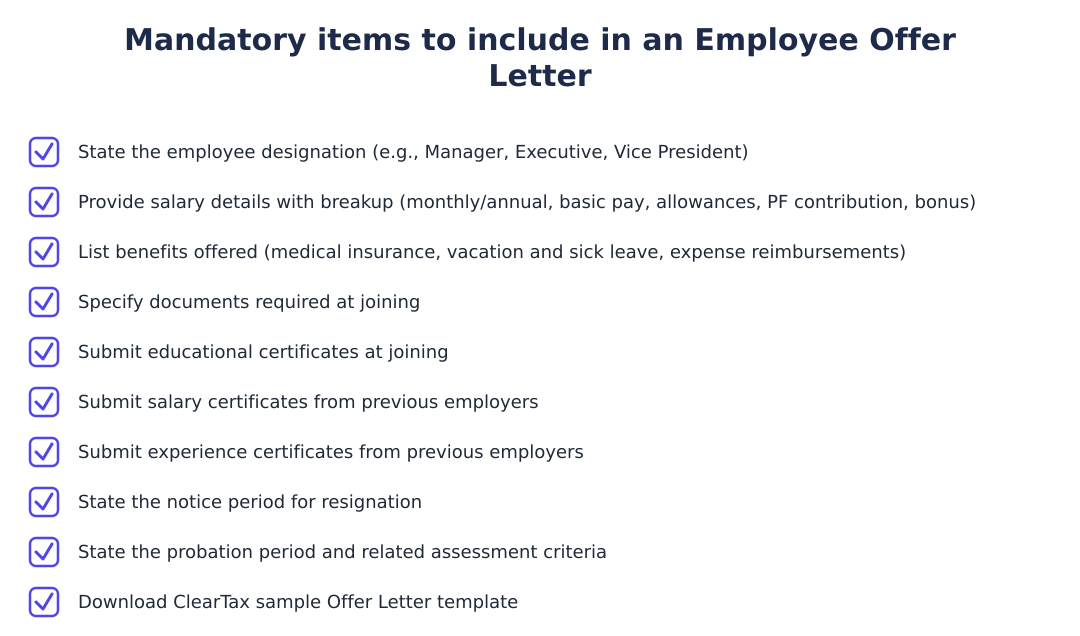
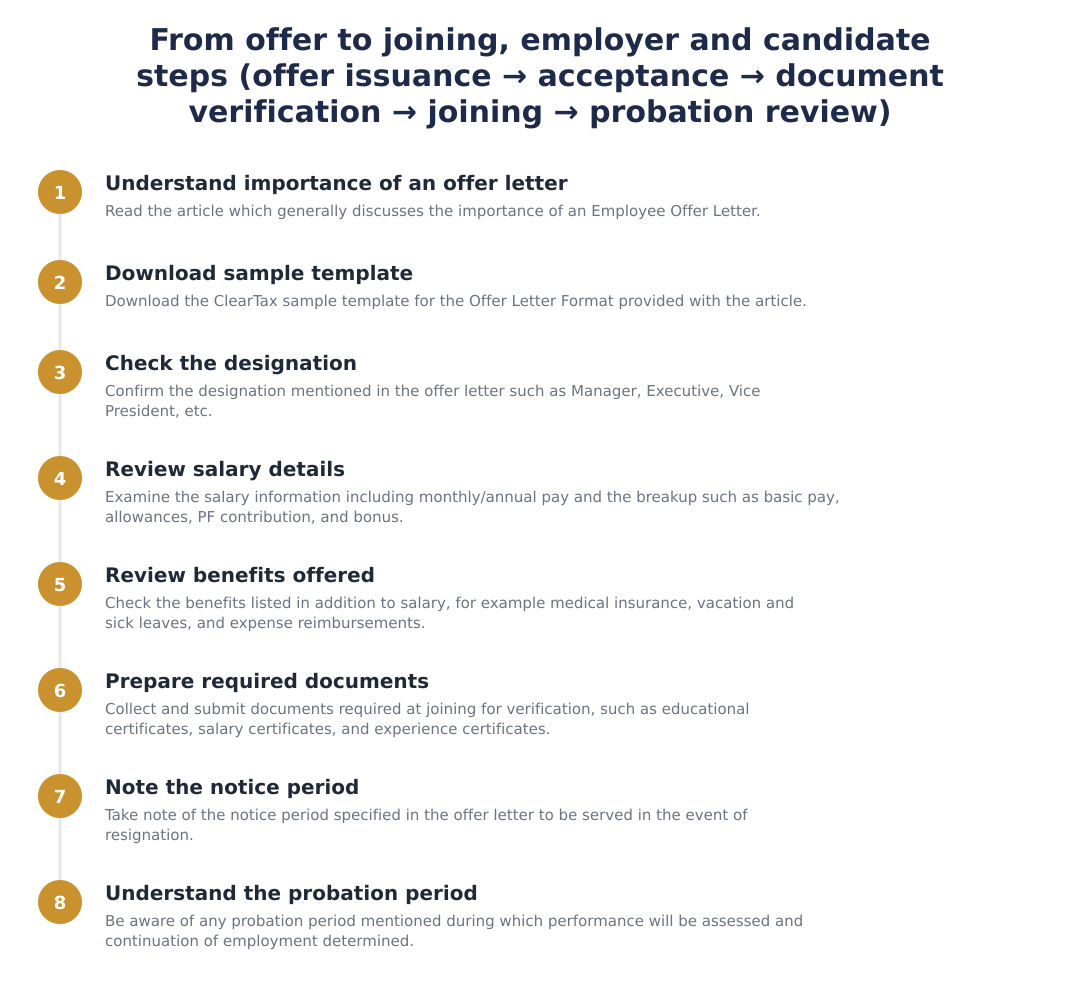
Designation and role description: Clearly state the job title and provide a concise description of the primary duties and responsibilities. Avoid ambiguous language; a focused role summary reduces mismatched expectations when the employee joins.
Compensation and salary breakup: Describe the structure of compensation, for example, base pay and whether additional components such as allowances, bonuses or reimbursements are part of the package. Indicate the frequency and mode of payment and whether any element is conditional on performance or subject to deductions as per company policy.
Employee benefits and policies: List benefits that form part of the employment relationship, such as insurance, leave entitlements, travel or expense reimbursement frameworks, and any other perks. Note if benefit eligibility is conditional upon completion of probation or other criteria.
Documents required at joining: Specify the documents the candidate must submit when they report for duty for identity, education or prior-employment verification. Mention any directions about certified copies or originals for inspection to help the candidate prepare in advance.
Notice period and termination provisions: State the notice period the employee is expected to serve on resignation as well as any probationary notice expectations. Also mention whether termination during probation follows a different process. Clear notice provisions reduce later disputes about exit obligations.
Probation and confirmation: If the hire will be on probation, state the probationary duration and the criteria or process for confirmation. Explain whether certain benefits or permanent employment status will only follow successful completion of probation and assessment.
How to draft an effective offer letter
Use plain, unambiguous language: An offer letter should be easy to read, avoid legal jargon where possible, and set out obligations and expectations clearly. Where legal or policy language is necessary, consider attaching a referenced policy document or handbook so that the main letter remains concise.
Include acceptance mechanics and timelines: Tell the candidate how to accept the offer (for example, by signing and returning a copy or sending an acceptance email) and state a reasonable deadline for acceptance. Also describe what will happen after acceptance, for example, completing pre-employment checks or receiving a final agreement.
Address confidentiality and company policies: If the role requires adherence to confidentiality, intellectual property, or code-of-conduct obligations, reference the relevant policy documents and note that continued employment may be subject to agreeing to those policies. This ensures candidates are aware of important employment conditions before joining.
Provide signature blocks and contact point: Conclude with signature lines for an authorised company representative and the candidate, and provide a contact person for any questions. Listing a contact reduces back-and-forth and helps resolve queries quickly before the start date.
Related Products and Services
Employers often use templates and compliance support services to standardise offer letters and ensure consistency across hires. Template libraries and onboarding platforms can reduce drafting time and help maintain a consistent tone and structure in all offers.
Services such as background-verification providers, payroll setup solutions, and digital-signature tools are commonly used alongside offer letters to streamline verification, salary processing and formal acceptance. Integrating these services with your hiring process can reduce administrative delays between offer acceptance and joining.
Legal or HR advisory services can help review templates for role-specific clauses, confidentiality terms, or industry-specific compliance requirements. Using expert review periodically keeps documents aligned with evolving business policies and organisational norms.
A clear, well-structured offer letter benefits both employer and candidate by recording the core terms of employment, reducing misunderstandings, and speeding up onboarding. Use concise role descriptions, transparent compensation and benefits statements, and explicit instructions on acceptance and documentation. Coupling a good offer letter with simple operational processes, a named contact, checklist of documents, and timelines, will make the transition from offer to first day straightforward and professional.
Frequently asked questions
What is an employment offer letter and why is it important?
An employment offer letter is a formal document from an employer that confirms a job offer and sets out key terms of employment. It is important because it records the candidate’s designation, salary (monthly/annual and breakup such as basic pay, allowances, PF contribution, bonus), benefits (like medical insurance, vacation and sick leave, expense reimbursements), required documents for joining, notice period and any probation period, providing clarity and legal protection for both parties. Having these details in writing reduces misunderstandings about pay, role and conditions and serves as a reference when completing joining formalities. Employers and candidates often use standard templates (for example ClearTax’s sample offer letter) to ensure all necessary points are covered.
What details about salary should be included in an offer letter?
An offer letter should include the monthly or annual salary and a clear salary breakup showing components such as basic pay, allowances, employer PF contribution and any bonus structure. This breakdown helps the employee understand take-home pay versus gross cost to company and any statutory deductions. If there are variable pay elements or conditions for bonuses, the letter should state how they are calculated and paid. Including these specifics avoids confusion at payroll stage and during termination or resignation.
What benefits should be mentioned in an offer letter?
An offer letter should clearly list employee benefits in addition to salary, such as medical insurance, vacation and sick leave entitlements, and expense reimbursement policies. It should specify any eligibility conditions, waiting periods, coverage limits or provider details for benefits like medical insurance. If there are additional perks (travel allowance, meal coupons, stock options), those should also be described or referenced to the company policy. Clear mention of benefits helps the candidate evaluate the total compensation package beyond the basic salary.
What documents are typically required at the time of joining according to an offer letter?
Offer letters typically list documents to be submitted at joining for verification, such as educational certificates, salary certificates, and experience certificates from previous employers. Identity proofs, address proof, passport-size photographs and PAN/Aadhaar copies are also commonly requested for HR and statutory records. The letter should state whether originals must be shown and photocopies submitted, and any timelines for producing pending documents. Clear instructions on documents speed up background checks and payroll setup.
How should notice period be described in an offer letter?
An offer letter should explicitly state the notice period the employee must serve on resignation and any corresponding notice required by the employer. It should mention the duration (for example 1 month or 3 months) and whether payment in lieu of notice or forfeiture clauses apply. The letter may also outline consequences for not serving the full notice, such as deduction from final settlement or recovery of training costs. Clear notice-period terms protect both employer operations and employee planning when leaving the job.
What is a probation period and how is it included in the offer letter?
A probation period is a specified initial duration during which the new employee’s performance is evaluated and is commonly stated in offer letters with its length and assessment criteria. The letter should mention the exact probation duration (for example 3 or 6 months), any reduced benefits or notice period during probation, and the evaluation process for confirmation or termination. It should also state whether the employer can extend probation and what happens upon successful completion (confirmation as regular employee). Transparent probation terms set expectations about job security and performance standards.
Can I request changes to an offer letter before accepting the job?
Yes, you can request changes to an offer letter before accepting the job, and it is common to negotiate terms like salary, joining date, notice period or specific benefits. Any negotiated changes should be documented in writing and a revised offer letter or addendum issued by the employer to avoid misunderstandings. Until you accept the updated written offer, the original terms remain non-binding for you. Always get final agreed terms in writing before resigning from your current job or making commitments.
Where can I find a standard offer letter template to download?
You can download a standard employee offer letter template from resources such as ClearTax’s sample offer letter format, which includes fields for designation, detailed salary breakup, benefits, documents required at joining, notice period and probation period. Templates typically provide a ready-made structure you can customize for role-specific terms and company policies, saving time and ensuring legal and HR essentials are covered. Use the template as a starting point and adapt clauses (leave policy, PF, confidentiality) to your organisation’s practices before issuing it to candidates.
What other HR or business services are related to issuing an offer letter?
Related services that support issuing and implementing an offer letter include company registrations (Private Limited, LLP, OPC), GST registration, payroll and tax filings (presumptive business tax returns), digital signatures and trademark registration for employer branding. These services ensure the employer has the required legal structure, statutory compliance and digital capabilities to hire, run payroll, and protect intellectual property. For startups, combined packages (registration, GST, payroll and trademark) simplify setup and help produce consistent employment documents like offer letters and contracts.
Need help staying Finance Templates compliant?
MoneyGence's AI Finance OS tracks your compliance, wallet share, and finances in one place, built for agencies and growing businesses.
Get started with MoneyGence