Double Entry Bookkeeping: Guide to Double-Entry System
This guide explains the double-entry system of bookkeeping: what it is, why it matters, and how accountants and business owners use it to maintain reliable financial records. You will learn the core principles that underlie the system, how transactions are recorded as paired entries, how journal entries are structured, and the practical advantages that make double-entry the accounting method of choice for organisations that need accurate, auditable accounts. Understanding these concepts helps business owners interpret books of account, spot errors early, and produce information that supports better financial decisions. The double-entry system is foundational for modern accounting because it ties every change in one part of the books to a corresponding change elsewhere, creating a self-balancing record. That balance makes it easier to prepare financial statements and to trace the origin of figures during reviews or audits. This guide focuses on conceptual clarity and practical implications: you will come away with an understanding of the guiding principles, how to think about journal entries, and the key benefits businesses obtain by adopting double-entry bookkeeping. Whether you are setting up accounting for a small business, supervising bookkeepers, or preparing to discuss finances with an auditor or banker, this primer will help you approach bookkeeping with confidence and ask the right questions about your records.
Principles of Double-Entry System of Bookkeeping
At its core, the double-entry system records each transaction in a way that reflects both the source and the destination of value. Every recorded event affects at least two accounts: one account reflects where value is coming from, and another reflects where value is going. This dual perspective provides a fuller picture of how transactions change the financial position of the business.
The system rests on consistent rules for deciding which accounts to increase and which to decrease when a transaction occurs. By applying these rules uniformly, bookkeepers ensure that the ledger remains balanced and that debit and credit entries correspond across accounts. This consistency is what enables reconciliations, trial balances, and the reliable preparation of financial statements.
Because each entry has a counterpart, errors that would distort single-line records are easier to detect. If the sum of debits does not equal the sum of credits, that mismatch signals a recording problem that can be investigated. That built-in check improves data quality and supports trustworthy reporting over time.
Journal Entries of Double-Entry System of Bookkeeping
Journal entries are the initial recorded form of a transaction and provide a chronological record of business events. Each journal entry identifies the accounts affected, the amounts involved, and a brief description or narration explaining the nature of the transaction. This makes journals useful for both bookkeeping and later review by managers or auditors.
In a double-entry framework, a journal entry lists at least two lines: one or more debit postings and one or more credit postings. The total debits for the entry will equal the total credits, preserving the accounting balance. Journal entries can be simple, affecting just two accounts, or compound, affecting several accounts on each side when a transaction is more complex.
Good journal practices include clear narration, consistent account naming, and cross-references to supporting documents such as invoices, receipts, or contracts. These practices make it easier to trace an item from the ledger back to its source documentation during reconciliations or compliance reviews.
Advantages of Double-Entry System of Bookkeeping
The double-entry system offers several practical benefits that make it the preferred method for businesses that require reliable financial information. Because every transaction links two sides of the accounts, the system supports comprehensive financial reporting and facilitates the preparation of key statements that summarise performance and position.
Another advantage is improved error detection. The equality of debits and credits creates a control that highlights recording mistakes, omissions, and certain types of fraud. When balances do not reconcile, bookkeepers have a starting point for investigating discrepancies and restoring the accuracy of the records.
Finally, double-entry records are more useful for decision-making. They provide a fuller view of how transactions affect assets, liabilities, equity, revenue, and expenses, information that managers, lenders, and statutory reviewers rely on when assessing a business’s financial health and creditworthiness.
Complete financial picture
By capturing both the giving and receiving sides of transactions, the double-entry system enables preparation of comprehensive financial statements. These statements present how resources are owned and used, and how operations have changed the business during a period. The two-sided recording ensures that the ledgers contain the necessary detail to construct balance sheets and performance reports.
For businesses, having this complete financial picture supports planning and controls. Owners and managers can see not just cash movements but the broader effects on obligations, investments, and profitability, insights that single-entry records usually cannot provide.
Better financial decisions
The richer data produced by double-entry bookkeeping feeds more reliable management information. When revenues and expenses are recorded in ways that reflect their underlying economic effects, financial ratios and trend analyses become meaningful tools for decision-making.
Access to dependable historical and current information allows businesses to compare alternatives, evaluate cash flow implications, and plan investments. Lenders and external stakeholders also prefer records that follow double-entry conventions because those records give clearer signals about creditworthiness and operational performance.
Reduces bookkeeping errors
The balancing feature of double-entry bookkeeping provides a constant verification mechanism. When totals of debits and credits do not match, it indicates that an entry is incomplete or incorrect, prompting a targeted review. This makes it easier to locate mistakes than when using single-line or cash-only bookkeeping approaches.
While the system does not eliminate human error, it significantly lowers the chance that errors will go unnoticed and accumulate over time. Regular reconciliations combined with disciplined journal practices keep records accurate and reliable for reporting and compliance purposes.
Preferred by statutory bodies and banks
Because double-entry accounts provide a comprehensive audit trail and enable the preparation of standard financial statements, they are widely accepted by banks, auditors, and regulatory bodies for credit assessment, tax compliance, and statutory reporting. The clarity and traceability of entries make review and verification processes more straightforward.
For businesses seeking formal financing or undergoing statutory scrutiny, maintaining books under the double-entry method reduces friction during assessments and demonstrates a commitment to robust financial controls.
The double-entry system is the backbone of reliable accounting. By recording the dual effect of each transaction, it provides balanced ledgers, supports accurate financial statements, and improves error detection and decision-making. Adopting good journal practices and regular reconciliations will amplify these benefits and help keep business finances clear and defensible.
Frequently asked questions
What is the double-entry system of bookkeeping?
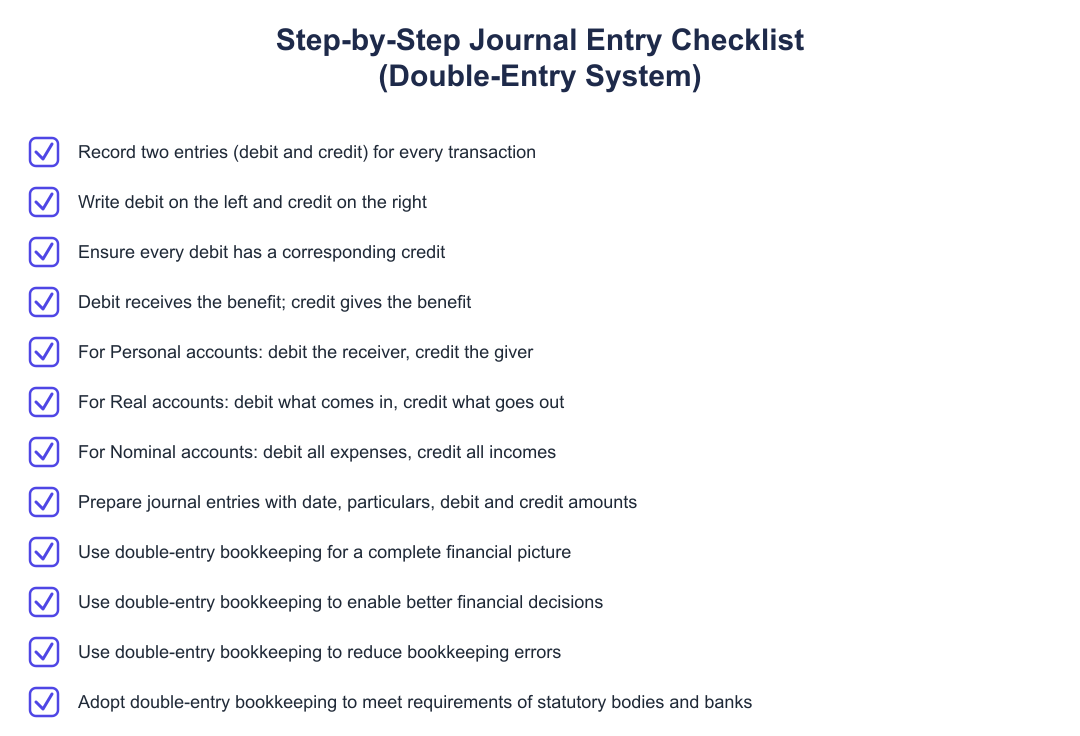
The double-entry system of bookkeeping records every transaction with two entries: a debit and a credit. In this system each transaction affects at least two accounts so that total debits always equal total credits, for example, paying salaries would debit Salary Cash A/c and credit Cash for ₹20,000. Large businesses typically use this method because it provides a complete and balanced record of financial activity, making detection of errors and preparation of financial statements easier. The system is governed by rules for personal, real and nominal accounts to ensure consistency in recording.
What are the basic principles or rules of double-entry bookkeeping?
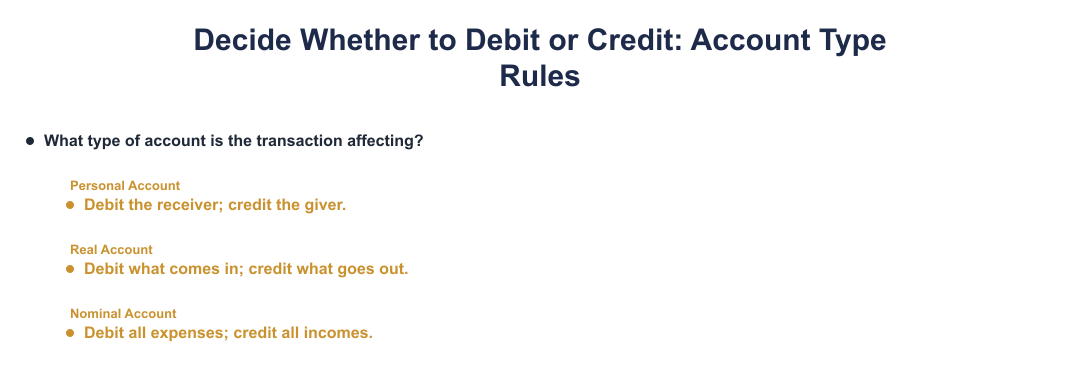
The basic principles require that every transaction have two entries, debit and credit, and that debit entries are written on the left while credits are written on the right. Additionally, the traditional rules apply by account type: for personal accounts, debit the receiver and credit the giver; for real accounts, debit what comes in and credit what goes out; for nominal accounts, debit all expenses and losses and credit all incomes and gains. These rules ensure consistency so that the accounting equation remains balanced and errors can be located more easily.
How do you make journal entries in the double-entry system?
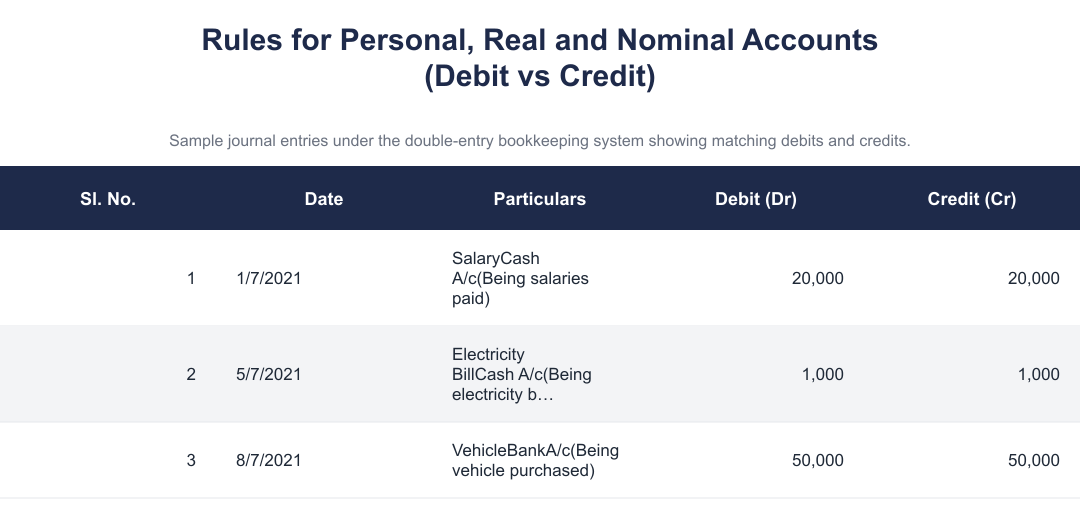
To make a journal entry you record the date, the accounts to be debited and credited, and the corresponding amounts so total debits equal total credits. For example, on 1/7/2021 Salary Cash A/c was debited and Cash A/c credited for ₹20,000 (Being salaries paid); on 8/7/2021 Vehicle was debited and Bank A/c credited for ₹50,000 (Being vehicle purchased). Each journal entry should include a brief narration explaining the nature of the transaction to maintain an audit trail and clarity.
How does double-entry bookkeeping give a complete financial picture?
Double-entry bookkeeping provides a complete financial picture by recording both sources and uses of funds so assets, liabilities, equity, income and expenses can be derived from the books. Because every transaction affects at least two accounts, financial statements such as the balance sheet and profit & loss account can be prepared directly from the ledger balances. This comprehensive recording helps stakeholders and management see the company’s financial position and performance at any point in time.
How does double-entry bookkeeping help make better financial decisions?
Double-entry bookkeeping supports better financial decisions by supplying reliable, reconciled figures on income, expenses, assets and liabilities that managers can analyze. With accurate ledgers and periodic trial balances, businesses can identify trends, assess profitability, manage cash flows and plan budgets using real transactional data. The system’s built-in checks (debits equaling credits) increase confidence in the numbers used for forecasting, investment and cost-control decisions.
Does double-entry bookkeeping reduce bookkeeping errors?
Yes, double-entry bookkeeping reduces bookkeeping errors because each transaction has two offsetting entries so imbalances between total debits and credits reveal mistakes. Since the sums of debits and credits must match, trials such as a trial balance quickly expose arithmetic or posting errors; for example, if a ₹50,000 vehicle purchase is posted only to one side the trial balance will not tally. While it cannot catch every kind of error (like compensating errors), it significantly lowers the rate of undetected mistakes compared with single-entry systems.
Why do statutory bodies and banks prefer double-entry bookkeeping?
Statutory bodies and banks prefer double-entry bookkeeping because it produces verifiable, balanced accounts that support audits, compliance and credit assessment. The system’s structured ledgers and trial balances make it easier for regulators and lenders to review financial statements, verify transactions and assess creditworthiness. This reliability is why large businesses and entities seeking loans or regulatory approvals adopt double-entry bookkeeping as a standard practice.
What are the main advantages of using the double-entry system?
The main advantages are that it gives a complete financial picture, supports better decision-making, reduces bookkeeping errors and is preferred by banks and statutory bodies. Because every transaction affects two accounts, businesses can prepare accurate financial statements and detect discrepancies through trial balances; for example, routine entries like salaries (₹20,000) and electricity payments (₹1,000) are fully traceable. These features make the system suitable for large businesses that require reliable accounting and external validation.
How do I record common transactions like salaries, bills and asset purchases in double-entry bookkeeping?
You record common transactions by debiting the appropriate expense or asset account and crediting the payment account (cash or bank) so debits equal credits. For example: paying salaries, debit Salary Cash A/c ₹20,000 and credit Cash A/c ₹20,000; paying an electricity bill, debit Electricity Bill A/c ₹1,000 and credit Cash A/c ₹1,000; purchasing a vehicle, debit Vehicle A/c ₹50,000 and credit Bank A/c ₹50,000, each with a brief narration. Keeping consistent account names and clear narrations helps when posting to ledgers and preparing the trial balance.
Need help staying Accounting compliant?
MoneyGence's AI Finance OS tracks your compliance, wallet share, and finances in one place, built for agencies and growing businesses.
Get started with MoneyGence