Digital Signature for Income Tax E-Filing | Validate Online Transactio
This guide explains how a digital signature is used to validate online transactions and why having one matters for individuals and businesses that operate in India’s digital compliance environment. You will learn what a digital signature does, the kinds of transactions it commonly secures, what to expect when evaluating a digital signature plan, and where to look for missing operational details such as document requirements, validity periods, and renewal procedures. Understanding digital signatures helps you streamline e-filing, incorporation, return filing and other online regulatory processes by ensuring authenticity, integrity and non-repudiation of electronic submissions. Whether you are choosing a provider, preparing documents, or simply trying to understand why a digital signature is necessary, this guide will give you a practical framework to ask the right questions and avoid common implementation pitfalls. Note: this guide focuses on the purpose and practical implications of digital signatures; operational specifics such as classes, validity periods, fees and renewal terms vary by provider and certifying authority and should be confirmed directly with them.
Digital Signature Plan
A digital signature plan is a service offering from a certifying authority or reseller that enables you to obtain and use a digital certificate for signing electronic documents and transactions. The core purpose of such a plan is to provide the cryptographic credentials required to prove the origin and integrity of an electronic submission.
When assessing a plan, focus on what transactions it supports, whether it integrates with the portals you use, and what customer support or onboarding assistance is included. Because operational details differ by provider, confirm specifics like supported platforms and setup assistance before purchase.
Plan Description, What is the plan?
At its core, a digital signature plan provides the digital certificate and the mechanism for applying it to online filings and submissions. The certificate ties a signer’s identity to a cryptographic key pair, which is then used to sign electronic forms and documents so recipients and authorities can verify authenticity.
Practically, this means that when you complete an online form (for example, tax filings or company-related returns), the digital signature affixed to the submission enables the receiving system to confirm the identity of the submitter and that the content has not been tampered with after signing.
Plan Description, Who should take this plan?
Any individual or organisation that regularly submits official documents or regulatory filings online will find a digital signature essential. This includes people and entities that need to e-file tax returns, register or incorporate a company or LLP, submit annual returns, or complete other compliance-related online transactions.
Even if your current transaction volume is low, using digital signatures prepares your organisation for secure digital compliance and can save time when dealing with portals that mandate signed electronic submissions.
Documents Needed
Providers and certifying authorities typically require identity and address verification before issuing a digital certificate. The exact documents accepted and the verification process vary between providers and the type of certificate you apply for.
Because verified operational requirements are provider-specific and not covered in this guide, always check the issuer’s official checklist for acceptable document types and submission format to ensure a smooth application and issuance process.
FAQs
What are the different types of Digital Signatures and their uses?, Different certificate classes and types exist in practice, each designed for particular use cases. The verified fact available for this guide confirms that digital signatures are used to validate online transactions such as Income Tax e-filing, company or LLP incorporation, filing annual returns, and similar submissions. For a precise list of certificate types and their intended uses, consult the certifying authority or your service provider.
What is the validity of a digital signature?, Validity periods, renewal terms and related timelines are defined by the issuing authority or vendor. This guide does not include provider-specific validity information; check the certificate details presented by the issuer to know exact validity and renewal dates.
Will my DSC be renewed under the same plan?, Renewal policies differ between providers and plans. Confirm with your provider whether renewals are automatic, require a new purchase, or have any changes in terms or pricing.
ClearTax Advantage & Testimonials
When choosing a digital signature provider, consider reliability, integration with the portals you use, customer support and transparent documentation. Seek testimonials and case studies that demonstrate real-world onboarding experience and after-sales support.
Independent reviews and direct feedback from current users are valuable for understanding how responsive a provider is during setup and renewal, and whether they help resolve integration issues with government portals or third-party platforms.
A digital signature is a foundational tool for secure, verifiable online transactions used in e-filing, company incorporation, annual returns and other regulatory submissions. While this guide explains the practical role and selection considerations, operational specifics such as document lists, certificate classes, validity and renewal procedures vary by issuer, always confirm those details with your chosen provider or certifying authority before purchasing or applying.
Frequently asked questions
What is a digital signature and why is it used for online transactions like income tax e-filing?
A digital signature is an electronic certificate that verifies the identity of the sender and ensures the integrity of electronic documents, and it is used to validate online transactions such as Income Tax e-filing, company or LLP incorporation, and filing annual returns. It binds the signatory to the document and prevents tampering during transmission; for many statutory filings the government requires a Class II or Class III DSC depending on the purpose. For example, Class II DSCs are commonly required for Company filings with MCA and income tax e-filing by entities, while Class III DSCs are used for high-security activities like e-tendering and e-auctions.
What does the Digital Signature plan include when I buy it through a provider like ClearTax?
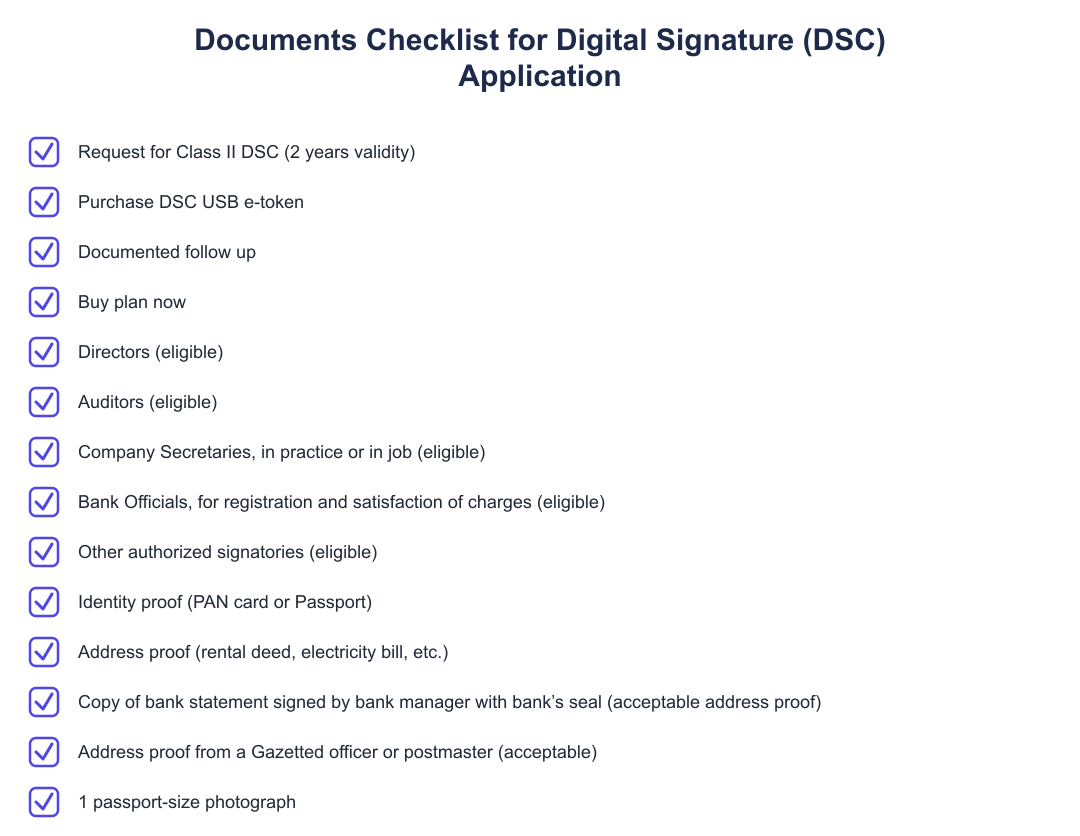
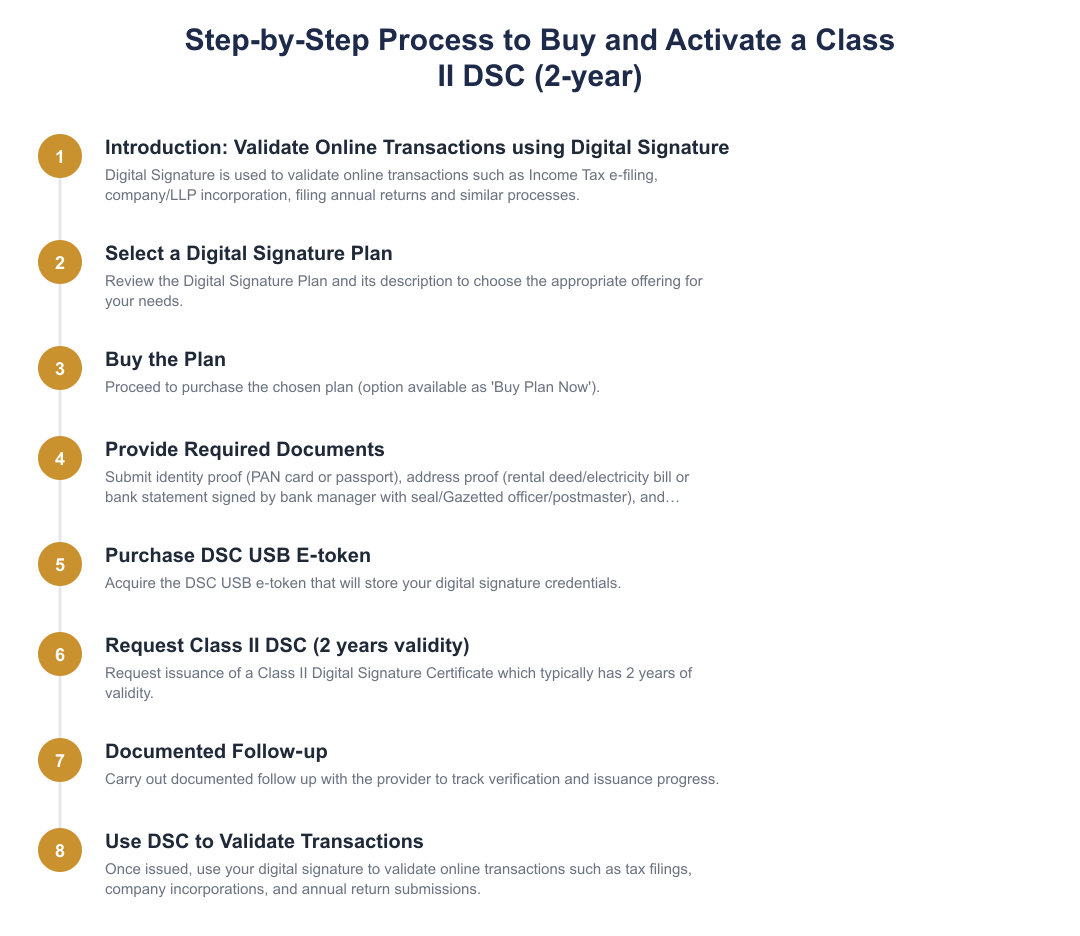
The Digital Signature plan typically includes request processing for a Class II DSC with two years validity, provision of a USB e-token to store the certificate, and documented follow-up to help complete verification and issuance. The package covers collection and submission of required identity and address documents, passport-size photograph, and liaising with the certifying authority to expedite issuance. Some plans may also include help with registering the DSC on portals such as MCA and Income Tax e-filing, though renewal is sold separately.
Who should get a Class II digital signature?
A Class II digital signature should be obtained by directors, auditors, company secretaries (whether in practice or employed), bank officials responsible for registration and satisfaction of charges, and other authorised signatories who file statutory documents. It is mandatory for entities required to get tax audits and for many company filings with the MCA, and is generally sufficient for most business compliance needs. If you participate in e-tendering or e-auctions you will instead need a Class III DSC.
What documents are required to apply for a Class II digital signature?
To apply for a Class II digital signature you need identity proof such as PAN card or passport, address proof like a rental deed, electricity bill, a bank statement signed by a bank manager with the bank’s seal, or certification by a gazetted officer/postmaster, and one passport-size photograph. The certifying authority uses these documents to verify your identity for issuance of the DSC. Ensure the documents are current and correctly attested where required to avoid processing delays.
What are the different types of digital signatures and when is each type used?
There are three main types of digital signatures: Class I is used mainly for securing email communication and does not suffice for statutory filings; Class II is used for company or LLP incorporation, income tax return e-filing, obtaining DIN/DPIN and filing other forms with the Ministry of Corporate Affairs and Income Tax Department; Class III is used primarily for e-tendering and participation in e-auctions where higher assurance is needed. For most business compliance activities such as MCA filings and tax e-filing, a Class II DSC is adequate; Class III is required only for specific high-security procurement processes.
How long is a digital signature valid and can it be renewed?
Digital signatures commonly come with a validity of one or two years and can be renewed once the term expires. Renewal must be purchased separately and the certifying authority or provider must be informed so government portals are updated about the new certificate; it is mandatory to notify authorities about expiry and reissuance. Plan purchases often list the validity period (e.g., 2 years) at the time of sale, and you should renew before expiry to avoid interruption in filing and access to portals.
Will my digital signature be automatically renewed under the same plan I bought originally?
No, renewal of a DSC is not included automatically in the initial plan and must be purchased separately at applicable renewal rates. You must proactively buy a renewal plan when your DSC term nears expiry and complete the verification steps again as required by the certifying authority. Providers typically remind customers before expiry, but it is the applicant’s responsibility to ensure renewal and inform relevant government portals about the new certificate.
How do I receive and use the DSC USB e-token provided with the plan?
When you buy the plan you are provided a USB e-token that securely stores your digital certificate; the token is delivered to you and must be plugged into your computer when signing documents or logging into government portals. Install the token drivers and middleware supplied by the issuer, import the certificate using the PIN provided, and then use it to digitally sign e-forms on portals like MCA and Income Tax e-filing. Keep the token safe and back up any recovery credentials, because loss of the token means you will need to request re-issuance of the certificate.
What advantages do I get from using a provider like ClearTax for obtaining a digital signature?
Using a provider like ClearTax simplifies the DSC procurement process through guided document submission, documented follow-up, and support for portal registration, which reduces processing time and errors. ClearTax highlights its marketplace reputation, such as recognition in media, and offers customer support to help you pick the correct DSC class and complete verification formalities. This bundled assistance is particularly helpful for first-time applicants or businesses that need timely compliance for MCA and Income Tax e-filings.
Need help staying Company Registration compliant?
MoneyGence's AI Finance OS tracks your compliance, wallet share, and finances in one place, built for agencies and growing businesses.
Get started with MoneyGence