Depreciation Methods: Types, Formulas & Examples
This guide explains the main depreciation methods used in accounting and finance, why depreciation matters for businesses, and how to choose an approach that fits a particular asset and reporting need. You will learn what depreciation means in practical terms, the common methods practitioners use to allocate an asset's cost over time, and the considerations that influence method selection. The guide focuses on conceptual clarity rather than numerical formulas, it helps you understand the strengths, limitations, and typical use-cases for each method so you can apply the right approach when preparing financial statements, planning cash flow for replacements, or comparing alternatives for tax and management reporting. Readers who manage fixed assets, prepare accounting records, or advise businesses will find guidance on how different methods reflect economic consumption, impact reported profit in early versus later years, and align with business objectives such as matching revenue and expense or reflecting usage patterns. The guide also outlines the practical steps to determine depreciation for an asset, and it answers frequently asked questions about choosing and changing methods. Use this as a conceptual reference to inform conversations with accountants, auditors, or tax advisors when you need to translate asset behaviour into consistent accounting treatment.
What is Depreciation?
Depreciation is the accounting process of allocating the cost of a tangible asset over the period it is expected to provide economic benefit. Instead of charging the entire purchase cost to the period in which the asset was acquired, depreciation spreads that cost across multiple reporting periods so that expense recognition aligns more closely with the pattern of usage and revenue generation.
Beyond its role in periodic profit measurement, depreciation helps businesses track the remaining book value of assets, plan for future replacement, and produce financial statements that give a more realistic view of ongoing operating performance. Different assets and business circumstances call for different approaches to how that allocation is structured.
Why is Depreciation Important?
Depreciation plays a central role in matching expenses to the periods in which assets contribute to revenue, which supports clearer assessment of operational profitability. By converting a one-time cash outflow into a systematic expense, it prevents disproportionate swings in reported results solely because of timing of purchases.
For management, depreciation provides signals about the ongoing cost of operating and maintaining an asset base. It aids budgeting for maintenance and replacement and informs investment decisions by showing how asset costs are being consumed over time.
For external users of financial statements, such as lenders, investors, and other stakeholders, consistent depreciation practices improve comparability and help users assess the sustainability of earnings and the sufficiency of asset-backed resources.
Types of Depreciation Methods (overview)
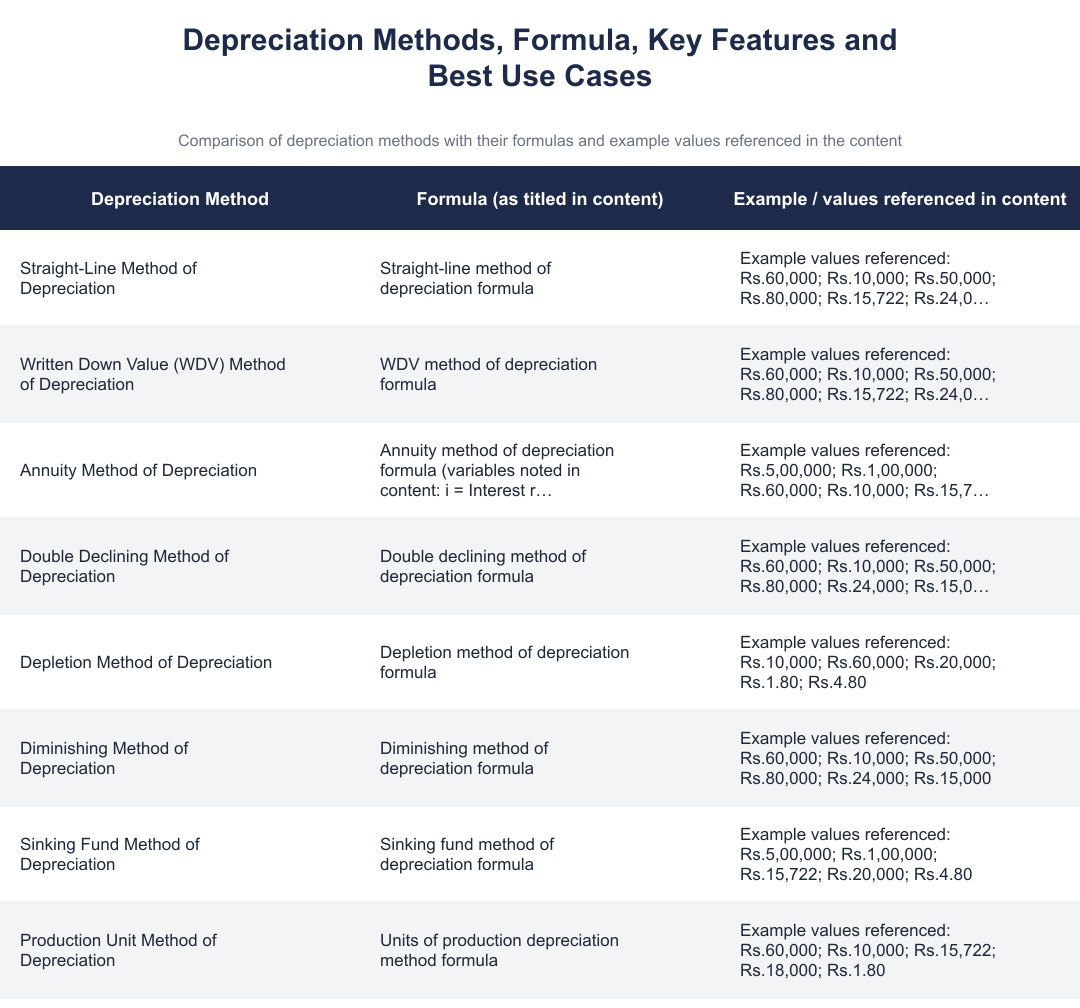
Accounting recognizes several families of depreciation methods. At a basic level they differ in whether they allocate cost evenly over an asset's useful life, accelerate expense recognition toward earlier years, tie expense to usage or output, or accumulate reserves to fund future replacement.
Commonly discussed methods include straight-line approaches, declining-balance or diminishing-balance approaches, usage-based approaches, and reserve-based approaches such as sinking funds. Each family has variants and practical adjustments that organisations choose based on the asset's consumption pattern, tax or regulatory requirements, and the informational needs of users.
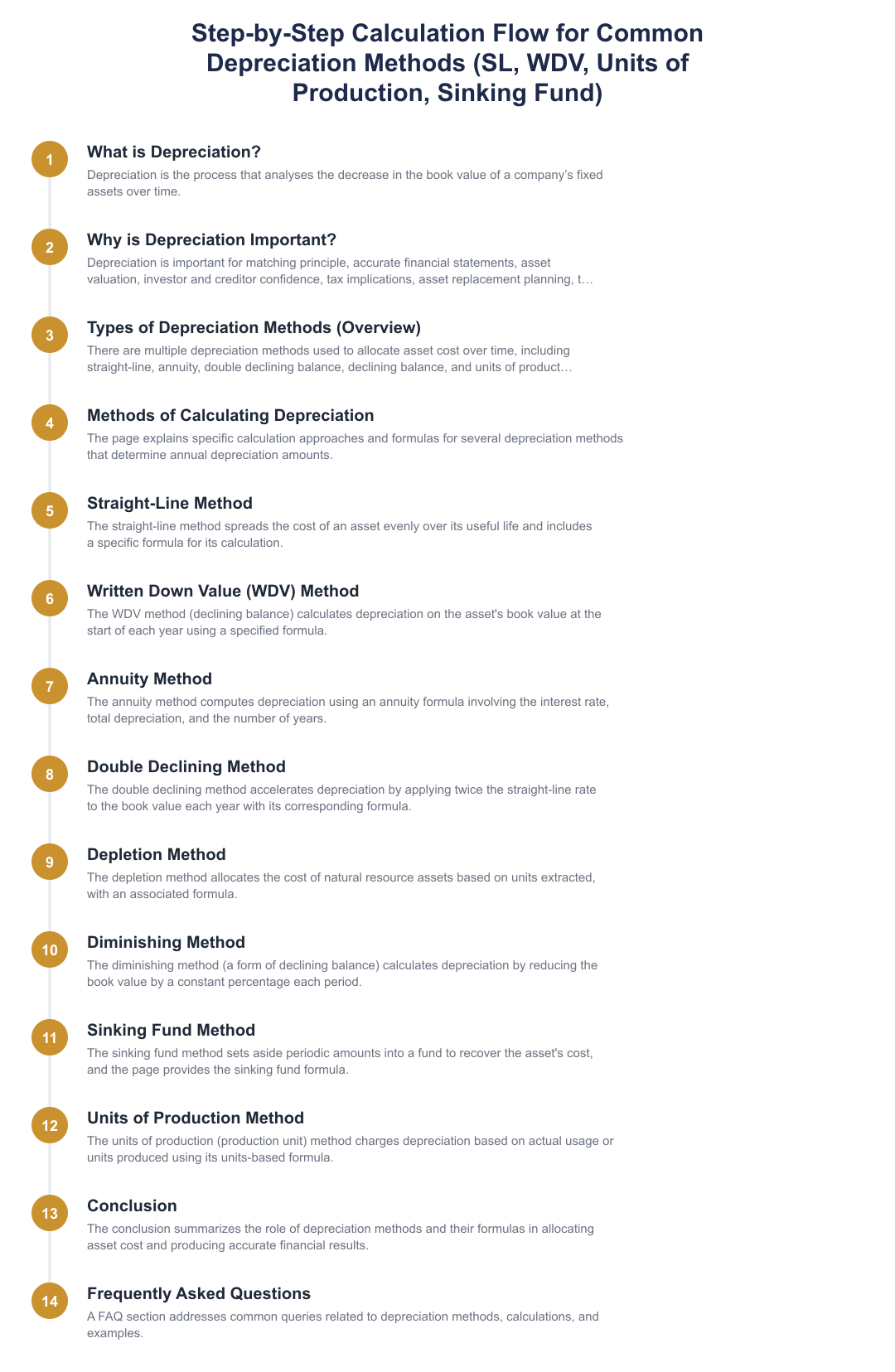
Methods of Calculating Depreciation, practical steps
Determine which expenditures form part of the asset's capitalised cost that will be depreciated rather than expensed immediately.
Make a reasoned estimate of the period over which the asset is expected to provide economic benefits; this affects how the cost is allocated across periods.
Estimate any expected salvage or scrap value at the end of the asset's useful life to avoid depreciating more than the recoverable amount.
Choose a method that best reflects the asset's pattern of consumption, straight-line for even use, usage-based for output-driven assets, or accelerated methods for assets that lose value faster in early years.
Once chosen, apply the method consistently from period to period; if a change is required, document the rationale and apply any required accounting treatment for changes in estimate or policy.
Record depreciation expense in the income statement and reduce the asset's carrying amount on the balance sheet, and provide appropriate disclosures in financial statement notes.
Common Depreciation Methods, conceptual descriptions
Straight-line method: This approach spreads the depreciable amount evenly across an asset's useful life. It is intuitive and simple to apply, which makes it popular for assets that provide consistent service over time.
Written-down value / Diminishing-balance methods: These accelerate expense recognition by applying a fixed rate to the asset's declining book value, producing higher depreciation charges in early years and smaller charges later on. Such approaches are useful when assets are more productive, or more likely to lose value, in the initial years.
Double-declining and other accelerated variants: These are forms of diminishing-balance methods that use a higher acceleration factor to front-load depreciation even more aggressively, reflecting rapid early consumption or obsolescence risks.
Units-of-production / Usage-based methods: These tie depreciation to actual usage, activity, or output, for example, machine hours or units produced, so expense follows the economic driver of wear and tear.
Sinking fund and annuity-style approaches: These set aside a future replacement amount over time, combining periodic contributions and assumed investment earnings to accumulate a replacement fund. They separate the accounting expense recognition from the mechanics of reserve accumulation.
Depletion: Used for natural resources, depletion charges reflect the extraction of a finite asset and allocate cost based on the quantity removed or produced.
Note on selection: The best method depends on the nature of the asset, the pattern of economic benefits, tax or regulatory constraints, and the reporting objectives of the business. Management should choose a method that yields the most reliable and relevant depiction of expense allocation.
Practical considerations when choosing a method
Consider the asset's physical usage, technological obsolescence risk, and maintenance profile. Equipment with steady output may suit straight-line allocation, while assets that decline quickly in productivity may warrant an accelerated method.
Think about the effects on financial ratios, profit reporting, and tax positions. Different methods change profit timing and carrying value, which influences metrics used by management and external stakeholders.
Ensure documentation: keep the rationale for the selected method, the useful life and residual value estimates, and any subsequent changes. Clear disclosure improves transparency and supports informed decision-making by users of the financial statements.
Depreciation is a foundational accounting concept that affects reported profit, asset values, and planning for future investment. Understanding the conceptual differences between methods, straight-line, accelerated, usage-based, and reserve-based, allows you to match accounting treatment to the economic reality of each asset. Choose and document the method that best reflects how an asset contributes to revenue, and revisit estimates periodically to ensure financial statements remain reliable and useful.
Frequently asked questions
What is depreciation and why does a business need to record it?
Depreciation is the systematic allocation of the cost of a tangible fixed asset over its useful life to reflect its falling book value due to wear and tear, obsolescence or usage. Recording depreciation helps match asset cost with the revenue the asset helps generate (matching principle), produces more accurate financial statements, affects taxable income and aids in planning for asset replacement; for example, spreading a Rs.10 lakh machine’s cost over 10 years recognises Rs.1 lakh per year under straight-line depreciation (ignoring salvage). Depreciation methods and rates vary depending on asset type, expected useful life and accounting/tax rules, so companies choose the method that best reflects consumption of economic benefits.
What are the main types of depreciation methods used in accounting?
The main depreciation methods are straight-line (SLM), written down value or diminishing balance (WDV), double-declining balance (DDB), units of production (or production unit), annuity, sinking fund, depletion and diminishing/decreasing methods. Each method spreads the depreciable amount differently, SLM charges equal amounts each year, WDV and DDB charge larger amounts early on, units of production tie expense to output, while annuity and sinking fund use interest-based formulas to determine annual charges. Choice depends on how the asset’s economic benefits are consumed, tax rules and management’s reporting objectives.
How do you calculate depreciation using the straight-line method (SLM)?
Under the straight-line method, annual depreciation = (Cost of asset − Salvage value) ÷ Useful life (in years). This gives a constant depreciation charge each year; for example, a Rs.5,00,000 asset with Rs.50,000 salvage and 9 years useful life has annual depreciation of (5,00,000−50,000)/9 = Rs.50,000. SLM is simple and appropriate when the asset provides roughly equal benefit each year and is commonly used for financial reporting.
What is the written down value (WDV) method and how is depreciation computed under it?
The written down value (WDV) or diminishing balance method charges depreciation as a fixed percentage of the asset’s opening book value each year, so depreciation declines over time. Formula: Depreciation for the year = Opening book value × Depreciation rate (percent); for example, with 20% rate, a Rs.1,00,000 opening balance gives Rs.20,000 first-year depreciation and the next year's base becomes Rs.80,000. WDV is suitable when assets lose more value earlier in life or for tax regimes that allow declining-balance rates set by law.
What is the double declining balance (DDB) method and what is its formula?
Double declining balance is an accelerated depreciation method that applies twice the straight-line rate to the asset’s opening book value, producing higher depreciation in early years. Formula: Annual depreciation = 2 × (1 ÷ Useful life) × Opening book value; for example, a 5‑year asset has a double-declining rate of 40% (2 × 1/5), so a Rs.2,00,000 opening value yields Rs.80,000 first-year depreciation. DDB does not subtract salvage when computing the percentage but depreciation is limited so book value does not fall below salvage value.
How does the units of production (production unit) method work and what formula is used?
The units of production method charges depreciation based on actual use or output; annual depreciation = (Cost − Salvage value) ÷ Total estimated units of production × Units produced during the year. For example, a machine costing Rs.10 lakh with Rs.1 lakh salvage and 1,00,000 total estimated units has a per-unit charge of (10,00,000−1,00,000)/1,00,000 = Rs.9; if it produces 12,000 units in a year the depreciation is Rs.1,08,000. This method is best when wear is closely related to activity level rather than time.
What is the annuity method of depreciation and what formula is used to compute the annual charge?
The annuity method treats depreciation as an annuity that recovers the book value over the asset’s life, incorporating an interest factor; annual depreciation = [i × BVSY] ÷ [1 − (1 + i)^−n], where i is the interest rate in decimal (interest%/100), BVSY is the book value at the start of the year, and n is the remaining life in years. This yields a constant annual charge that includes a component for interest and a component for principal (depreciation); for example, with BVSY = Rs.1,00,000, i = 0.08 and n = 5 the formula gives the fixed annual amount to amortise that book value over five years. The annuity method is used when a constant annual burden is desired and when interest cost is a consideration.
How does the sinking fund method calculate annual depreciation and what is the formula?
The sinking fund method requires periodic contributions so that, with interest, the accumulated fund equals the total depreciation (Cost − Salvage) by the end of the asset’s life; the annual contribution A can be computed as A = TDA × i ÷ [(1 + i)^n − 1], where TDA is total depreciation amount, i is the interest rate (decimal) and n is the number of years. For example, to accumulate Rs.90,000 over 10 years at 6% (i = 0.06) you solve A = 90,000×0.06/[(1.06)^10 −1] to find the yearly deposit required. The sinking fund method separates depreciation provisioning from the profit & loss charge by showing a fund accumulation on the balance sheet.
How should a business choose the right depreciation method for an asset?
Choose the method that best reflects how the asset’s economic benefits are consumed: use straight-line when benefits are even, WDV or double-declining when benefits are front-loaded, units of production when wear is usage-based, and annuity/sinking fund when interest considerations or replacement funding are priorities. Also consider tax regulations (some jurisdictions prescribe or restrict methods and rates), materiality, industry practice and the effect on reported profits, for example, accelerated methods lower early taxable income but reduce profits. Maintain consistent application and disclose any change in method with reasoning and impact in the notes to financial statements.
Need help staying Accounting compliant?
MoneyGence's AI Finance OS tracks your compliance, wallet share, and finances in one place, built for agencies and growing businesses.
Get started with MoneyGence