Convert Partnership Firm to LLP: Procedure & Documents
This guide explains the legal framework and practical consequences when a partnership firm converts into a Limited Liability Partnership (LLP) in India. You will learn which statutory provision governs the conversion, the principal legal differences between a partnership and an LLP that matter for owners and creditors, what happens to assets, liabilities and ongoing proceedings on conversion, and the partner-level liabilities that continue after conversion. Understanding these points helps partners decide whether conversion aligns with their risk profile, governance needs and future plans. The conversion process is not merely a change of name or formality, it alters the entity’s legal personality, the extent of partner liability going forward, and the obligations around accounts and compliance. This guide sticks to the statutory facts that determine outcome and liability on conversion, so you will get clear, reliable direction on the consequences that are certain under the law and what partners must accept in their statements of consent during the conversion.
Key Differences Between a Partnership and an LLP
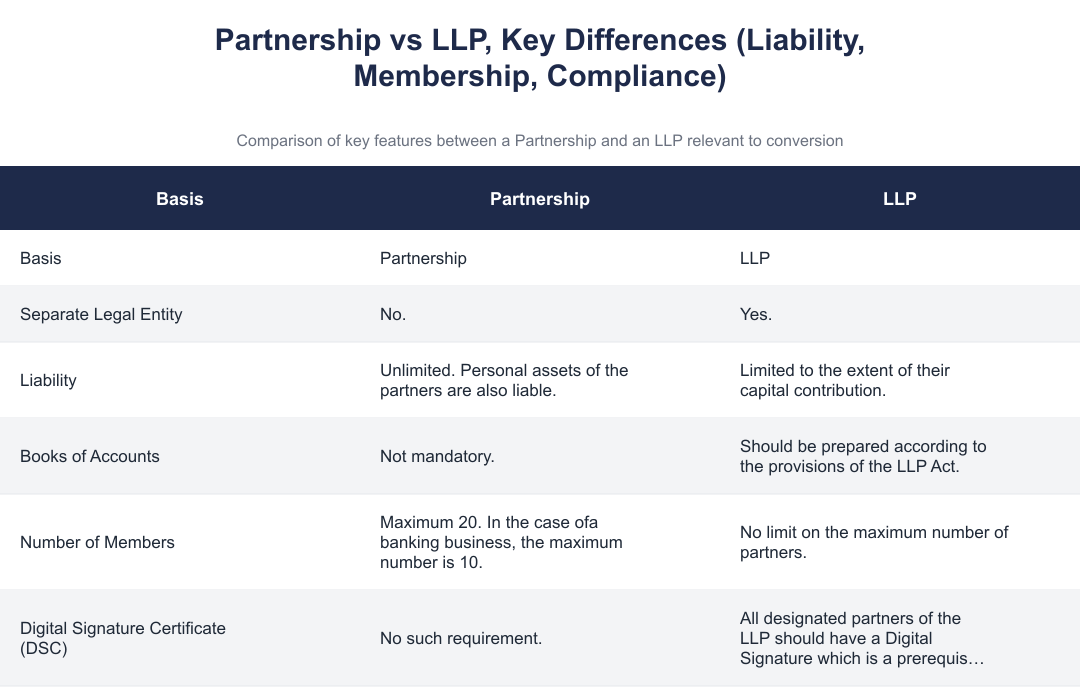
The Limited Liability Partnership (LLP) and the traditional partnership differ fundamentally in legal character. An LLP is a separate legal entity, it has its own legal personality distinct from its partners; a partnership (general partnership) does not enjoy this separate legal status.
Liability treatment is another core distinction. In a partnership, partners carry unlimited liability, which means their personal assets can be exposed for firm liabilities. In contrast, in an LLP partners’ liability is limited to the extent of their capital contribution to the LLP.
On compliance and record-keeping, LLPs are subject to statutory requirements for maintaining books of accounts as mandated by the LLP Act, whereas partnerships do not fall under the same LLP-specific accounting obligations.
There is also a statutory limit on membership for general partnerships: a maximum of 20 partners for most businesses, and a lower limit of 10 where the partnership carries on banking business.
Side-by-side: Partnership vs LLP (key legal points)
| Basis | Partnership | LLP |
|---|---|---|
| Separate legal entity | No. | Yes. |
| Liability | Unlimited; personal assets of the partners may be liable. | Limited to the extent of partners' capital contribution. |
| Books of accounts | Not governed by LLP Act requirements. | Should be prepared according to the provisions of the LLP Act. |
| Number of members (general partnerships) | Maximum 20 (10 for banking business). | No separate limit stated in verified facts. |
Statutory Basis and Conditions for Conversion
Conversion of a partnership firm into an LLP is governed by the Limited Liability Partnership Act, 2008. Specifically, Section 55 of the Act read with Schedule II prescribes the legal framework for converting a registered partnership into an LLP.
Because the conversion is statutory, the process and its consequences flow from the Act and Schedule II. Parties contemplating conversion should base their decisions on these provisions because they determine which partners become LLP partners, how liabilities transfer, and what formal statements must accompany the conversion application.
Procedure, high‑level steps under Section 55 and Schedule II
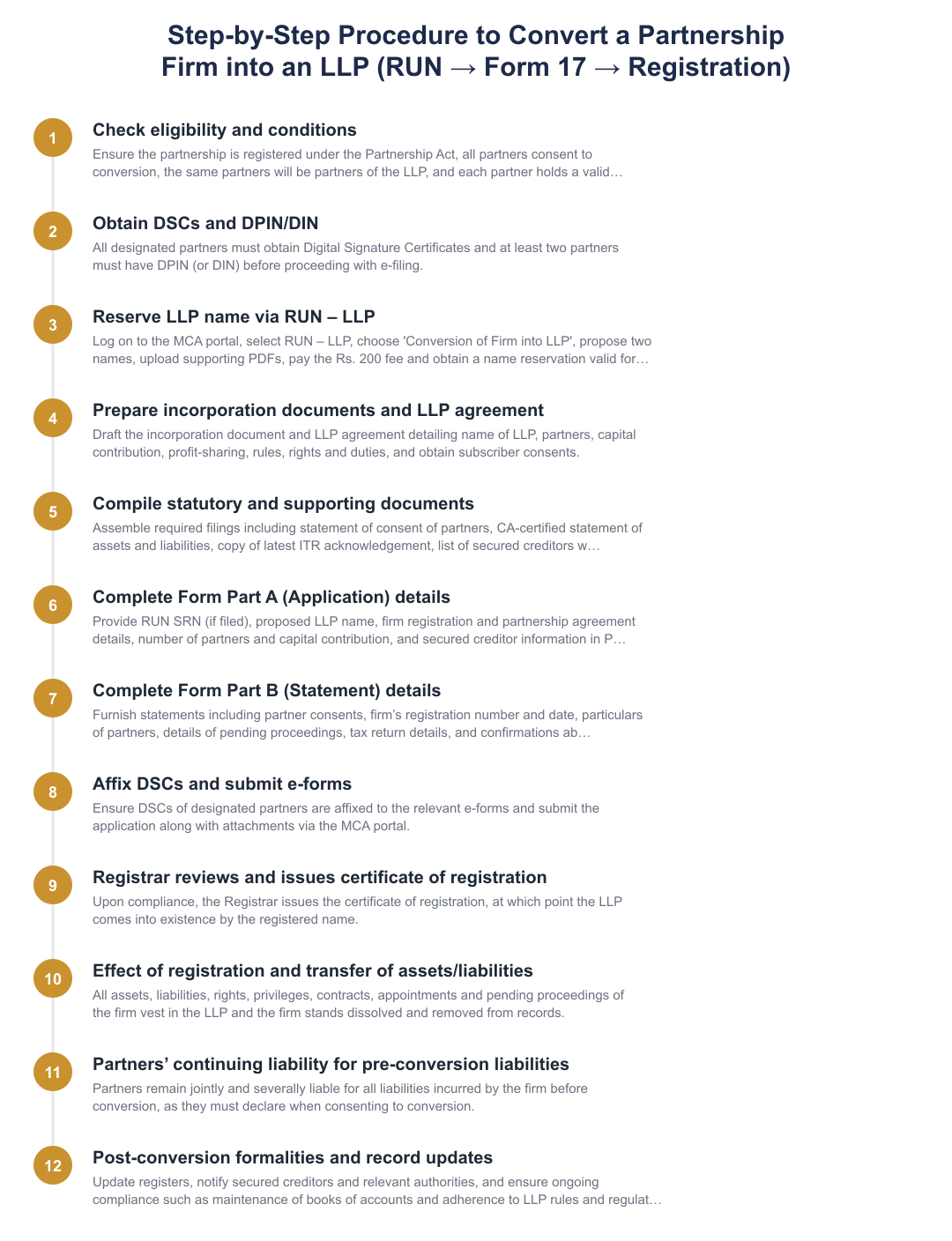
Begin the conversion process in accordance with the requirements laid down in Section 55 and the related provisions of Schedule II of the LLP Act.
File the prescribed application and accompanying statements required by the Act and Schedule II so that the Registrar can record the LLP incorporation and dissolution of the firm.
On registration, the LLP is constituted and the legal consequences described under the Act, vesting of assets and liabilities, and dissolution of the firm, take effect.
Effect of Registration and Continuing Liabilities
Once registered as an LLP under the conversion provisions, all assets, liabilities, rights and privileges that were vested in the partnership firm vest in the LLP. The firm stands dissolved and may be removed from records if it was registered under the Indian Partnership Act, 1932.
Proceedings, orders or judgments that were pending against or in favour of the firm continue to be enforceable against the LLP after conversion. Existing contracts, appointments and authorities that involved the firm operate as if the LLP is the party, preserving legal continuity.
Despite the transfer of liabilities to the LLP, partners must give statutory statements of consent. As part of that consent, partners are required to state that they will remain liable, jointly and severally, for all liabilities incurred by the firm before conversion. This preserves creditor protection for pre‑conversion obligations.
Practical implications for partners and creditors
For partners, conversion alters prospective exposure: post‑conversion, their liability in relation to LLP obligations is limited to capital contribution, but they remain personally accountable for pre‑conversion liabilities by virtue of their statutory consent. This dual outcome means conversion shifts future risk while keeping responsibility for historical obligations.
For creditors and counterparties, the law ensures continuity and enforceability: rights, liabilities and ongoing proceedings do not evaporate on conversion but can be enforced against the LLP, and partners have expressly undertaken joint and several liability for pre‑conversion debts. This combination balances the LLP’s separate legal identity with protection for those who dealt with the firm before conversion.
Conversion from a partnership firm to an LLP is a statutory process governed by Section 55 read with Schedule II of the LLP Act. It creates a separate legal entity and limits future partner liability to capital contribution while ensuring that assets, liabilities and ongoing proceedings transition to the LLP. Partners must, however, accept joint and several liability for liabilities incurred before conversion. These are the core legal outcomes you should weigh when considering conversion; for procedural detail and form-level requirements consult the Act, Schedule II and the Registrar’s filing guidance.
Frequently asked questions
What is the main difference between a partnership firm and an LLP?
The main difference is that an LLP is a separate legal entity while a partnership is not. In an LLP partners have limited liability limited to their capital contribution, whereas in a partnership partners have unlimited liability and personal assets can be at risk. LLPs must prepare books of accounts as per the LLP Act and require Digital Signature Certificates (DSC) for designated partners for e‑filing, while partnerships do not have those statutory e‑filing requirements. There is also no upper limit on the number of partners in an LLP, whereas a partnership is generally limited to 20 (10 for banking businesses).
Why should I consider converting a partnership firm into an LLP?
You should consider converting because an LLP offers limited liability, perpetual succession and is more attractive for investors compared with a traditional partnership. The LLP structure limits partners’ liability to their agreed capital contribution, keeps the business alive despite death or change of partners, and is viewed favourably by venture capital and foreign investors. LLPs also allow multidisciplinary professional collaboration and provide flexibility in management under the LLP Agreement, making them suitable for growing or professionally-managed businesses.
What are the legal conditions required to convert a registered partnership firm into an LLP?
To convert a registered partnership firm into an LLP the conversion must comply with Section 55 of the LLP Act, 2008 and Schedule II, and all existing partners of the firm must become partners of the LLP. The firm must be registered under the Indian Partnership Act, 1932, all partners must provide consent, and designated partners must obtain DPIN/DIN and valid Digital Signature Certificates (DSC) before e‑filing. No new partners may be added in the conversion application, secured creditors’ consents must be obtained where applicable, and all statutory approvals (if any) must be secured prior to filing.
What are the step-by-step procedures to convert a partnership firm into an LLP?
The conversion process starts with reserving a name on the MCA portal via RUN‑LLP (choose 'Conversion of Firm into LLP') and paying the Rs. 200 fee; the reserved name is valid for 90 days. After name approval, designated partners with DSCs must file prescribed incorporation forms (including LLP Form 17) with details like SRN of RUN, firm registration, partners’ particulars, capital contribution and audited statement of assets and liabilities certified by a CA. On successful registration the Registrar issues a certificate of registration, the firm’s assets, liabilities and contracts vest in the LLP, and the registered partnership firm stands dissolved and removed from records.
What documents do I need to file for converting a partnership firm into an LLP?
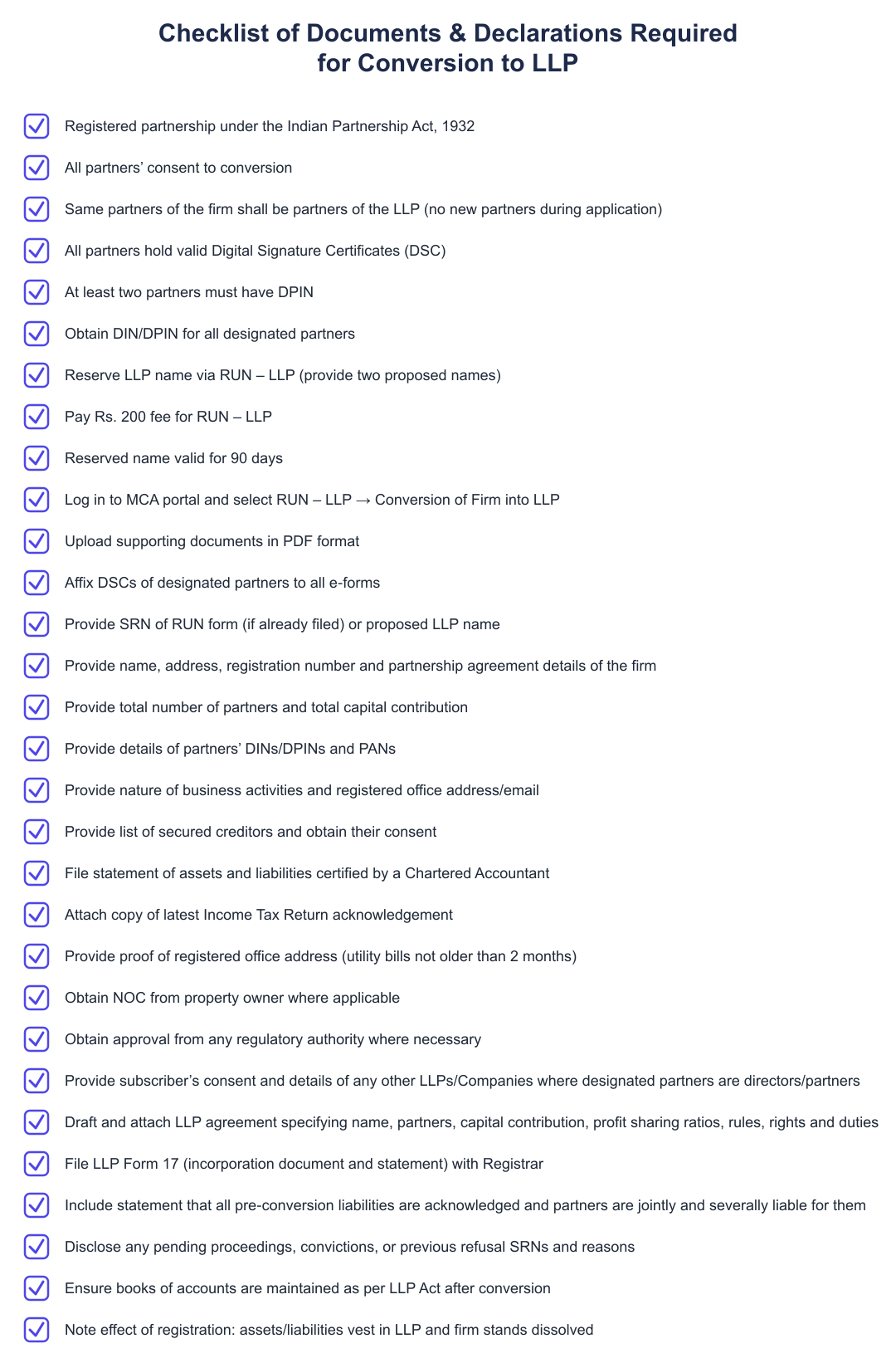
You need the RUN‑LLP SRN or proposed LLP name, the firm’s registration and partnership agreement details, CA‑certified statement of assets and liabilities, latest income tax return acknowledgement, consent of all partners and consents of secured creditors (if any). Additional documents include proof of registered office (NOC from owner, utility bill not older than 2 months), identity and address proofs of partners, subscriber consent, approvals from regulatory authorities if required, and details of DIN/DPIN and DSCs of designated partners. LLP incorporation filings also require an incorporation document and statement by the professional (CA/CS/CMA/advocate) certifying compliance with incorporation requirements.
Do all partners need Digital Signature Certificates (DSC) and DPIN/DIN before converting?
Yes, all designated partners of the proposed LLP must have Digital Signature Certificates (DSC) and at least two partners must have DPIN/DIN before filing e‑forms. Every e‑form submitted to the MCA requires the DSCs of designated partners for successful electronic submission, and DPIN/DINs are required to identify designated partners. Without valid DSCs and DPIN/DINs the conversion application cannot be processed, so partners should obtain these credentials in advance.
What is LLP Form 17 and what information does it require?
LLP Form 17 is the incorporation document and statement required for conversion that furnishes particulars of the firm and the proposed LLP and must be filed with the Registrar. Part A of the form includes application details like SRN, name and address of the firm, registration number under the Partnership Act, date of partnership, number of partners and total capital contribution; Part B requires the statement including consent of partners, details of assets and liabilities, list of secured creditors and declarations about pending proceedings and approvals. The form must be accompanied by supporting attachments such as CA-certified statements, partner consents, ITR acknowledgement and other necessary approvals or NOCs.
What is the legal effect of registration of an LLP on the existing partnership firm?
Upon registration the LLP comes into existence by the registered name and all assets, liabilities, rights and privileges of the partnership firm vest in the LLP. The partnership firm stands dissolved and will be removed from the Registrar’s records if it was registered under the Partnership Act, and all existing contracts, appointments and pending legal proceedings continue with the LLP as the party. Additionally, any order or judgment against or in favour of the firm may be enforced against or by the LLP and partners remain jointly and severally liable for liabilities incurred before conversion unless otherwise agreed.
Are partners liable for debts incurred before conversion and can they be removed immediately after conversion?
Partners remain jointly and severally liable for all liabilities incurred by the firm before the conversion until discharged, and each partner must state this liability in the consent statement filed with the Registrar. All partners of the firm must initially become partners of the LLP at the time of conversion; a partner who wishes to cease being a partner must be removed only after the conversion process is complete following LLP procedures. Therefore partners cannot be excluded from the LLP in the conversion application itself, and secured creditors’ consents should be obtained if liabilities are secured.
Need help staying Company Registration compliant?
MoneyGence's AI Finance OS tracks your compliance, wallet share, and finances in one place, built for agencies and growing businesses.
Get started with MoneyGence