Companies Compliance Facilitation Scheme 2026, Complete Guide
This guide explains the Companies Compliance Facilitation Scheme, 2026 in practical terms and helps company directors, company secretaries, chartered accountants and compliance teams understand what to expect and how to approach the window of relief and procedural measures that such schemes typically offer. You will learn the likely objectives behind a facilitation scheme, the common benefits for companies and officers in default, typical eligibility considerations, and the practical steps organisations should take to decide whether to opt in. The guide focuses on pragmatic compliance planning: assessing outstanding filings, documenting reasons for past non-compliance, coordinating with professional advisers, and preparing records so participation, if appropriate, is smooth and defensible. It also highlights governance implications for directors and the kinds of internal controls firms should strengthen after completing their participation. Understanding a facilitation scheme matters because these windows usually present a time-limited chance to regularise matters with reduced friction. For many companies, timely participation can reduce administrative burdens, lower costs associated with long-pending defaults, and remove barriers to other corporate actions. For professionals, the scheme creates workstreams that must be prioritised and executed accurately to avoid follow-on issues. This guide is written to help you prioritise tasks, assess readiness, and align corporate governance with regulatory expectations when a facilitation scheme is in force, without assuming any specific clause, fee or timeline.
What a Companies Compliance Facilitation Scheme usually aims to achieve
Facilitation schemes announced by corporate regulators are generally intended to encourage companies to clear legacy non-compliances and to update public records so the registry reflects the true status of entities. Such schemes often prioritise easing procedural or cost barriers that block companies from coming into good standing, while also giving the registry accurate and up-to-date information about active and inactive entities.
From a practical perspective, these schemes typically balance two objectives: incentivising voluntary compliance and preserving the integrity of the corporate registry. For directors and officers, the scheme can be an opportunity to resolve outstanding statutory filings and rectify omissions without prolonged adjudication. For the regulator, it is a mechanism to reduce backlog, update data and channel resources to cases that require deeper scrutiny.
Who should consider participating and how to prioritise cases
Companies with overdue statutory filings, missing financial statements, or gaps in board and member records should assess whether participation is appropriate. The decision to participate depends on the company’s commercial plans (for example, seeking investment or loans), the status of directors, and whether any parallel regulatory or litigation processes are under way that could affect eligibility.
Prioritise filings that unlock immediate practical benefits: filings that enable bank account operations, renewals, or corporate transactions should come first. Equally, companies that are inactive but want to regularise their status before taking any corporate action should review outstanding obligations and collect supporting documents before applying under the scheme.
How to prepare, checklist for companies and professionals
Start by compiling a list of all pending statutory filings, board and member records, and financial statements. Gather documentary support such as board minutes, bank records, and audited or unaudited accounts as applicable. Early coordination with the statutory auditor or company secretary can reduce last-minute rework, especially where attestations or certifications are required.
Maintain an internal audit trail of steps taken to comply: board resolutions approving filing, engagement letters with professionals, and proof of payments, where applicable. This documentation is useful not only for the scheme filing itself but also for demonstrating good faith and remedial intent should questions arise after regularisation.
Common pitfalls to avoid when using a facilitation scheme
Do not delay compiling records until the last minute. Many companies underestimate the time required to retrieve older documents, obtain auditor certifications or reconstitute missing registers. Delays can lead to errors or incomplete filings, which may limit the benefits available under the scheme.
Avoid assuming automatic immunity from other regulatory processes. Participation in a regularisation window typically addresses specific compliance gaps but may not extinguish liabilities or ongoing investigations that fall outside the scheme’s scope. Seek professional advice if you suspect parallel proceedings or if the company has other exposures that might not be covered.
After regularisation, governance steps and next actions
Once filings are completed, update internal compliance calendars and assign clear ownership for statutory deadlines to prevent recurrence. Implement standard operating procedures for routine filings, and consider periodic internal reviews to detect lapses early. This reduces the likelihood of reliance on future schemes and improves corporate credibility.
Communicate the outcome to stakeholders, including lenders, investors and key suppliers, if the regularisation materially affects the company’s ability to transact. Where director or officer records were impacted, confirm record updates with the regulator and maintain proof of compliance in the company’s minute books and compliance register.
A Companies Compliance Facilitation Scheme can be a valuable tool for companies seeking to regularise past defaults and restore clean records with the corporate registry. Careful planning, early documentation, and coordination with professional advisers will maximise the benefits and reduce risks. After regularisation, strengthening internal controls and compliance processes will preserve the gains and reduce the need for future remediation windows.
Frequently asked questions
What is the Companies Compliance Facilitation Scheme (CCFS) 2026?
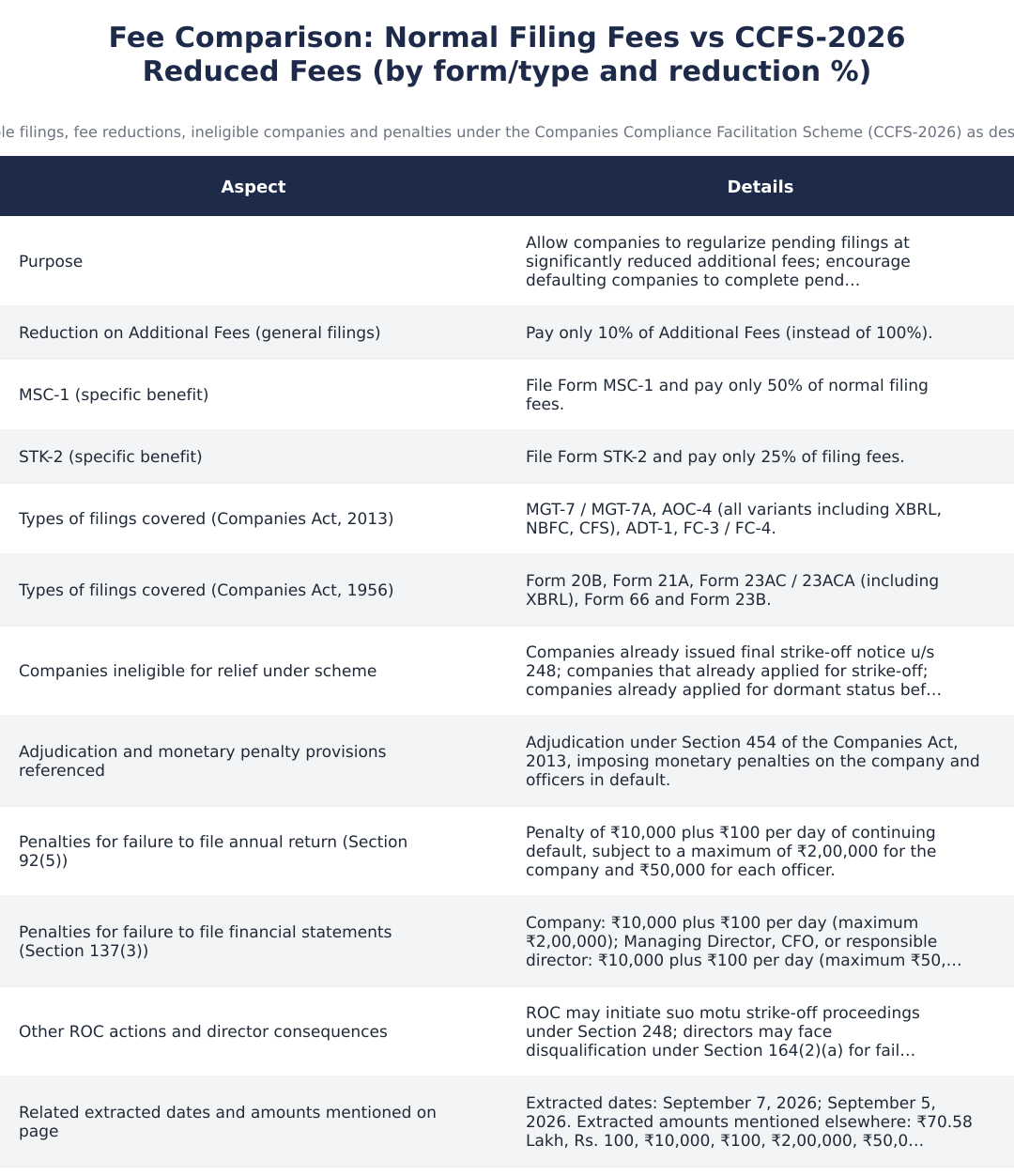
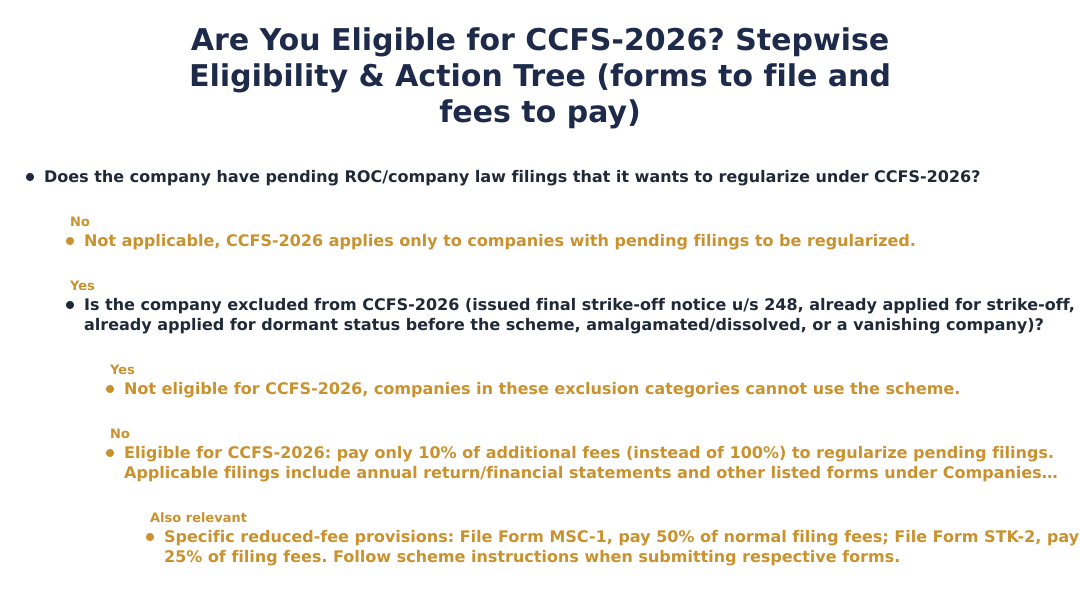
The Companies Compliance Facilitation Scheme (CCFS) 2026 is a special MCA scheme that lets companies regularize pending filings by paying substantially reduced additional fees. The scheme aims to reduce additional fees (in many cases to 10% of what would otherwise be payable) to encourage defaulting companies to complete pending compliances, update MCA records and either become dormant or close down legally. It covers a broad range of defaulted filings under the Companies Act (both 2013 and selected 1956 forms) subject to exclusions, and also contains specific reduced-fee provisions for forms like MSC-1 (50% of normal fees) and STK-2 (25% of filing fees). Companies should check the exact forms covered and timelines in the official scheme notification before filing.
Which forms and filings are eligible under CCFS-2026?
CCFS-2026 covers a wide range of common ROC filings including annual filings under the Companies Act, 2013 such as MGT-7 / MGT-7A (annual return), AOC-4 (financial statements, including XBRL, NBFC and CFS variants), ADT-1 (appointment of auditor), and FC-3 / FC-4 (return of allotment/other). It also lists certain forms under the Companies Act, 1956 like Form 20B, 21A, 23AC / 23ACA (including XBRL), Form 66 and Form 23B as eligible. Special provisions are noted for MSC-1 (50% of normal filing fees) and STK-2 (25% of filing fees), while the standard benefit in other cases is reduced additional fees to a fraction (e.g., 10%) of the usual surcharge.
How much will companies pay instead of full additional fees under CCFS-2026?
Under CCFS-2026 the additional fees for many delayed filings are drastically reduced, in many cases companies pay only 10% of the additional fees that would otherwise be applicable. Separate reduced rates are specified for certain forms: companies filing Form MSC-1 pay only 50% of the normal filing fees, while those filing Form STK-2 pay only 25% of the filing fees. The exact quantum (10% or specific percentages for MSC-1 and STK-2) and how they apply should be verified against the scheme notification and the particular form being filed.
Which companies are excluded from the CCFS-2026 benefits?
Companies expressly excluded from CCFS-2026 include those already issued a final strike-off notice under Section 248, companies that have already applied for strike-off, companies that applied for dormant status before the scheme, amalgamated or already dissolved companies, and vanishing companies. These exclusions mean such entities cannot regularize defaults under CCFS-2026 and must pursue other remedies or wait for separate MCA directions. If your company falls into any of these categories you should consult ROC communications or a professional for alternative options.
Does CCFS-2026 protect companies and directors from penalties or prosecution?
No, CCFS-2026 does not automatically provide immunity from all penalties or adjudication; it primarily offers reduced additional filing fees to regularize statutory filings. Adjudication under Section 454 of the Companies Act, 2013 may still apply where the ROC initiates penalty proceedings, and statutory penalties under Section 92(5) (annual return), Section 137(3) (financial statements) and other provisions can still be relevant if adjudication proceeds. The scheme aims to encourage compliance and reduce administrative burden, but it does not guarantee relief from prior or separate adjudicatory actions unless specifically stated in the scheme terms; companies facing formal penalty notices should seek legal advice before relying solely on the scheme.
Can filing under CCFS-2026 prevent strike-off or director disqualification?
Filing under CCFS-2026 can help avoid future ROC action such as suo motu strike-off under Section 248 if the company regularizes outstanding returns, but it does not automatically reverse proceedings already at an advanced stage like a final strike-off notice. Regularizing three consecutive years of defaults will also help prevent directors from being disqualified under Section 164(2)(a), since disqualification occurs when financial statements or annual returns are not filed for three consecutive financial years. If strike-off or disqualification notices have already been issued, affected entities should check the scheme exclusions and seek professional assistance to understand whether revival or other remedies are available.
What are the penalties for not filing annual returns and financial statements outside the scheme?
Outside the scheme, penalties can be significant: under Section 92(5) a company faces ₹10,000 plus ₹100 per day of continuing default (capped at ₹2,00,000) for failing to file annual returns, and each officer can face up to ₹50,000; under Section 137(3) failure to file financial statements attracts ₹10,000 plus ₹100 per day (maximum ₹2,00,000) for the company and up to ₹50,000 for responsible officers like MD or CFO. Additionally, the ROC may initiate suo motu strike-off proceedings under Section 248 and adjudication under Section 454 of the Companies Act, 2013 can impose monetary penalties on the company and officers in default. These penalties are separate from the reduced fee mechanism provided by CCFS-2026 and may continue to be enforced unless specifically addressed by adjudicatory orders or scheme provisions.
How does CCFS-2026 help inactive companies that want to become dormant or close legally?
CCFS-2026 helps inactive companies by reducing the cost barrier to file pending statutory returns so they can either apply for dormant status or complete legal closure procedures without prohibitive additional fees. By regularizing past filings (for example annual returns and financial statements) at reduced additional fee rates, companies can update MCA records and then pursue formal dormant status via the prescribed forms or initiate voluntary strike-off/closure processes as per law. However, companies that had already applied for dormant status before the scheme or have been issued final strike-off notices are excluded from the scheme benefits, so they must follow alternate procedures.
Do I still have to pay normal filing fees if I use CCFS-2026, or only the reduced additional fees?
You must pay the normal statutory filing fees in addition to the reduced additional fees prescribed under CCFS-2026; the scheme reduces only the additional/penalty component (for example to 10% or specified percentages for certain forms) and does not waive the normal filing fee itself. For certain specific filings the scheme prescribes alternative fee treatments (e.g., MSC-1 at 50% of normal filing fees and STK-2 at 25% of filing fees), but generally normal filing fees remain payable alongside the reduced additional fees. Always verify the exact payable amounts for the particular form and period of default as provided in the official scheme rules before submitting payment.
Need help staying Company Registration compliant?
MoneyGence's AI Finance OS tracks your compliance, wallet share, and finances in one place, built for agencies and growing businesses.
Get started with MoneyGence