Cancel GST Registration Online: Step-by-Step Guide 2026
This guide explains what it means to cancel a GST registration, who can initiate cancellation, the practical consequences for a business, and high-level steps you should consider before and after cancellation. Whether you are closing down a business, transferring it, or changing its legal structure, understanding cancellation helps you avoid compliance gaps and unexpected liabilities. The guide focuses on the practical implications and planning considerations that matter to proprietors, partners, directors and tax teams so you can make informed decisions and coordinate with your accountant or tax advisor. You will learn who may start the cancellation process, what typically happens to your tax obligations when registration ends, common reasons businesses seek cancellation, what happens when the tax authority initiates cancellation, and general options if you need to undo a cancellation. This is not a substitute for professional advice for your specific facts, but it will prepare you to ask the right questions, assemble the necessary records, and communicate clearly with the tax officer or portal during the process.
Meaning of Cancellation of GST Registration
Cancellation of GST registration is the formal ending of a taxpayer's registration with the goods and services tax administration. Conceptually it means the business is no longer recognised under the GST system for the previously held registration number and should not continue to charge or collect GST under that registration.
In practice, cancellation affects how you file returns, maintain records and discharge any outstanding tax, interest or compliance obligations that relate to the period while you were registered. Businesses typically treat cancellation as a legal and administrative milestone that requires careful documentation and reconciliation of supplies, tax payments and input tax credits earned before the effective end date.
Consequences of GST Registration Cancellation
Once a registration is cancelled, the business should stop issuing tax invoices that show GST under that registration. Continuing to trade under a cancelled registration can create compliance risks and may lead to penalties or other enforcement action by tax authorities.
Cancellation also typically necessitates final reconciliations, for example, settling any outstanding tax liabilities, accounting for unused input tax credits and preserving business records for the statutory retention period. Even after cancellation, records relating to periods of registration generally remain subject to audit or assessment by the tax authority.
Who can Cancel the GST Registration?
Cancellation can be initiated by the taxpayer or suo moto by a Tax Officer. This means that either the person registered under GST may apply to have their registration cancelled, or an assessing officer may initiate the process on the authority’s own motion.
Because both parties may initiate cancellation, businesses should monitor their compliance closely and maintain open communication with tax officers. If you believe your registration should be cancelled, prepare supporting documentation and consult your tax advisor; conversely, if you receive communication from the tax authority about cancellation, respond promptly and seek clarification where necessary.
Cancellation by Tax Officer
When a tax officer initiates cancellation, it is often because of information or evidence suggesting that the registration is no longer valid or that statutory conditions for registration are not met. An officer-led cancellation may follow an inquiry or verification exercise.
If you are subject to an officer-initiated cancellation, treat communications from the tax office seriously. You should obtain full details of the grounds for cancellation, provide clear and timely responses, and work with your advisor to present supporting documents or explanations that clarify your position.
Revocation of Cancellation of Registration
Revocation refers to the reopening or reinstatement of a registration that was previously cancelled. In principle, if circumstances that led to cancellation change or the taxpayer successfully disputes the grounds for cancellation, there are routes to seek reinstatement.
If you intend to pursue revocation, gather all evidence that supports your case, such as proofs of business continuity, corrected returns or payments that address the issues raised, and engage with the officer or portal handling your file. Timely, transparent engagement increases the chances of a favourable outcome.
Cancellation of GST registration is an important administrative step with legal and financial consequences. Remember that either the taxpayer or a tax officer can initiate cancellation, so proactive compliance and prompt response to any authority communication are key. Consult your tax advisor to plan reconciliations, preserve records and, if needed, pursue revocation or re-registration in line with your business plans.
Frequently asked questions
How do I cancel my GST registration online as a taxpayer?
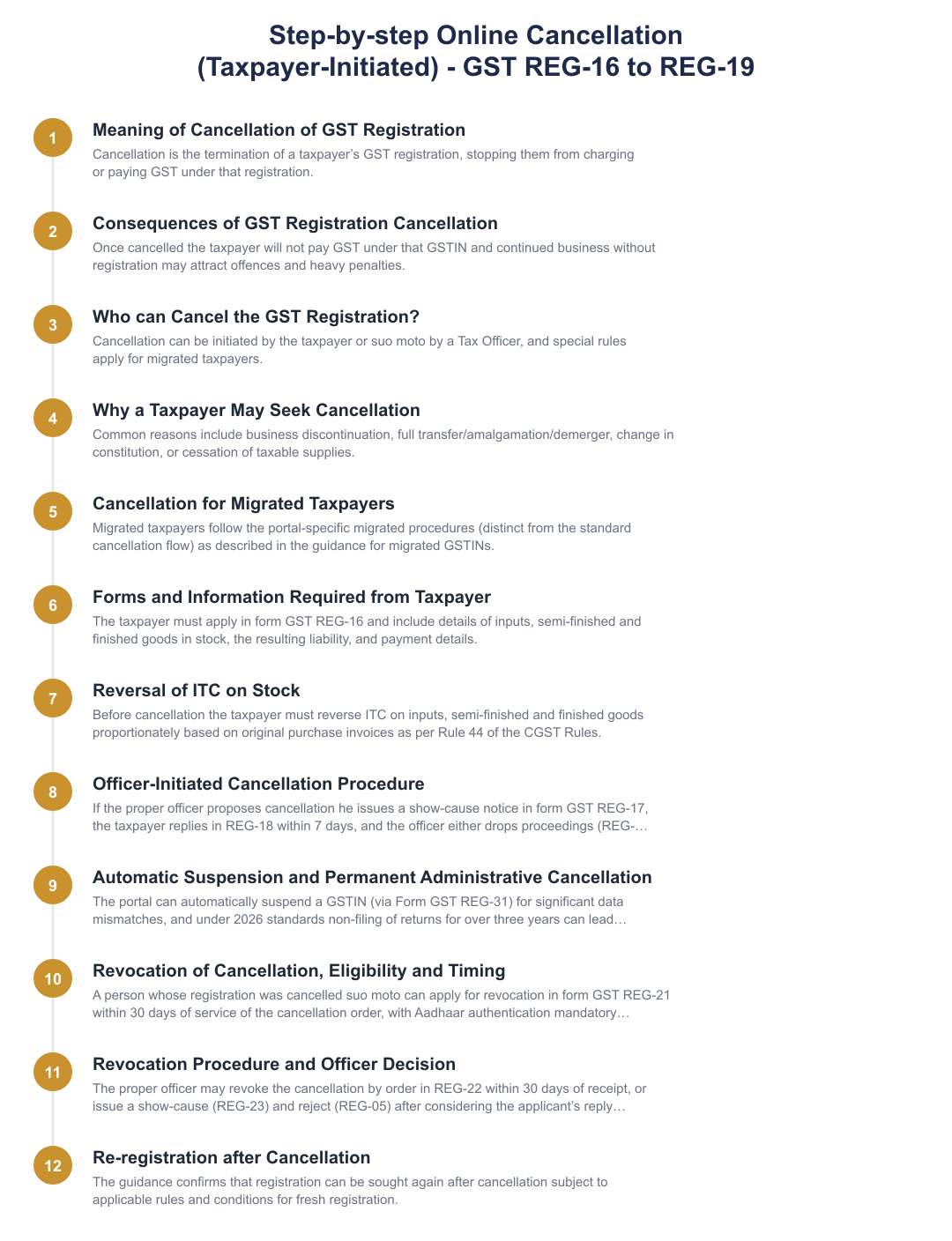
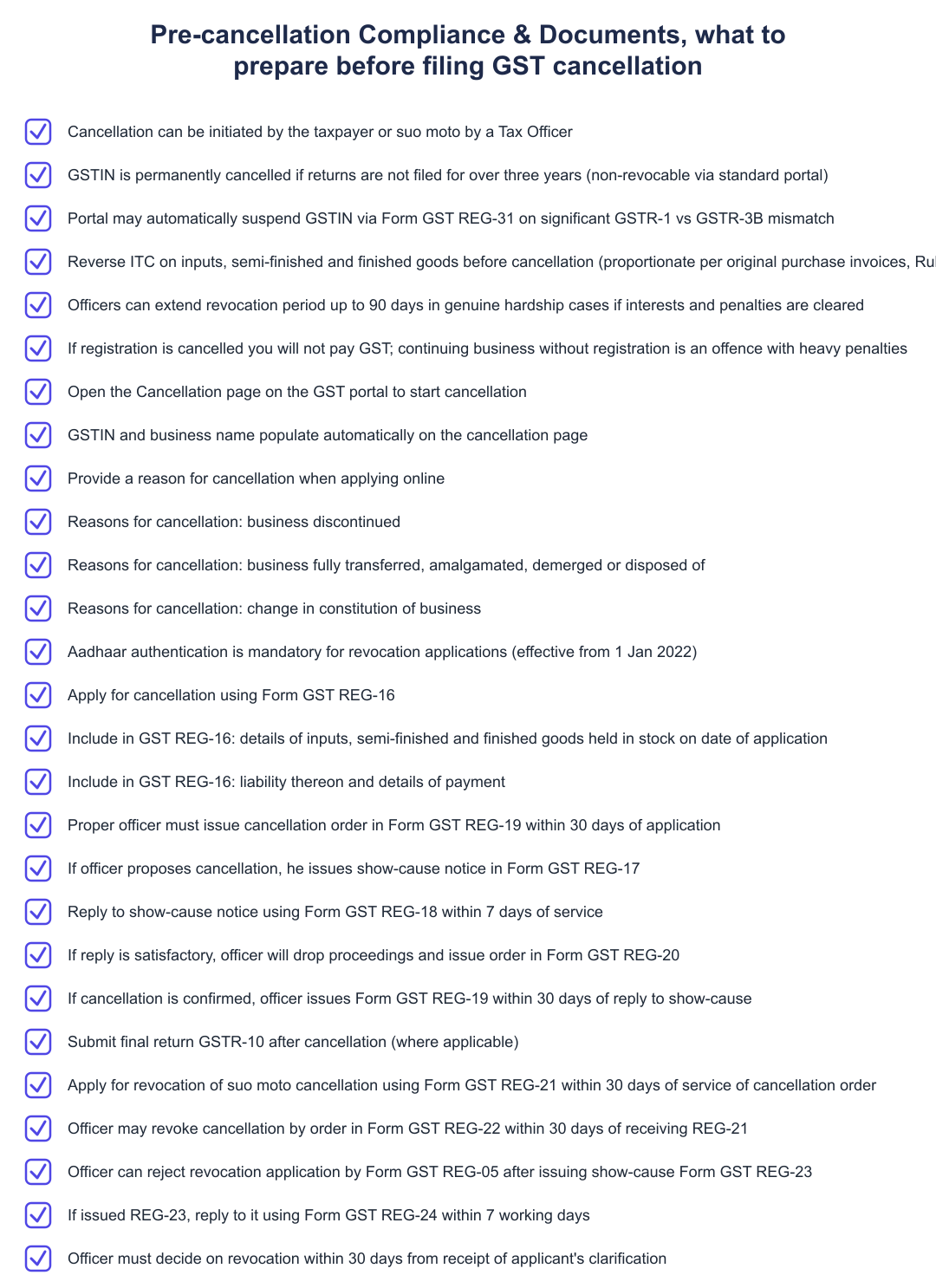
You cancel your GST registration online by submitting Form GST REG-16 on the GST common portal and following the portal prompts. In REG-16 you must provide details of inputs, semi‑finished and finished goods in stock on the date of application, the tax liability on those stocks and details of payment; the proper officer must then issue the cancellation order in Form GST REG-19 within 30 days of the application. The portal will pre-fill your GSTIN and business name and you must give a reason for cancellation; if the officer requires more information he may interact through portal notices. Remember to reverse input tax credit on closing stock proportionately as per Rule 44 before completing the process to avoid later demands.
What happens to my business when GST registration is cancelled?
When GST registration is cancelled the business will no longer be able to charge or collect GST and must stop filing regular GST returns. For businesses required to be registered, continuing to trade without registration after cancellation is an offence and attracts penalties and interest; you must also file the final return (GSTR-10) within three months of cancellation or such extended time as allowed. Additionally, you must reverse ITC on stock of inputs, semi‑finished and finished goods on the date of cancellation and pay any outstanding tax, interest and penalties determined by the tax officer.
Can the tax officer cancel my GST registration on his own (suo moto)?
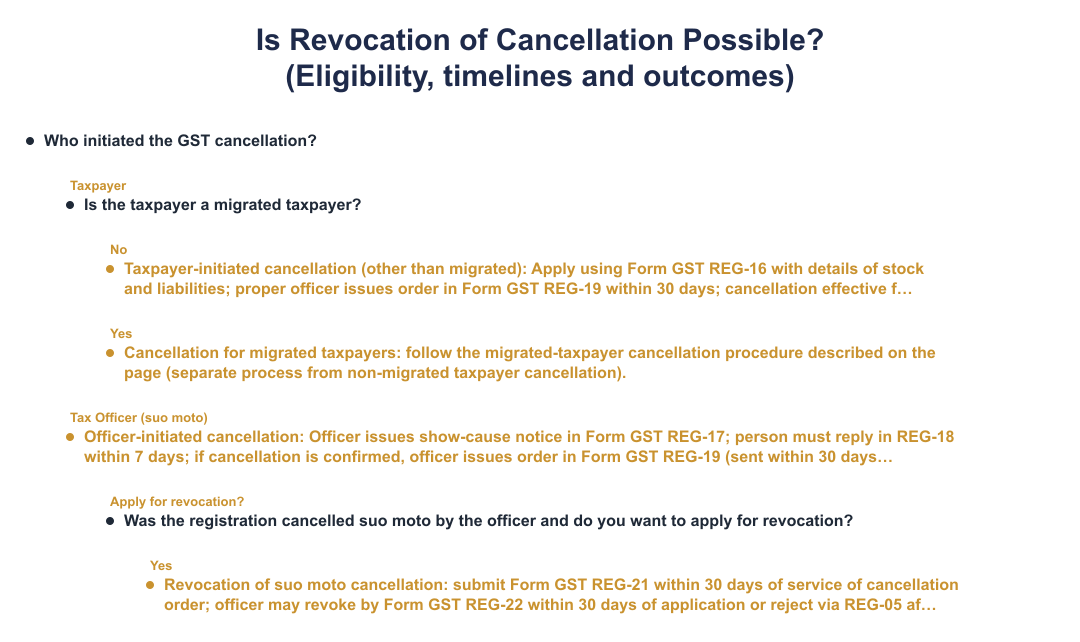
Yes, a proper officer can cancel your GST registration suo moto by issuing a show‑cause notice in Form GST REG-17 and following statutory procedure. You must reply within 7 days in Form REG-18 explaining why registration should not be cancelled; if the reply is unsatisfactory the officer will issue an order in Form REG-19 within 30 days of the reply. Grounds include not conducting business at declared place, issuing invoices without supply, anti‑profiteering violations, misuse of ITC or prolonged non‑filing of returns under specified rules.
What is suspension of GST registration and when does it happen automatically?
Suspension is a temporary deactivation and the portal can automatically suspend your GSTIN (using Form GST REG-31) when it detects significant mismatches between GSTR‑1 and GSTR‑3B data or other specified triggers. Suspension prevents use of the registration for issuing invoices or availing ITC until the mismatch or issue is resolved; it is different from permanent cancellation and is meant to secure compliance. You must reconcile returns and provide explanations or documents on the portal to get the suspension lifted; unresolved issues may lead to further proceedings including cancellation.
What is revocation of cancellation and can I apply for it?
Revocation of cancellation is the formal reversal of a suo moto cancellation order and you can apply for it using Form GST REG-21 if your registration was cancelled by the proper officer. The application must be filed within 30 days of service of the cancellation order on the common portal (officers may extend this up to 90 days in genuine hardship cases if all dues, interest and penalties are cleared). The officer will record reasons in writing and may revoke by order in Form GST REG-22 within 30 days of receiving REG-21 or reject via REG‑05 after issuing a show‑cause REG‑23 and considering your REG‑24 reply.
Are there cases where GST registration is permanently cancelled and cannot be revoked online?
Yes, under the 2026 rules if a taxpayer fails to file returns for over three consecutive years the GSTIN is subject to permanent administrative cancellation that cannot be revoked through the standard online portal. Permanent cancellation for prolonged non‑filing means you would need to re‑apply for a fresh registration (there is no revocation route) and may face penalties and demands for unpaid taxes. Other officer‑initiated cancellations may still be revocable under the REG‑21/REG‑22 process, subject to timelines and clearing of dues.
Can I get GST registration again after cancellation?
Yes, you can apply for fresh GST registration again after cancellation except in cases where the GSTIN was permanently administratively cancelled for non‑filing for over three years. Re‑registration requires a new application on the GST portal and you must complete any pending tax, interest or penalty liabilities and comply with registration conditions like Aadhaar authentication where applicable. If cancellation was revoked under REG‑22, your old registration may be restored instead of fresh registration; otherwise a new GSTIN will be issued upon successful application.
What are the immediate compliance actions required before or after seeking cancellation?
You must reverse input tax credit on stock of inputs, semi‑finished and finished goods proportionately based on the original purchase invoices (as per Rule 44, CGST Rules) and pay the tax liability on those stocks before or at the time of cancellation application. File the final return (GSTR‑10) within three months of cancellation, settle any outstanding tax, interest and penalties, and provide full stock and payment details in Form REG‑16 to avoid future demands. Failure to complete these actions can result in the officer rejecting revocation requests or initiating recovery and penalty proceedings.
Is Aadhaar authentication required for revocation of cancelled GST registration?
Yes, Aadhaar authentication has been mandatory for applying for revocation of cancelled GST registration under CGST Rule 23 when filing Form GST REG‑21 since 1 January 2022. This means the applicant must complete Aadhaar authentication on the portal as part of the REG‑21 submission to prove identity and enable the officer to process the revocation request. Failure to complete Aadhaar authentication may lead to rejection of the revocation application or procedural delays.
Need help staying GST compliant?
MoneyGence's AI Finance OS tracks your compliance, wallet share, and finances in one place, built for agencies and growing businesses.
Get started with MoneyGence