Budget 2026 GST changes for businesses: Key Highlights & Compliance
This guide summarises the broad compliance and indirect/direct tax measures announced in Budget 2026 that enterprise finance, tax and compliance teams should prioritise. You will get a structured walkthrough of the key proposal areas that typically affect businesses, changes in the indirect tax (GST) framework, income‑tax-related compliance and administration shifts, and customs and excise measures that influence import/export and manufacturing decisions. Rather than a verbatim legislative text, this article explains what those proposals mean in practical terms: how they affect cash flow, refund mechanisms, transfer pricing and cross‑border supply chains, and which internal processes are likely to need updating. The aim is to help CFOs, tax heads, in‑house counsels and outsourced compliance teams identify the immediate actions to take after Budget day, the likely implementation priorities, and the areas where you should seek targeted advisory support. Reading this will help you triage which proposals require board or audit committee attention, which need systems and ERP changes, and which will primarily be handled through updated tax returns and disclosures.
Budget 2026 Highlights, high‑level view
The Budget emphasises a balance between promoting economic growth and improving the ease of tax compliance for businesses. On the policy side, announcements aim to reduce friction in tax procedures and to align tax rules with evolving business models, while on the administrative side there is an emphasis on digital processes and clearer dispute resolution pathways.
For enterprises this means the Budget’s measures should be read not only for their headline impact but also for operational consequences: expected changes to refund processing, valuation rules, and appellate mechanisms can materially affect working capital and litigation exposure. Tax and finance teams should therefore treat the Budget as the start of an implementation cycle, policies announced will typically be followed by draft rules, notifications and timelines that determine the real impact.
Goods and Services Tax, what enterprises should watch
Proposals under indirect tax in Budget 2026 focus on improving procedural clarity and reducing disputes. The announcements point to measures that simplify how taxable value is computed, mechanisms for handling discounts or post‑sale adjustments, and the way intermediary or cross‑border services are treated for place‑of‑supply purposes. For businesses, these are important because they affect invoice treatment, ITC accounting and the way contracts are drafted with customers and suppliers.
Another central theme is refund facilitation and cash‑flow support. Budget proposals aim to streamline provisional refunds and reduce barriers for exporters and other eligible taxpayers to claim refunds promptly. Operationally, this will require enterprises to revisit documentation practices, reconcile their export and domestic supplies more frequently, and update ERP mappings for refund trails.
Finally, administrative continuity for appeals and dispute resolution is a recurring focus. The Budget signals intent to avoid gaps in appellate mechanisms so that taxpayers continue to have recourse to an administrative or judicial forum while permanent bodies are being set up. Tax departments should therefore monitor the follow‑up notifications that specify which authority will handle interim appeals and the practical steps for filing them.
Income tax proposals that affect compliance and planning
Income‑tax measures in the Budget emphasise tighter compliance, simplified return processes and sector‑specific incentives. On the compliance front, changes signalled include staggered filing timelines and extended windows for revising returns, easing the burden on individuals and many non‑audit businesses while also shifting the annual compliance calendar.
There are also proposals targeting withholding taxes (TDS) and tax collected at source (TCS) to remove ambiguities and rationalise the rates applicable to certain categories of supplies and receipts. For enterprises, clear rules on withholding obligations reduce disputes and lower the risk of interest or penalty exposure arising from incorrect deductions.
Corporate taxation and transfer‑pricing measures focus on simplifying dispute resolution and providing safe harbours and thresholds that reduce compliance friction for routine transactions. The Budget highlights measures designed to fast‑track pre‑emptive pricing agreements and to calibrate safe‑harbour margins for key service categories, practical steps that can reduce litigation and provide predictability for multinational groups.
Customs and central excise, implications for supply chains
Customs and excise proposals are geared towards rationalising duty structures and aligning incentives with domestic manufacturing objectives. Announcements include measures to simplify tariff schedules, reduce exemptions where local capacity exists, and to incorporate effective duty rates for easier reference. For trade and procurement teams, such changes require a review of sourcing strategies and landed‑cost modelling.
The Budget also signals sectoral concessions and targeted duty reliefs intended to support specific manufacturing segments and exports. Where duty exemptions or accelerated concessions are proposed, enterprises should assess whether they meet the eligibility conditions and whether additional documentation or timelines affect their production planning and export compliance.
Operational changes in customs administration are also highlighted, including longer validity of certain rulings and moves towards more self‑declaration and operator‑centric warehousing frameworks. These administrative shifts can reduce procedural delays but will necessitate stronger internal controls and documentation standards to support self‑declarations and to qualify for enhanced facilitation.
What tax and compliance teams should do first
Immediately after the Budget, assemble a cross‑functional team (tax, legal, treasury, procurement and IT) to map out which Budget measures apply to your business and to prioritise actions by impact on cash flow and compliance risk. Start by identifying contracts, vendor arrangements and export/import practices that may need amendment.
Update your tax calendar and ERP workflows to reflect any announced shifts in return deadlines, refund procedures or withholding obligations. Even where final rules are pending, adopting a conservative approach to documentation and reconciliations will reduce exposure and make later compliance simpler.
Engage with external advisors early for areas that raise complex international tax or transfer‑pricing questions, and plan for system updates where safe‑harbour or threshold changes require new reporting. Where customs or excise concessions are relevant, prepare the supporting eligibility evidence so you can claim benefits promptly when notifications are issued.
Budget 2026 outlines a mix of administrative and policy measures meant to improve clarity, reduce frictions and support manufacturing and exports. For enterprises the immediate priorities are impact assessment, process and system updates, and documentation readiness. Because implementation details normally follow Budget announcements, staying closely engaged with tax counsel and monitoring departmental notifications will ensure your business captures benefits and remains compliant as rules are finalised.
Frequently asked questions
What are the key GST changes announced in Budget 2026 that affect enterprises?
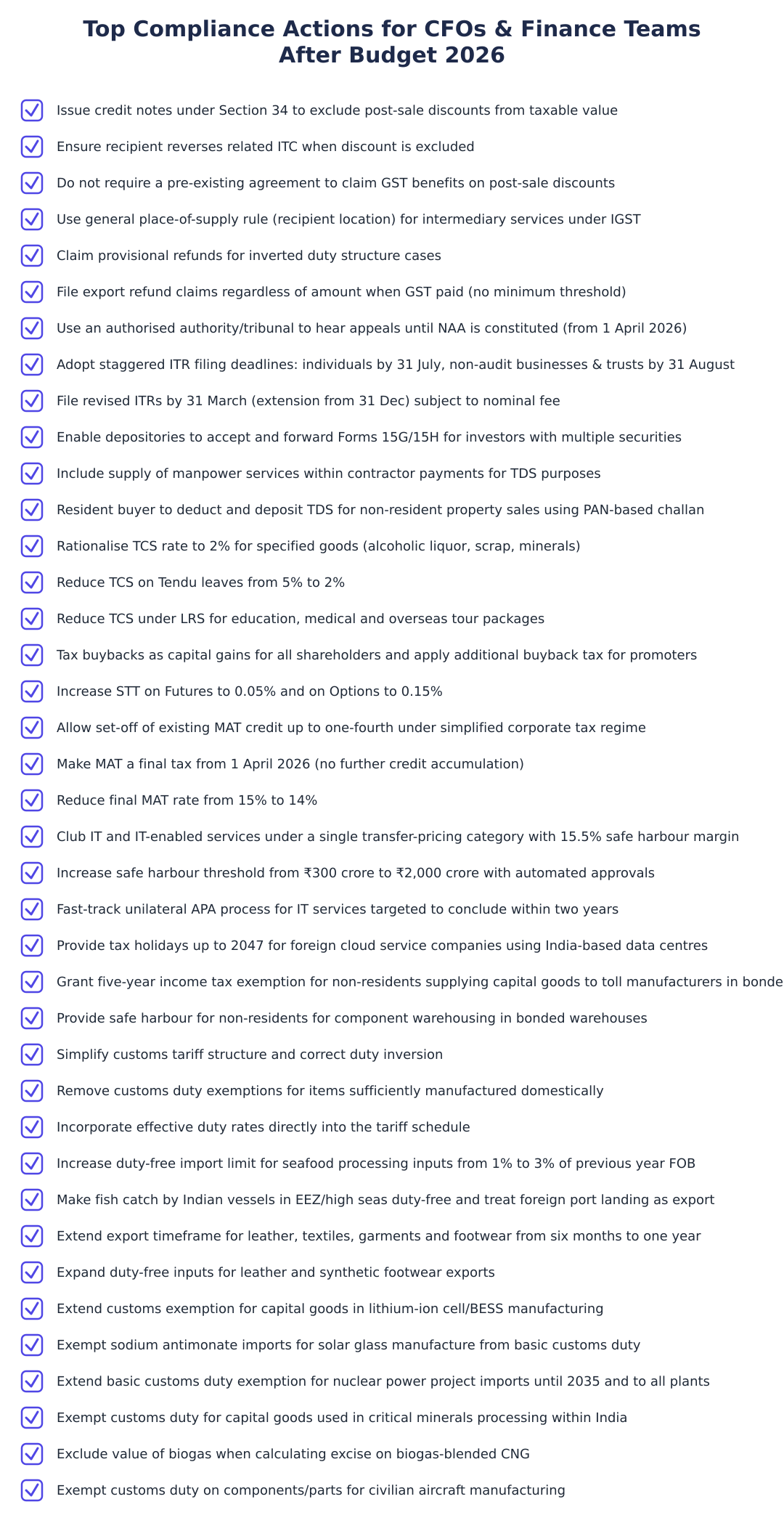
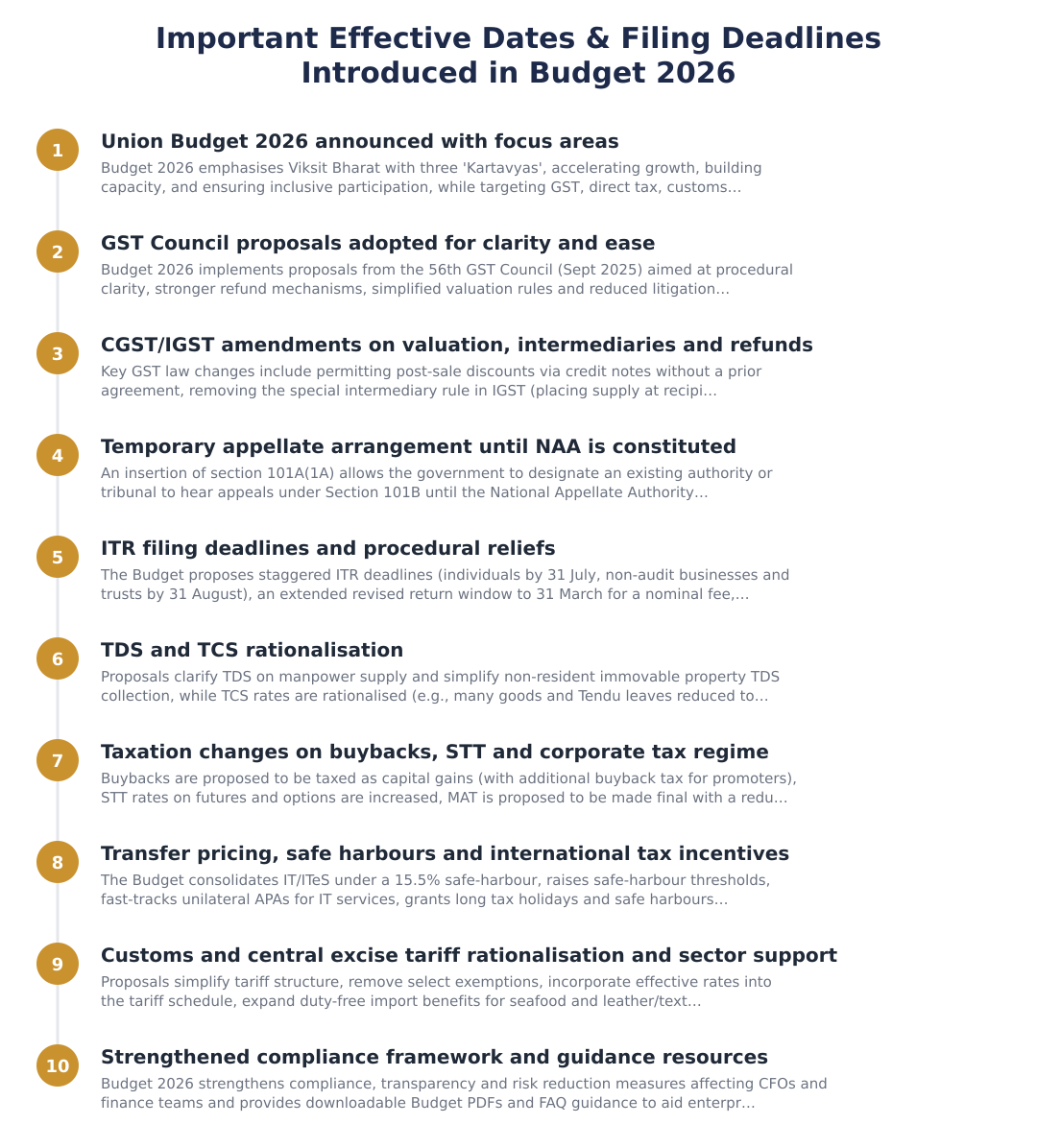
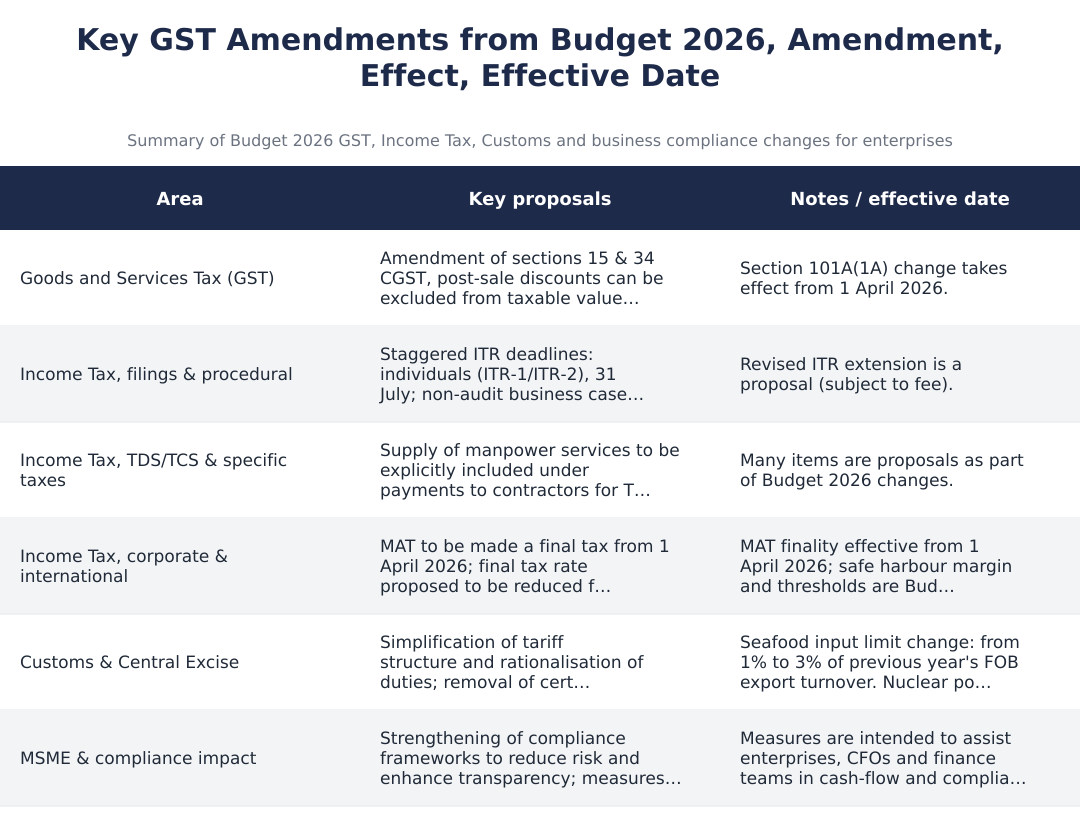
Budget 2026 introduced several targeted GST changes for enterprises, including clarifications on valuation, stronger refund mechanisms, and simpler procedures to reduce litigation. Notable amendments include removal of the requirement for a pre-existing agreement to claim post-sale discount benefits (amendments to Sections 15 & 34 of the CGST Act), removal of the special intermediary rule under Section 13 of the IGST Act so place of supply follows the recipient location, and provisional refunds for inverted duty structure claims under Section 54(6). The Budget also removed the minimum threshold for sanctioning refunds for exports with payment of GST (Section 54(14)), and inserted Section 101A(1A) to allow existing authorities to hear appeals until the National Appellate Authority (NAA) is constituted from 1 April 2026. These measures aim to improve cash flow, export clarity, and dispute resolution for businesses.
How does Budget 2026 change refund rules for exporters and inverted duty situations?
Budget 2026 makes refunds faster and more accessible by allowing provisional refunds for claims arising from inverted duty structures and removing the minimum threshold for sanctioning refunds on exports made with payment of GST. Provisional refunds under amended Section 54(6) will improve cash flows while final adjudication proceeds, and removal of the threshold under Section 54(14) ensures even small export refund claims are processed. These steps reduce liquidity constraints for exporters and businesses dealing with duty inversion disputes and are intended to cut down litigation and administrative delays.
What is the change to the appellate process under GST from 1 April 2026?
From 1 April 2026, until the National Appellate Authority (NAA) is constituted, the government may authorise an existing authority or tribunal to hear appeals under Section 101B through the newly inserted Section 101A(1A). This prevents any interruption in the appellate mechanism and ensures taxpayers can continue to challenge orders while NAA is being set up. The amendment is temporary but effective immediately from the stated date to avoid gaps in appellate jurisdiction.
What are the new ITR filing deadlines proposed in Budget 2026?
Budget 2026 proposes staggered Income Tax Return (ITR) deadlines: individuals filing ITR-1/ITR-2 have a due date of 31 July, while non-audit business cases and trusts have an extended deadline of 31 August. Additionally, the deadline to file a revised ITR is proposed to move from 31 December to 31 March subject to payment of a nominal fee, offering more time for corrections. The changes aim to reduce last‑minute filing pressure and align return timelines with other compliance processes.
How has TDS and TCS been simplified or rationalised in Budget 2026?
Budget 2026 clarified and rationalised both TDS and TCS: it explicitly includes supply of manpower services within payments to contractors for TDS purposes, and proposes PAN-based challans for resident buyers to deduct and deposit TDS on immovable property sales by non-residents. For TCS, rates are rationalised, for example, specified goods such as alcoholic liquor, scrap and minerals have a proposed TCS rate of 2%, and Tendu leaves’ TCS is proposed to fall from 5% to 2%, with reductions under the Liberalised Remittance Scheme (LRS) for education, medical and overseas tour packages. These changes reduce compliance ambiguity and simplify tax collection for cross-border and sectoral transactions.
What corporate tax and MAT (Minimum Alternate Tax) changes did Budget 2026 introduce?
Budget 2026 proposed to make MAT a final tax from 1 April 2026, reduce the MAT rate from 15% to 14% as the final tax rate, and allow existing brought-forward MAT credit to be fully set off; additionally, MAT credit in the new simplified corporate tax regime can be set off up to one-fourth of the tax liability. These measures are intended to encourage companies to migrate to the simplified corporate tax regime while ensuring orderly utilisation of accumulated MAT credits. The changes also remove future accumulation of MAT credits after the effective date, so businesses must plan credit utilisation accordingly.
What transfer pricing and safe harbour reforms were announced for multinational and IT/ITeS firms?
Budget 2026 introduced several transfer pricing and safe harbour reforms: IT and IT-enabled services are to be clubbed under a single category with a common safe harbour margin of 15.5%, the safe harbour threshold is increased from ₹300 crore to ₹2,000 crore with automated approvals and optional five-year continuity, and unilateral APA timelines for IT services are fast‑tracked to conclude within two years (extendable by six months). The Budget also announced tax holidays up to 2047 for foreign companies providing cloud services through India-based data centres and specific safe harbour and exemptions for non-residents involved in bonded-zone supply chains and component warehousing. These steps aim to reduce disputes, provide pricing certainty, and attract cloud and data-centre investment.
Which customs and central excise measures in Budget 2026 will impact manufacturing and exports?
Budget 2026 proposes customs and excise changes to support domestic manufacturing and exports, including simplifying tariff structure, removing select duty exemptions where local manufacturing exists, and incorporating effective rates directly in the tariff schedule. Specific items affected include increased duty-free import limits for seafood-processing inputs from 1% to 3% of prior-year FOB, duty-free treatment for fish catch by Indian vessels in EEZ/high seas when exported, extended export timelines (six months to one year) for leather, textile and footwear sectors, and expanded duty-free imports for battery, solar, nuclear and critical minerals processing inputs. These measures are targeted to correct duty inversion, promote export competitiveness, and incentivise domestic value-addition.
What relief measures did Budget 2026 propose for MSMEs and finance teams in enterprises?
Budget 2026 introduced reliefs aimed at MSMEs and corporate finance teams by simplifying compliance timelines and easing cash-flow pressures: staggered ITR deadlines (31 July for individuals and 31 August for non‑audit businesses/trusts), extended revised ITR filing up to 31 March for a nominal fee, enhanced provisional GST refunds for inverted duty claims, and rationalised TCS/TDS provisions to reduce ambiguity. Additional measures like increased safe harbour thresholds and faster APA processes reduce transfer-pricing compliance burden for mid-sized enterprises, while customs/excise rationalisation supports manufacturing supply chains. Collectively these changes are designed to lower compliance costs, improve liquidity, and reduce disputes for MSMEs and CFOs managing tax affairs.
Need help staying GST compliant?
MoneyGence's AI Finance OS tracks your compliance, wallet share, and finances in one place, built for agencies and growing businesses.
Get started with MoneyGence