Bookkeeping vs Accounting: Key Differences Explained
This guide explains the practical distinctions between bookkeeping and accounting to help small-business owners, startup founders, and finance beginners understand which activities belong to each discipline and why the distinction matters. You will learn what bookkeeping focuses on, what accounting covers, how the two functions interact, and how knowing the difference can improve financial control, reporting, and decision-making. Understanding these roles helps in choosing the right personnel or service, setting up internal workflows, and ensuring that financial records move accurately from raw entries to useful reports that stakeholders can rely on. The guide keeps the explanation operational and non-technical so you can apply the insights to everyday business processes, whether you are designing a chart of accounts, deciding when to engage a professional accountant, or clarifying responsibilities between clerical staff and financial advisers.
Bookkeeping
Bookkeeping is the set of routine activities that capture and record a business’s financial transactions. It is focused on creating a reliable, chronological record of money coming in and out, using source documents such as receipts, invoices, bank statements, and vouchers. The aim is to ensure every financial event is logged so that the organisation has an accurate historical record.
In practice, bookkeeping covers tasks like entering sales and purchase transactions, posting bank and cash entries, reconciling basic records, and maintaining subsidiary ledgers. These tasks provide the raw data and supporting documentation that accounting uses. Bookkeeping tends to be procedural and rules-driven, and it emphasises consistency and completeness in the recording process.
Good bookkeeping establishes the foundation for financial transparency and auditability. When entries are timely and well-organised, they reduce the time accountants need to prepare reports and make it easier to spot data entry errors, duplicate entries, or missing documentation. For many businesses, clear bookkeeping practices also help in managing day-to-day cash flow and vendor/customer relationships.
Accounting
Accounting builds on the records produced by bookkeeping and adds interpretation, classification, and summarisation to produce financial statements and insights. Accountants transform transactional data into meaningful information by applying accounting principles, performing adjustments, and preparing reports that reflect the financial position and performance of the business.
Typical accounting activities include reconciling and adjusting accounts, preparing trial balances and financial statements, analysing results, and producing management reports that highlight trends, margins, and other decision-useful metrics. Accounting is more analytical than bookkeeping and often requires professional judgement to apply policies consistently and to explain the financial implications of business events.
Beyond reporting, accounting also supports planning and compliance functions: accountants use historical data to assist with budgeting and forecasting and to ensure that records meet internal and external reporting expectations. Because accounting adds interpretation to recorded transactions, it is the bridge between raw data and business decisions.
Differences Between Bookkeeping and Accounting
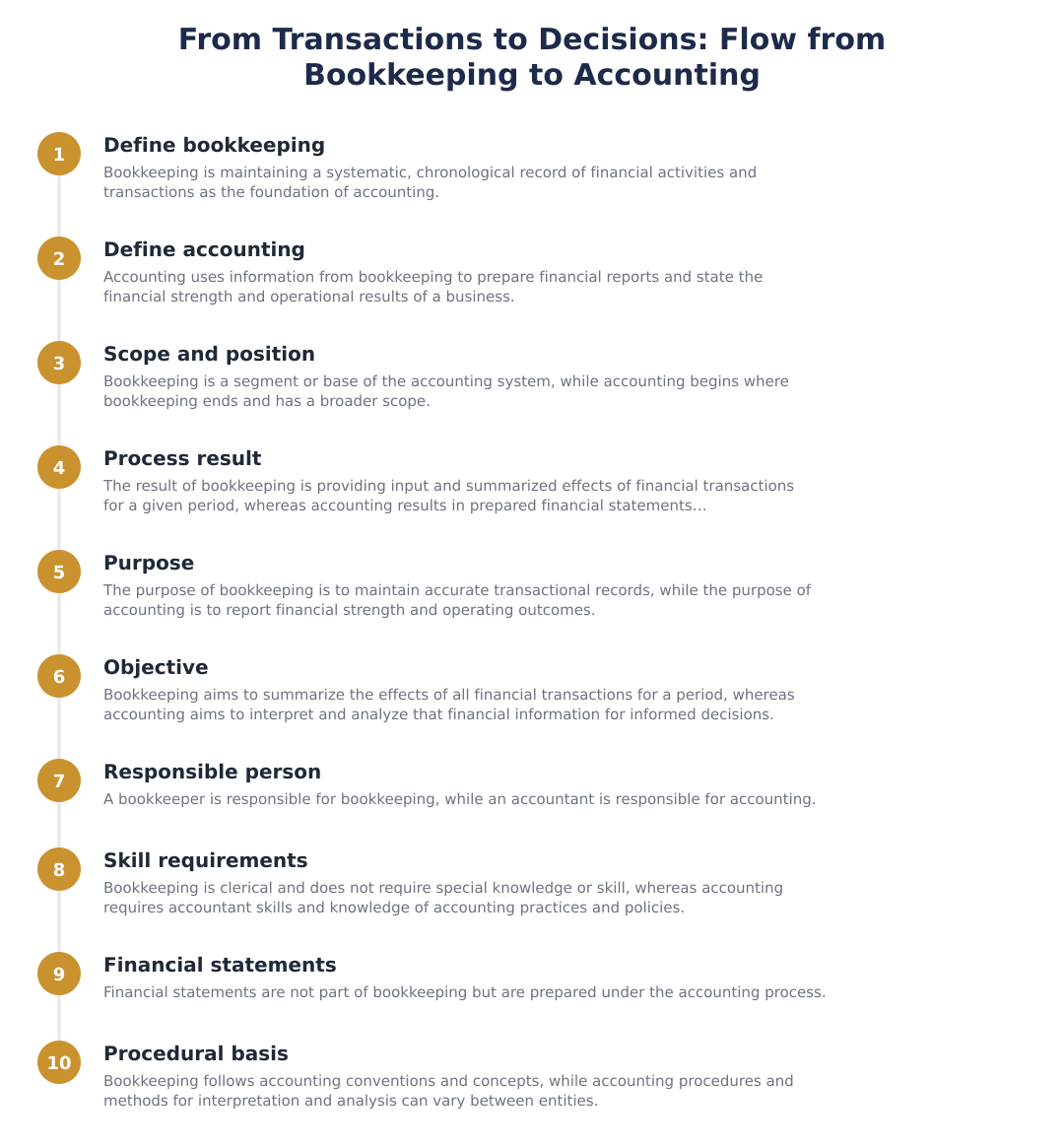
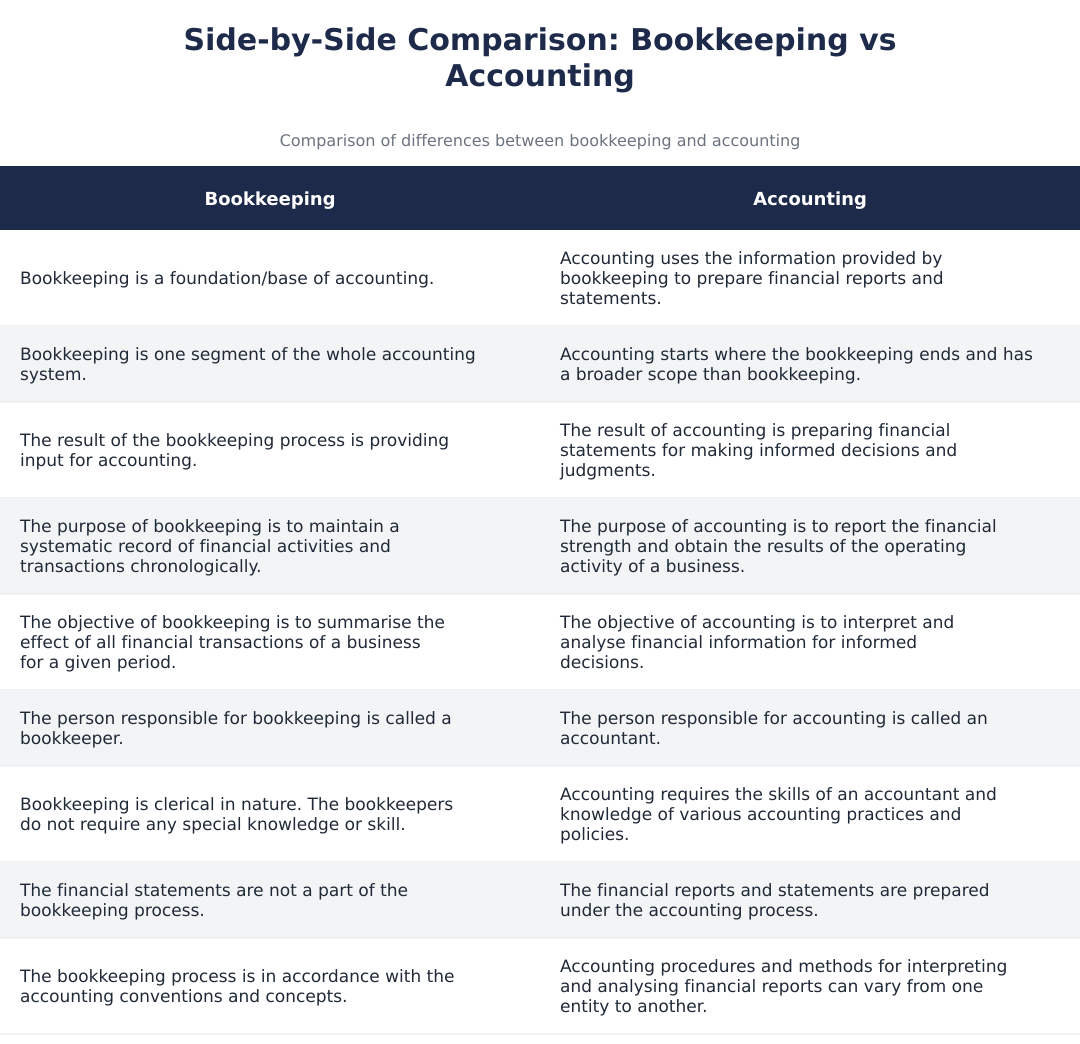
The most useful way to think about the difference is by role and outcome. Bookkeeping is primarily clerical and concerned with accurate, chronological recording of every financial transaction. Accounting uses those records to prepare summaries, reports, and analyses that support strategic decisions and external reporting. In other words, bookkeeping supplies the inputs; accounting converts those inputs into information.
Another distinction lies in skill sets and perspective. Bookkeeping emphasises attention to detail, consistency, and adherence to recording procedures. Accounting demands analytical skills, an understanding of accounting methods, and the ability to interpret results. Because accounting often involves adjusting entries and judgement calls, it typically sits at a higher level of responsibility within the finance function.
Operationally, businesses benefit from a clear workflow connecting the two functions: timely and accurate bookkeeping reduces the workload and increases the effectiveness of accounting. Clear delineation of responsibilities also helps avoid duplication of effort, prevents gaps in control, and makes it easier to scale finance operations as the organisation grows.
Knowing the difference between bookkeeping and accounting helps you design robust financial processes: keep bookkeeping focused on faithful recordkeeping and use accounting to interpret and report on those records. That separation improves accuracy, speeds up reporting, and ensures the organisation gets timely, decision-ready financial information.
Frequently asked questions
What is the main difference between bookkeeping and accounting?
Bookkeeping is the process of systematically recording a company’s financial transactions, while accounting uses those records to prepare financial reports and analyse results. Bookkeeping provides the chronological, factual input, sales, purchases, receipts, payments, whereas accounting interprets and summarises that input to produce financial statements, performance analysis and decision-making information. In practice bookkeeping is considered a foundation or one segment of the broader accounting system, and accounting starts where bookkeeping ends. For example, a bookkeeper records all invoices and receipts; an accountant prepares the profit and loss and balance sheet from those records.
Does bookkeeping prepare financial statements?
No, bookkeeping itself does not prepare financial statements; accounting prepares them using bookkeeping records. Bookkeeping produces the underlying, systematic records and summaries of transactions, which serve as input for accounting. Accountants then apply accounting conventions and analysis to prepare financial reports such as the profit and loss, balance sheet and cash-flow statements. So financial statements are the result of the accounting process, not the bookkeeping process.
Who is responsible for bookkeeping and who is responsible for accounting?
A bookkeeper typically handles bookkeeping, while an accountant handles accounting. Bookkeepers perform clerical tasks such as recording transactions chronologically and maintaining ledgers and journals; they generally do not require specialised accounting knowledge. Accountants require broader skills and knowledge of accounting principles and policies to interpret, analyse and report financial information. In many organisations the bookkeeper provides the organised data that the accountant uses to prepare reports and make financial judgments.
Is bookkeeping more clerical and accounting more analytical?
Yes, bookkeeping is primarily clerical, whereas accounting is analytical and interpretative. Bookkeeping focuses on the accurate, chronological recording of financial transactions and routine maintenance of records. Accounting involves applying conventions and principles to prepare statements, analyse financial strength and support decision-making, which requires specialised knowledge and analysis skills. Therefore accounting has a broader scope and can vary in methods between entities, while bookkeeping follows standard recording practices.
Which comes first: bookkeeping or accounting?
Bookkeeping comes first and provides the necessary input for accounting. The bookkeeping process creates the organised transactional records and summaries that accountants use to prepare financial reports and perform analysis. Accounting then interprets these records to report financial strength, operating results and to support informed decisions. In short, accounting starts where bookkeeping ends.
What are the objectives of bookkeeping compared to accounting?
The objective of bookkeeping is to maintain a systematic, chronological record of all financial transactions and to summarise their effects for a period; the objective of accounting is to interpret and analyse that financial information to report business performance and aid decision-making. Bookkeeping aims at completeness and accuracy of transactional data, while accounting aims at presenting financial strength, results of operations and insights for judgments. For example, bookkeeping produces the ledgers and trial balance; accounting uses them to prepare financial statements and management reports.
Do bookkeeping and accounting follow the same rules and conventions?
Bookkeeping records are maintained in accordance with accounting conventions and concepts, but accounting methods for interpreting and reporting can vary across entities. Bookkeepers follow standard recording procedures to ensure transactions are captured correctly, while accountants may apply different policies, estimates or presentation formats when preparing and analysing reports. Thus bookkeeping provides consistent factual input, while accounting introduces judgement and entity-specific methods when producing financial statements.
Can one person handle both bookkeeping and accounting in a small business?
Yes, in many small businesses a single person often performs both bookkeeping and accounting, but the roles have different demands. A single individual can record transactions, maintain books and also prepare financial statements and perform analysis, provided they have the required accounting knowledge and skills. However, bookkeeping is clerical and procedural, while accounting requires understanding of accounting practices, interpretation and judgment; larger organisations typically separate the roles for accuracy and control.
How do the outputs of bookkeeping differ from the outputs of accounting?
Bookkeeping outputs are detailed transactional records, ledgers and trial balances; accounting outputs are financial statements and analytical reports. Bookkeepers deliver the organised factual data, journals, vouchers, subsidiary ledgers, which serve as inputs. Accountants take that data to prepare profit and loss accounts, balance sheets, cash-flow statements and interpretative analyses to inform decisions and reporting. Therefore bookkeeping output is foundational, and accounting output is evaluative and decision-oriented.
Need help staying Accounting compliant?
MoneyGence's AI Finance OS tracks your compliance, wallet share, and finances in one place, built for agencies and growing businesses.
Get started with MoneyGence