Bookkeeping in Accounting: Objectives, Types & Importance
Bookkeeping is the foundational practice within accounting that ensures every financial event of a business is captured, organised and available for analysis. In this guide you will learn what bookkeeping aims to achieve, how it connects with accounting, the main types of bookkeeping systems, and why maintaining accurate books matters for decision-making, compliance and presenting financial statements. Clear, consistent bookkeeping transforms scattered receipts, invoices and payroll data into reliable records that accountants, managers and stakeholders can use. Whether you are a small business owner, a startup founder or someone preparing to work with a professional accountant, understanding bookkeeping helps you recognise what records to keep, how transactions flow into financial reports and what role bookkeeping plays in detecting errors and protecting business assets. This article outlines the objectives of bookkeeping, compares single-entry and double-entry systems, and explains the practical importance of keeping organised books, all in straightforward language so you can apply the ideas to everyday business operations.
Connection Between Bookkeeping and Accounting
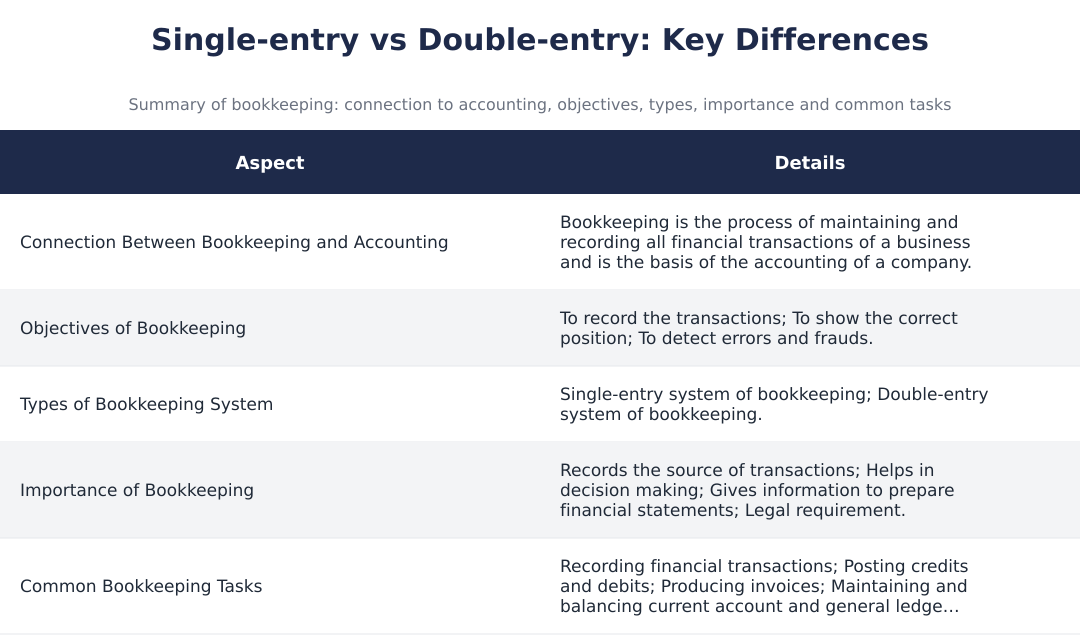
Bookkeeping and accounting are closely related but serve different purposes. Bookkeeping is primarily concerned with the systematic recording of financial transactions, capturing details such as dates, amounts, parties and the nature of each transaction. Accounting builds on those records to prepare summaries, analyse performance, produce financial statements and support strategic decision-making.
In practice, accurate bookkeeping is the data layer that enables accounting processes. Without reliable books, accountants cannot produce meaningful reports, assess profitability, manage cash flow or advise on tax and compliance matters. Conversely, accounting provides the interpretation, insight and reporting that give bookkeeping its business value.
Objectives of Bookkeeping
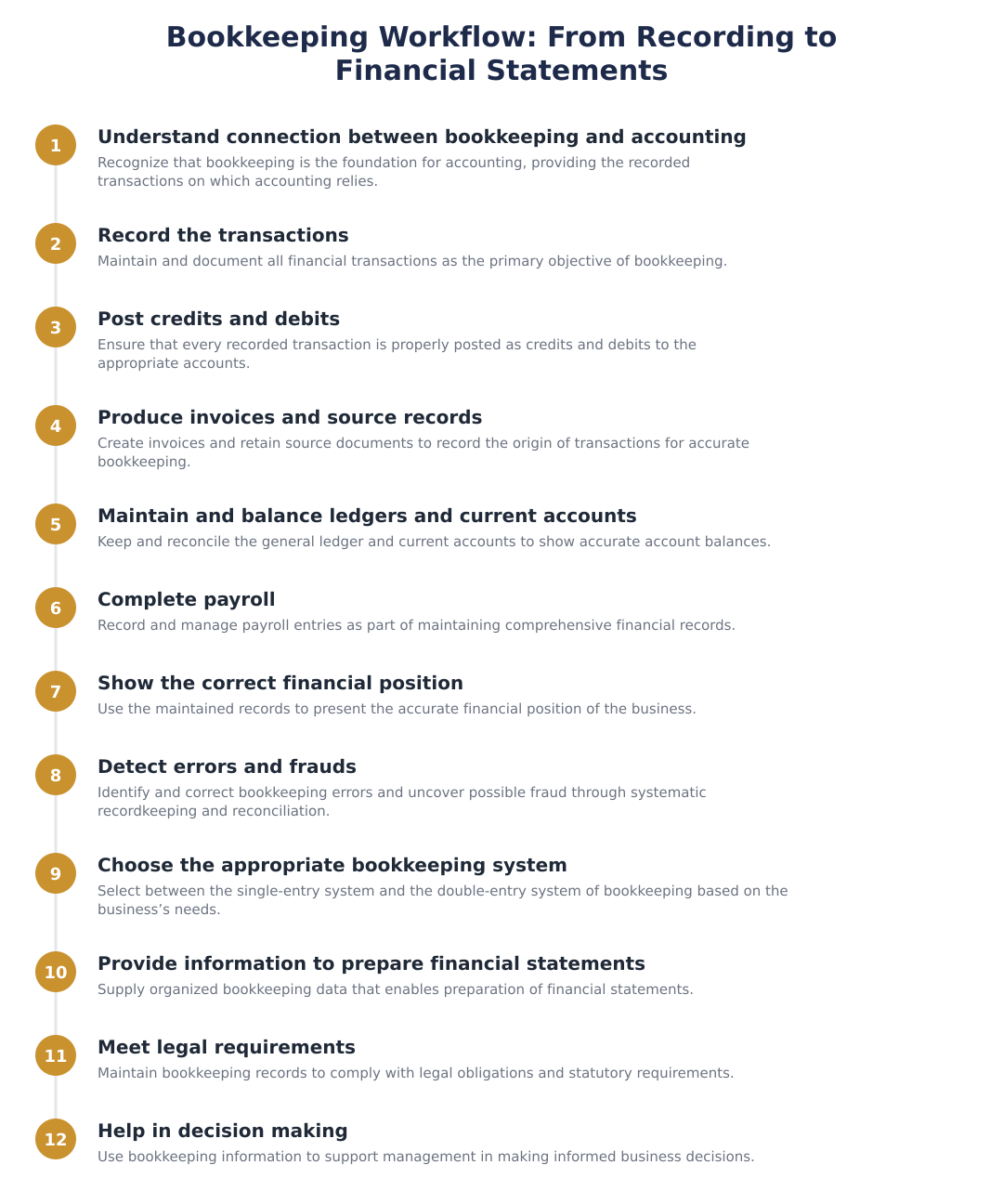
The principal objective of bookkeeping is to record all financial transactions of a business in a systematic, chronological manner. This ensures that every inflow and outflow is documented so that transactions can be traced back to their source documents when required.
Beyond mere recording, bookkeeping aims to maintain an organised and up-to-date set of books that facilitate the preparation of financial statements, help track the financial position of the business and support internal and external stakeholders with reliable information for decision-making.
To record the transactions
Recording transactions involves capturing each financial event as it occurs, using appropriate journals or electronic ledgers. This practice creates a permanent trail from source documents, such as invoices, receipts and bank statements, to the accounting records.
Well-maintained transaction records enable businesses to monitor cash flow, reconcile accounts and provide auditors or advisors with the documentation they need. They also support routine activities like billing customers, paying suppliers and processing payroll.
To show the correct position
A key objective of bookkeeping is to present a clear, accurate snapshot of the business’s financial position at any point in time. This means organising records so assets, liabilities, income and expenses can be summarised and analysed.
When books are current and reconciled, management can assess liquidity, understand working capital needs and make informed operational or strategic choices. Accurate records also help in preparing budgets and forecasting future performance.
To detect errors and frauds
Consistent bookkeeping creates internal checks and balances that make it easier to spot mistakes or irregularities. Regular reconciliations, cross-references to source documents and routine review of ledger balances help uncover discrepancies early.
While bookkeeping alone does not guarantee fraud prevention, clear and traceable records raise the cost and difficulty of misappropriation and make investigation and corrective action more straightforward when issues do arise.
Types of Bookkeeping System
Bookkeeping systems generally fall into two broad categories, each suited to different sizes and complexities of business operations. Selecting the appropriate system depends on factors such as transaction volume, reporting needs and the level of financial control desired.
Smaller businesses often choose simpler methods that are quicker to manage, while larger organisations tend to use systems that provide greater detail and internal control. Technology and accounting software have also influenced how bookkeeping systems are implemented, allowing businesses to automate routine entries and reporting.
Single-entry system of bookkeeping
The single-entry approach records each financial transaction once, typically in one running cash book or register. It is straightforward and may be sufficient for small operations with a limited number of transactions and simple reporting needs.
However, because it records only one side of each transaction, single-entry bookkeeping provides less built-in error detection and makes it harder to prepare full financial statements without additional adjustments or analysis.
Double-entry system of bookkeeping
The double-entry system records both sides of every transaction, debits and credits, across different accounts. This method provides a more complete picture of how transactions affect the financial position and results of a business.
Because each entry has a corresponding counter-entry, double-entry bookkeeping offers stronger internal checks and supports the direct preparation of financial statements. It is commonly used by larger businesses or those that require detailed financial reporting and analysis.
Importance of Bookkeeping
Good bookkeeping underpins business transparency and informed management. It provides the raw data for preparing profit and loss information, tracking expenses, understanding customer receivables and managing supplier payables.
Beyond internal use, well-kept books facilitate dealings with external stakeholders such as lenders, investors and advisors who rely on trustworthy records to assess creditworthiness and performance.
Records the source of transactions
Maintaining source documentation, invoices, receipts, contracts and bank statements, alongside ledger entries creates an audit trail. This makes it possible to verify entries, resolve disputes and comply with reporting or examination requirements when they arise.
Organising these supporting documents in a consistent manner saves time during reconciliations and audits and improves overall record reliability.
Helps in decision making
Timely bookkeeping produces the information managers need to make operational decisions such as pricing, cost control and investment in growth. Regular reports derived from books enable monitoring of trends and highlight areas that require attention.
Accurate books also support scenario planning and budgeting, allowing business owners to test the financial impact of strategic choices before committing resources.
Gives information to prepare financial statements
Bookkeeping supplies the account balances and transaction details that accountants use to prepare formal financial statements. Consistent categorisation of revenues and expenses makes assembling profit and loss information and balance sheet items more efficient.
When books are properly maintained, the process of closing periods and producing statements becomes less time-consuming and more accurate.
Legal requirement
For many businesses, maintaining certain records is a statutory expectation and plays a role in meeting regulatory obligations. Keeping organised books helps ensure that required information is available when authorities or external parties need to review financial records.
Even where legal mandates vary, maintaining clear books reduces risk, aids in timely compliance and supports transparency with stakeholders.
Consistent bookkeeping is a practical necessity for any business that wants accurate financial information, better decisions and smoother interactions with advisors and authorities. Choose a bookkeeping system that matches your business complexity, keep supporting documents organised, and review records regularly to maximise the value of your financial data.
Frequently asked questions
What is bookkeeping in simple terms?
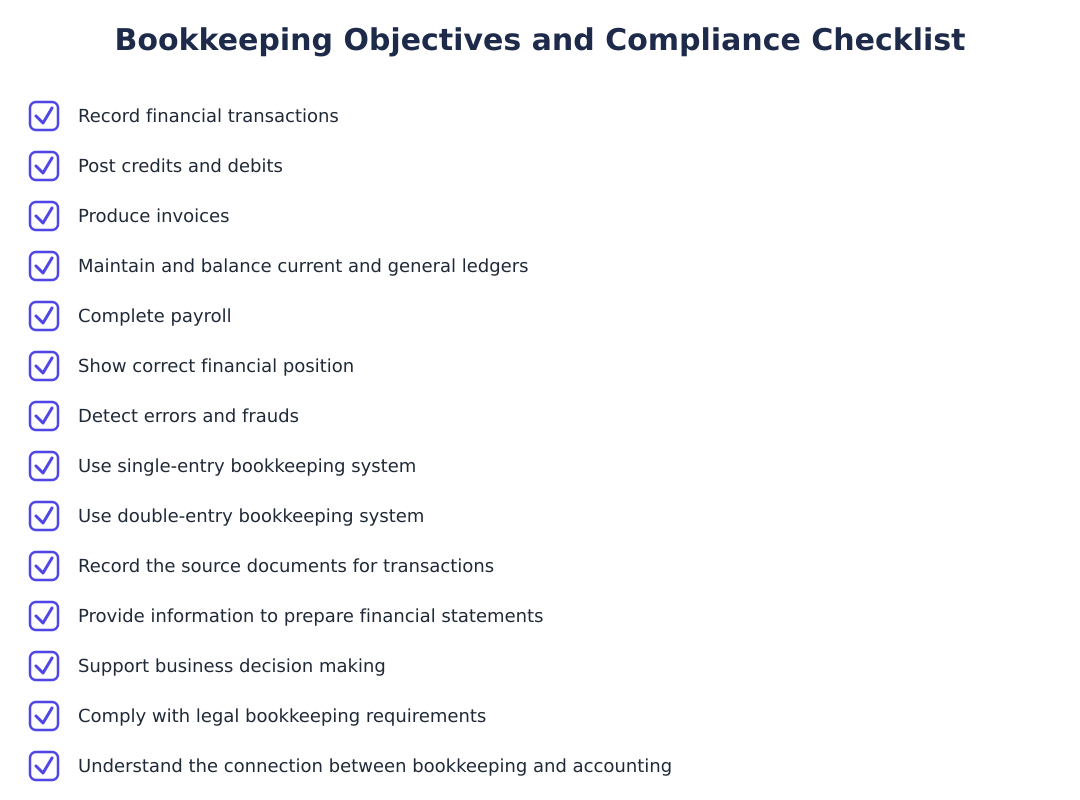
Bookkeeping is the process of maintaining and recording all financial transactions of a business. It involves systematic tasks such as recording sales and purchases, posting credits and debits, producing invoices, maintaining and balancing current and general ledgers, and completing payroll so every monetary event is documented. Bookkeeping provides the raw data needed for higher-level accounting functions like preparing financial statements and analysis. Accurate bookkeeping ensures business owners and stakeholders have a clear audit trail of all transactions.
How is bookkeeping connected to accounting?
Bookkeeping is the basis of accounting because it provides the recorded transactions that accounting analyses and reports. Bookkeeping captures and organizes source records (invoices, receipts, ledgers), and accounting uses that recorded information to prepare financial statements, analyse performance, and make tax and management decisions. Without reliable bookkeeping, accounting cannot produce accurate profit & loss, balance sheets, or compliance reports. In short, bookkeeping supplies the data; accounting interprets and communicates it.
What are the main objectives of bookkeeping?
The main objectives of bookkeeping are to record transactions, show the correct financial position, and detect errors and frauds. Recording transactions means maintaining a complete, chronological record of all financial events; showing the correct position involves preparing organized ledgers and trial balances to reflect assets, liabilities and capital; detecting errors and frauds comes from reconciliations and cross-checks that reveal mistakes or irregularities. These objectives together ensure accurate accounting and reliable financial information for decision-making and compliance.
What does 'record the transactions' mean in bookkeeping?
'Record the transactions' in bookkeeping means entering every financial event, such as sales, purchases, receipts and payments, into books or digital records in a systematic way. This includes documenting the source of transactions using invoices, receipts and vouchers and posting them into appropriate journals and ledgers. Consistent recording ensures that no transaction is omitted, which is essential for accurate financial reports and audits. For example, producing invoices and recording payroll are routine activities that capture transaction details.
How does bookkeeping show the correct position of a business?
Bookkeeping shows the correct financial position by maintaining and balancing ledgers and preparing trial balances that summarize assets, liabilities and owner’s equity. By organizing transactions into appropriate accounts and regularly reconciling balances, bookkeeping produces a snapshot of the business’s financial status at any point in time. That organized information is what accountants use to prepare formal financial statements like balance sheets. Accurate ledgers and reconciliations prevent misstatements of financial position.
How does bookkeeping help detect errors and frauds?
Bookkeeping helps detect errors and frauds through reconciliations, cross-checking entries, and maintaining an audit trail of source documents. Regularly comparing ledger balances with bank statements, invoices and receipts highlights inconsistencies, duplicate entries, or missing transactions that could indicate mistakes or fraudulent activity. Structured bookkeeping procedures and segregation of duties make it harder for intentional misstatements to go unnoticed. Prompt detection enables corrective action and helps maintain trust with stakeholders.
What are the types of bookkeeping systems and how do they differ?
The two main types of bookkeeping systems are the single-entry system and the double-entry system, and they differ in complexity and completeness. The single-entry system records only one side of each transaction (usually cash inflows and outflows) and is simpler but less reliable for detecting errors, while the double-entry system records both debit and credit sides for every transaction, providing a complete view of assets, liabilities and equity and better error detection. Small or very simple businesses may use single-entry, but most businesses use double-entry because it supports preparation of full financial statements. Double-entry bookkeeping underpins standard accounting practices and trial balances.
Why is bookkeeping important for decision making and compliance?
Bookkeeping is important because it provides accurate, up-to-date financial information that managers and owners can use to make operational and strategic decisions and to meet legal requirements. Timely bookkeeping produces records needed to prepare financial statements, calculate taxes, and comply with statutory reporting obligations, and it supplies the data used in budgeting, cash-flow planning and performance analysis. Good bookkeeping also documents the source of transactions for audits and regulatory inspections. Without reliable bookkeeping, decisions and compliance actions would be based on incomplete or inaccurate information.
Need help staying Accounting compliant?
MoneyGence's AI Finance OS tracks your compliance, wallet share, and finances in one place, built for agencies and growing businesses.
Get started with MoneyGence