BOI FD Calculator - Calculate Bank of India FD Returns Fast
A Bank of India (BOI) Fixed Deposit (FD) calculator is an online tool that helps savers estimate how much their fixed deposit will grow over a chosen tenure. This guide explains what a BOI FD calculator does, how it generally works, how to use it, the basic idea behind the mathematical calculation, and the practical benefits for savers and businesses. Whether you are planning a short-term safety bucket or a longer-term goal, understanding how to model FD returns in advance makes it easier to compare options, decide on tenure and payout frequency, and plan cash flows. You will learn the inputs such calculators typically need, the output they provide, common caveats to watch for, and why using a calculator is useful before committing funds to an FD.
How can the Bank of India FD Calculator Help You?
A BOI FD calculator streamlines the decision-making process around fixed deposits by converting multiple variables into a clear maturity estimate. Instead of doing manual arithmetic for different tenures and interest assumptions, the calculator provides a quick projected maturity amount and the interest component, helping you see the potential outcome of an investment instantly.
This tool is particularly helpful when comparing alternative deposit tenures, payout frequencies or interest scenarios. It allows investors to iterate quickly, changing one input at a time, to see how each factor affects final returns. For individuals and small businesses alike, that kind of rapid comparison is useful for aligning investment choices with liquidity needs and financial goals.
How does a Bank of India FD Calculator Work?
At a high level, an FD calculator takes a few user inputs and applies standard interest calculations to project future value. The core idea is to combine the initial investment with assumed interest accrual over the chosen period, taking into account how often interest is added to the deposit (compounding) or whether interest is paid out periodically.
Behind the scenes the calculator implements the arithmetic associated with fixed deposit growth. Depending on selected options, such as compounding frequency or payout mode, the tool adjusts the way interest is accumulated and displays a maturity figure along with the total interest earned. Many calculators also display interim values or allow reverse calculations (for example, finding the required rate or tenure to reach a target amount).
How do you use the Bank of India fixed Deposit Calculator?
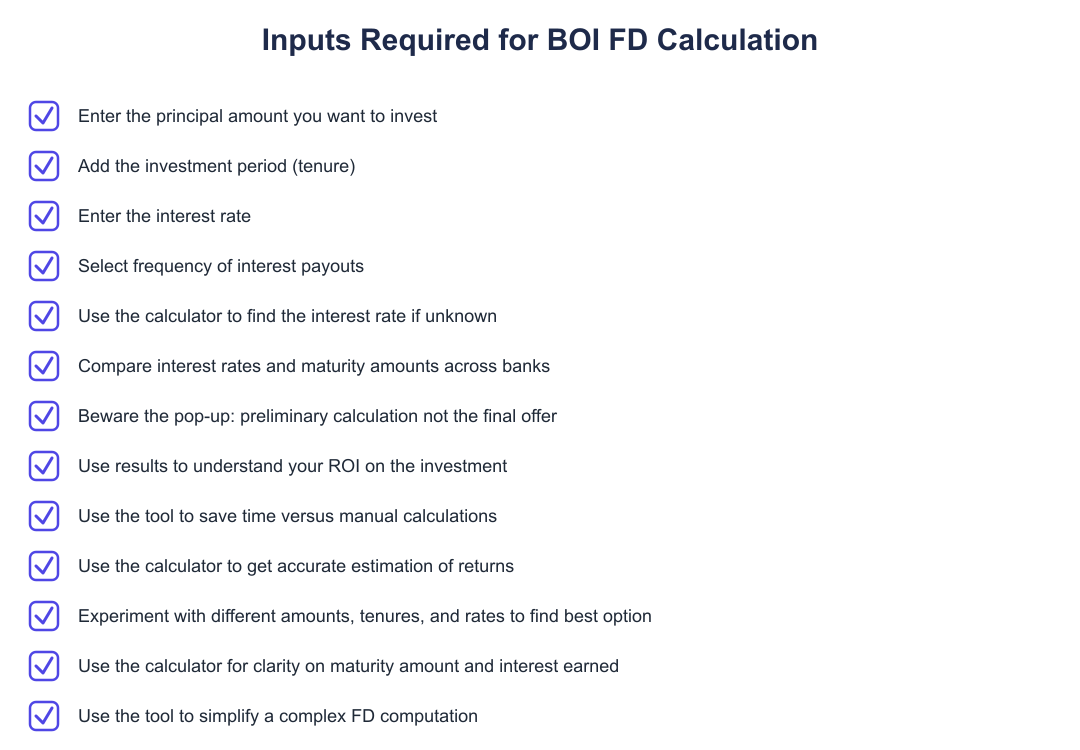
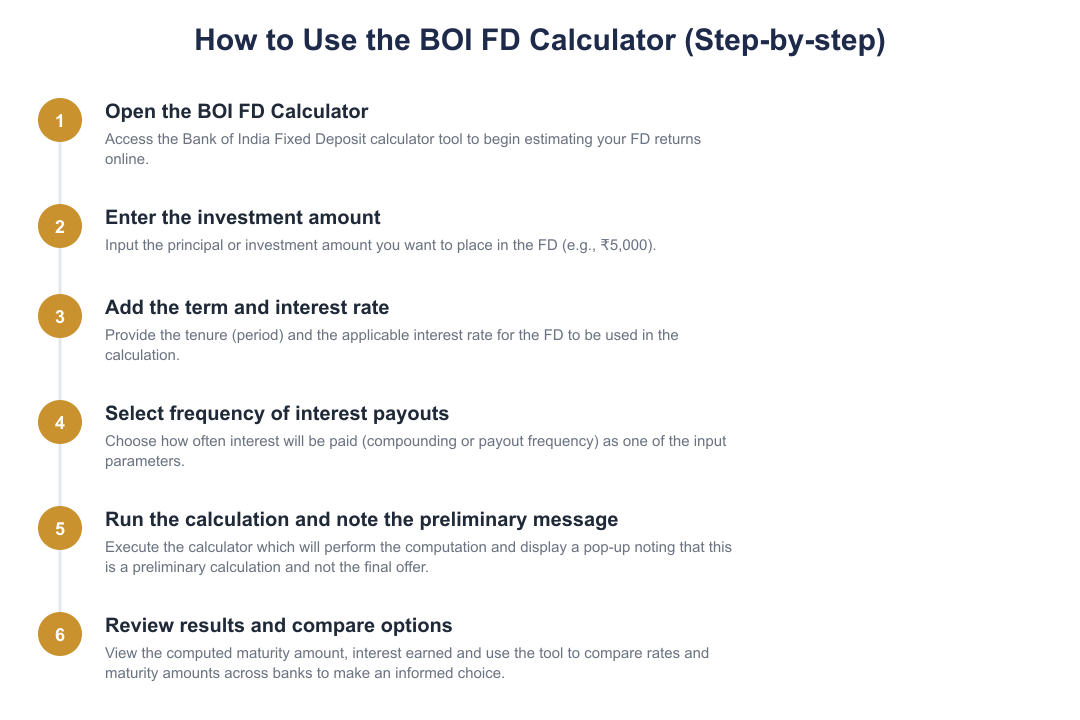
Using a typical BOI FD calculator involves entering a small set of inputs and reviewing the output. Common inputs include the amount you plan to invest, the expected interest rate, the investment tenure, and the interest payout frequency. Once entered, the calculator returns the projected maturity amount and the total interest over the period.
Most calculators are interactive: you can change any input to immediately see how the maturity amount changes. Some tools add helpful notes or disclaimers explaining that the displayed result is a preliminary estimate and that the actual offer from the bank may differ based on prevailing terms and any applicable taxes or charges.
Formula to Determine BOI FD Returns
The calculation behind FD returns is based on the concepts of principal, interest rate and time. If interest is compounded, the calculator repeatedly applies interest to the growing balance according to the chosen compounding frequency; if interest is paid out periodically, the balance does not grow by that interest for future compounding.
In practice, calculators implement the appropriate arithmetic so you do not need to perform repetitive manual calculations. They also handle different payout options and compounding intervals, which is why using a calculator is simpler and less error-prone than hand-computation, especially for longer tenures or non-annual compounding.
BOI FD Returns example:
Imagine a saver who wants a predictable return and chooses a fixed deposit for a specified period. The saver picks an investment amount, selects a tenure and chooses whether to receive interest periodically or let it compound until maturity. The calculator then shows the maturity amount and the interest component so the saver can decide whether the FD meets their objectives.
This kind of illustrative example helps highlight two practical considerations: how payout frequency affects liquidity and how compounding affects total returns. Running multiple scenarios side-by-side lets a saver balance the desire for higher compounded growth against the need for periodic income.
Benefits of the Bank of India FD Calculator
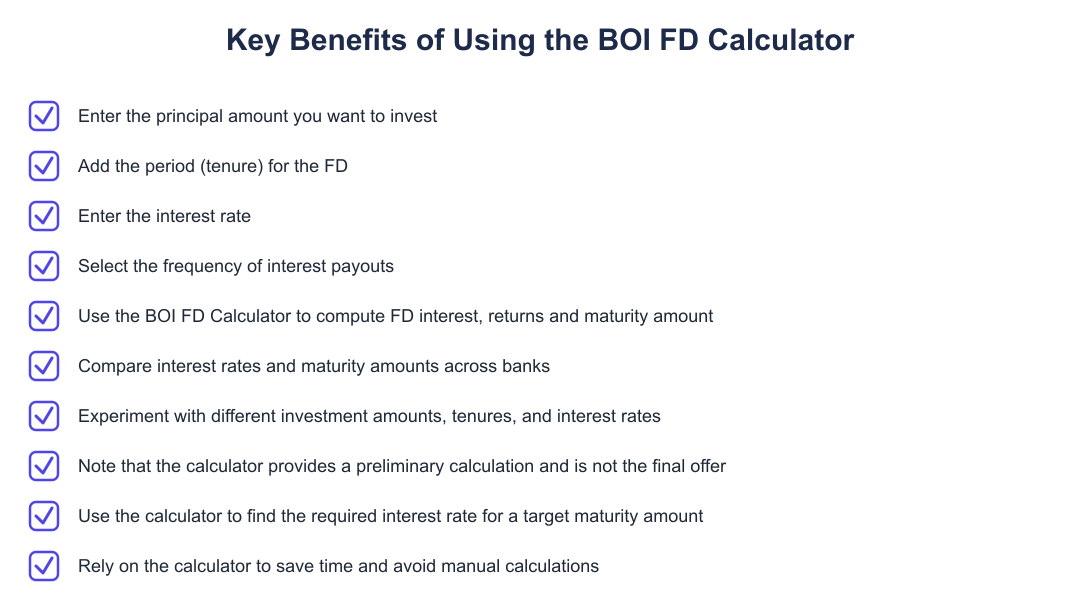
A dedicated FD calculator saves time and reduces calculation errors. It eliminates manual arithmetic, speeds up comparisons across tenures and payout options, and gives users clarity on expected maturity proceeds. This clarity supports better financial planning and helps investors align deposits with cash-flow needs and goals.
Additionally, the tool enables experimentation, changing investment amounts, tenures or payout choices quickly, so users can discover the combination that best suits their objectives. Many calculators also present brief disclaimers to remind users that the output is a projection and that the final bank offer may vary based on prevailing terms and statutory adjustments.
A BOI FD calculator is a practical, time-saving aid for anyone considering a fixed deposit. By converting a few inputs into a clear maturity projection, it supports better comparison, planning and decision-making. Use the calculator to run scenarios and understand trade-offs between compounding and periodic payouts, and always confirm final terms with the bank before investing.
Frequently asked questions
What is the BOI FD calculator and what does it calculate?
The BOI FD calculator is an online tool that calculates the interest earned and maturity amount on a Bank of India fixed deposit given your inputs. You enter the principal (investment amount), interest rate, tenure, and frequency of interest payouts, and the calculator uses the fixed-deposit formula to give you the maturity value and interest earned. It helps compare different tenures and rates quickly and gives a preliminary estimate (not a bank's final offer). Use it to evaluate options before approaching the bank for a formal FD booking.
How do I use the Bank of India fixed deposit calculator step by step?
To use the Bank of India fixed deposit calculator, first enter the principal amount you want to invest, then add the tenure (time period) and the interest rate, and select the frequency of interest payouts. After entering these details the calculator computes the maturity amount and shows the interest earned; it may display a disclaimer stating the result is a preliminary calculation and not the final offer. The tool also allows reversing the calculation to find an interest rate or tenure needed to reach a target maturity amount. Keep in mind inputs must be accurate to get a useful estimate for planning your investment.
What formula does the BOI FD calculator use to determine returns?
The BOI FD calculator uses the simple fixed-deposit formula M = P + (P × r × t / 100), where M is the maturity amount, P is the principal, r is the annual interest rate (in %), and t is the tenure in years. To find only the interest earned, subtract the principal (P) from the maturity amount (M). This formula gives straightforward estimates for non-compounded or annually computed interest; if interest is compounded more frequently, the effective return will change and you should use a compounding formula or the calculator's compounding option if available.
Can you show a quick example of BOI FD returns calculation?
Yes, for example, if you invest Rs 100,000 at an annual interest rate of 6% for 2 years, the maturity amount using the formula M = P + (P × r × t / 100) will be Rs 112,000 (100,000 + 100,000×6×2/100). The interest earned in this case is Rs 12,000 (maturity amount minus principal). This example assumes simple interest or annual payout; if interest is compounded quarterly or reinvested, the final amount will be slightly higher due to compounding.
What inputs affect the BOI FD calculator results the most?
The most important inputs that affect BOI FD calculator results are the investment amount (principal), the annual interest rate, the tenure of the deposit, and the frequency of interest payouts (which determines whether interest is compounded or paid out). Small changes in the rate or tenure can materially change the maturity amount, longer tenures or higher rates increase returns, while more frequent payouts without reinvestment reduce compounding benefit. Always verify the exact rate and payout frequency offered by the bank because the online estimate is preliminary.
Does the BOI FD calculator consider compounding and payout frequency?
The BOI FD calculator can factor in the frequency of interest payouts as one of its inputs, which affects whether interest is compounded or paid out periodically. If you choose reinvestment (compounding), the effective return increases with more frequent compounding periods (quarterly, monthly), whereas periodic payout options return interest to you and reduce compounded growth. Check the calculator settings to confirm it uses the correct compounding frequency that matches the bank's FD product for an accurate maturity estimate.
Are the results from the BOI FD calculator final and binding?
No, the results from the BOI FD calculator are preliminary estimates and not a final bank offer. The calculator provides an accurate estimation for planning, but the final interest rate, compounding frequency, and any special terms offered by Bank of India at the time of booking will determine the actual maturity amount. Always confirm rates and terms with the bank and request a formal FD confirmation before making financial decisions based solely on the online estimate.
What are the benefits of using the Bank of India FD calculator?
The Bank of India FD calculator offers accurate estimation of maturity amount and interest earned, saves time by eliminating manual calculations, and gives flexibility to experiment with different investment amounts, tenures, and rates to find the best option for your goals. It also provides clarity on how much you'll receive at maturity and helps you compare BOI rates with other banks to make an informed decision. Remember the calculator is a planning tool and should be followed by verification of current rates and terms with the bank.
Can the BOI FD calculator help me choose between interest payout options and reinvestment?
Yes, the BOI FD calculator can help you compare outcomes of different interest payout options by allowing you to input payout frequency and see how reinvesting interest (compounding) versus taking periodic payouts affects maturity. Reinvestment typically yields a higher maturity amount due to compounding, while periodic payouts provide regular cash flow but lower long-term returns. Use the calculator to simulate scenarios (monthly, quarterly, annual payouts or cumulative reinvestment) to decide which suits your cash-flow needs and investment goals.
Need help staying Calculators compliant?
MoneyGence's AI Finance OS tracks your compliance, wallet share, and finances in one place, built for agencies and growing businesses.
Get started with MoneyGence