Auditing Requirements of a Private Limited Company: Complete Guide
This guide explains the statutory auditing requirements that apply to private limited companies in India, and what directors, company secretaries, and finance teams need to know to stay compliant. You will learn which audits are mandatory, how an auditor is appointed, the key filing deadlines tied to the audit report, and the specific ROC forms used to report audit outcomes and the company’s annual return. Understanding these requirements matters because audit reports and annual filings are the primary documents submitted to the Registrar of Companies; timely and correct filings help avoid procedural non-compliance, preserve corporate governance standards, and ensure transparency for stakeholders. Throughout the guide we focus on the practical implications of the audit process, who must ensure the audit happens, what paperwork is produced, and when it must be filed, so you can prepare your internal timelines and documentation to meet statutory obligations.
Types of Audit Of A Private Limited Company
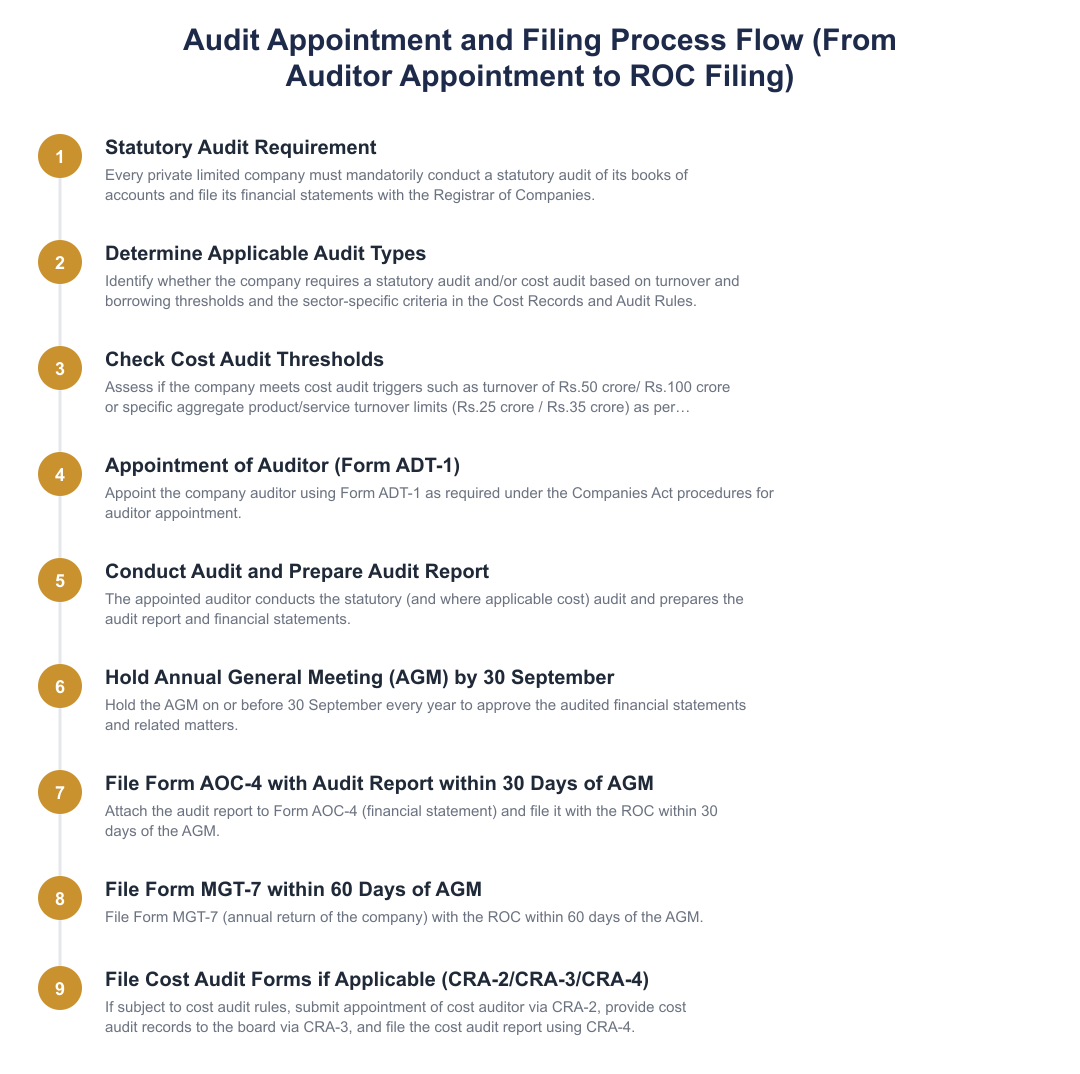
Every private limited company must mandatorily conduct a statutory audit of its books of accounts and file its financial statements with the Registrar of Companies. The statutory audit involves an independent auditor examining the company’s books, vouchers and records to form an opinion on the financial statements prepared by management.
Practically, this means companies should plan for an external audit as part of their annual closing process. The audit produces the audit report and audited financial statements, which are the primary outputs that must be attached to the annual filing submitted to the ROC.
While companies may also undertake other internal or special audits for internal control, management review, or regulatory needs, the statutory audit is the legal requirement that culminates in financial statements being filed with the Registrar.
Appointment of an Auditor
The appointment of the company’s statutory auditor is a formal process and must be documented appropriately. Form ADT-1 is the prescribed form used for the appointment of a company auditor.
Companies should ensure that the auditor’s appointment is made in accordance with the company’s statutory timelines and recorded so that there is a clear trail showing the auditor engaged for the relevant financial year. Using the correct form for the appointment helps maintain clear compliance records and ensures the appointment is visible to the Registrar.
Due Date Of Private Limited Company Audit
The audit process must be completed in time to support statutory filings that follow the company’s annual general meeting (AGM). The audit report produced by the statutory auditor is a required attachment to the financial statements filed with the ROC.
Specifically, the audit report must be attached to Form AOC-4 (financial statement) and filed with the ROC within 30 days of the AGM. In addition, the company’s annual return must be filed using Form MGT-7 within 60 days of the AGM. These timelines mean that companies should complete the audit well before the AGM so that the audited financial statements and the audit report are ready for filing within the prescribed windows.
ROC Forms for Audit Requirements
| Form | Purpose of the Form |
|---|---|
| Form ADT-1 | Appointment of company auditor |
| Form AOC-4 | Annual filing of company financial statements |
| Form MGT-7 | Filing of company annual return |
Compliance with statutory audit and filing requirements is a core governance obligation for private limited companies. Ensure the auditor is properly appointed and that audited financial statements and the audit report are ready in time for filing, remember the audit report must be attached to Form AOC-4 within 30 days of the AGM, and Form MGT-7 must be filed within 60 days of the AGM. Good planning around the audit timeline will make meeting these filing deadlines straightforward.
Frequently asked questions
Do all private limited companies need to get their accounts audited every year?
Yes, every private limited company must mandatorily conduct a statutory audit of its books of accounts and file its financial statements with the Registrar of Companies (ROC). The statutory audit report must be attached to Form AOC-4 and filed with the ROC; it forms part of the company’s annual compliance along with the annual return filed in Form MGT-7. Even if a company has no business activity, it still needs to prepare financial statements and get them audited unless a specific exemption applies under statute. Penalties and non‑compliance consequences can arise if audited financials are not filed with the ROC by the due dates.
What types of audits does a private limited company have to get?
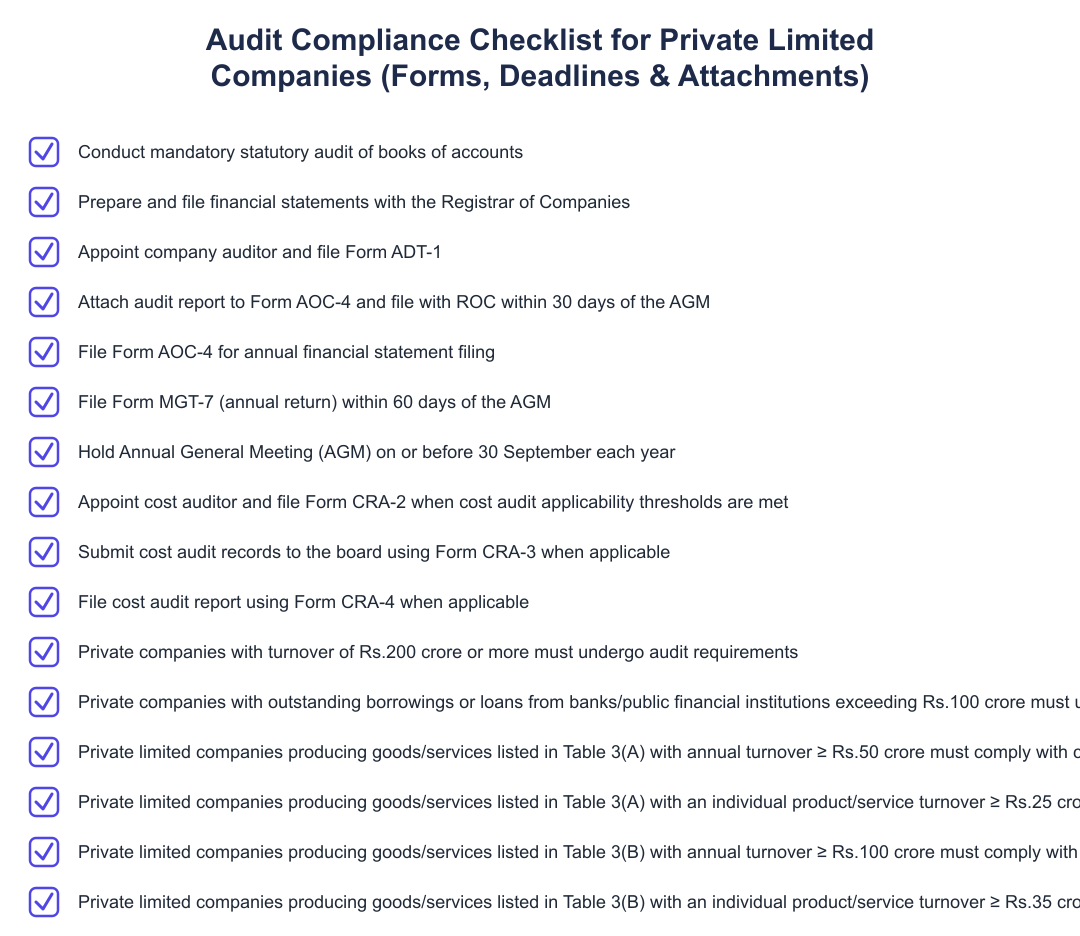
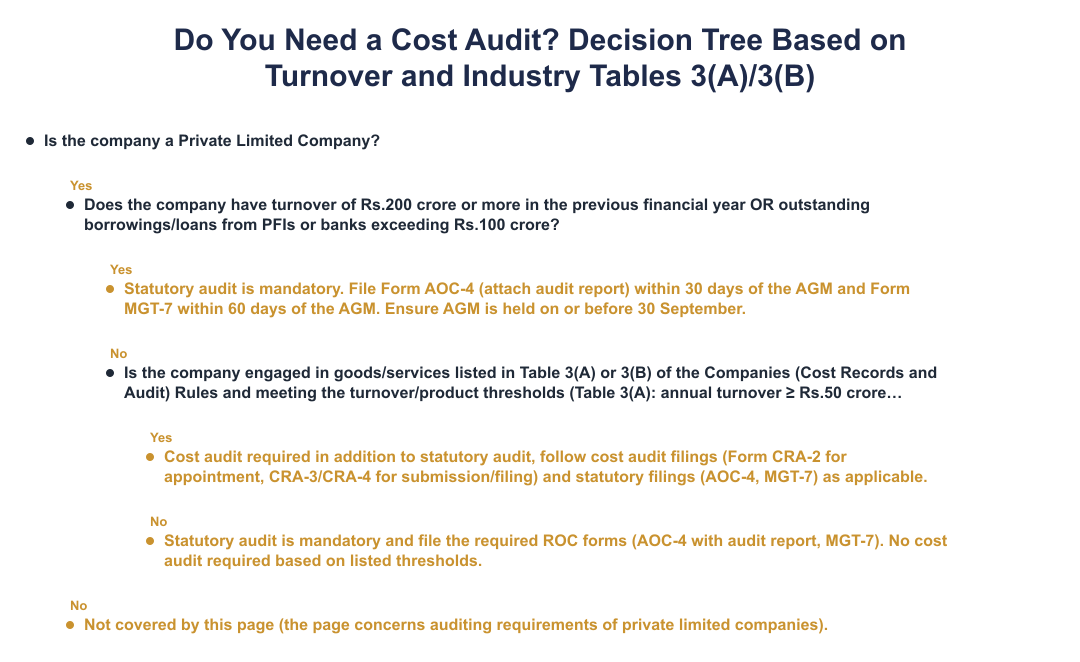
A private limited company may be subject to a statutory financial audit and, if applicable, a cost audit under the Companies (Cost Records and Audit) Rules. The statutory audit covers the company’s financial statements prepared under the Companies Act and is compulsory for all companies; cost audit applies only to companies meeting specified turnover/industry thresholds in the cost rules. Cost audit thresholds include various turnover limits (for example, Rs.50 crore/ Rs.100 crore or product/service-specific limits such as Rs.25 crore/ Rs.35 crore) depending on the table and category of activity listed in the Rules.
When and how is the auditor of a private limited company appointed?
An auditor for a private limited company is appointed by the company and the appointment must be recorded and filed with the ROC using Form ADT-1. The auditor is generally appointed by the shareholders (typically at the annual general meeting) to audit the company’s financial statements for the relevant financial year, and any change or new appointment is notified through Form ADT-1. Companies must ensure timely appointment so the auditor can complete the statutory audit and provide the audit report for filing with Form AOC-4.
What are the filing forms I need to know for audits and related filings?
Key ROC forms related to audit and annual compliance are Form ADT-1 for appointment of company auditors, Form AOC-4 for annual filing of financial statements (with the audit report attached), and Form MGT-7 for filing the company’s annual return. For companies required to undergo cost audit, the relevant ROC/cost forms include Form CRA-2 for appointment of a cost auditor, Form CRA-3 for submission of cost audit records to the board, and Form CRA-4 for filing the cost audit report. Each form serves a distinct purpose in the audit and reporting lifecycle and must be filed within its respective timelines.
What is the deadline to hold my company’s annual general meeting (AGM) and file audited financials?
The AGM for a private limited company must be held on or before 30 September every year for the previous financial year, and the audited financial statements (with the audit report) must be filed with the ROC by attaching the audit report to Form AOC-4 within 30 days of the AGM. Additionally, the annual return in Form MGT-7 must be filed within 60 days of the AGM. Companies should plan the AGM and auditor timeline so the statutory audit is completed in time to meet these filing deadlines.
Which private companies need a cost audit under the Companies (Cost Records and Audit) Rules?
Private limited companies engaged in specified goods or services listed in the Rules must get a cost audit if they meet the turnover thresholds set out in the Rules, for example, companies in Table 3(A) may need a cost audit if they had an annual turnover of Rs.50 crore or more in the previous financial year or an aggregate turnover of Rs.25 crore or more for an individual product/service; similarly, companies in Table 3(B) may be covered if annual turnover is Rs.100 crore or more or an individual product/service has Rs.35 crore or more. Separate thresholds also apply for broader cost audit applicability such as private companies with turnover of Rs.200 crore or more or outstanding borrowings over Rs.100 crore. The exact applicability depends on the activity classification and the numeric thresholds specified in the Rules.
Where do I attach the audit report when filing with ROC?
The statutory audit report must be attached to Form AOC-4 (the annual filing of the company’s financial statements) and filed with the Registrar of Companies. Form AOC-4 is the prescribed vehicle for submitting audited financial statements along with the auditor’s report, and failure to attach the audit report can render the filing non‑compliant. Ensure the audit report is the final signed report from the appointed auditor before attaching it to AOC-4 and submitting it within the 30‑day filing window after the AGM.
What are the filing timelines for the annual return and audit report?
The audited financial statements with the audit report must be filed in Form AOC-4 within 30 days of the AGM, while the company’s annual return in Form MGT-7 must be filed within 60 days of the AGM. Since the AGM must be held on or before 30 September each year, these timelines effectively set the compliance calendar for year‑end filings and help determine backward deadlines for completing the statutory audit. Companies should coordinate auditor appointment and audit fieldwork so the final audit report is ready in time to meet these ROC filing deadlines.
If my private company has high turnover or borrowings, does that change audit requirements?
Yes, certain higher-turnover or high-borrowing private companies may trigger additional audit requirements such as cost audit or enhanced compliance: for example, private companies having turnover of Rs.200 crore or more, or outstanding borrowings/loans from banks or public financial institutions exceeding Rs.100 crore, fall into categories that attract extra scrutiny and specific audit provisions under the Rules. Separately, companies in specified industries with turnover thresholds (Rs.50 crore/ Rs.100 crore and product-specific thresholds like Rs.25 crore/ Rs.35 crore) may require a cost audit in addition to the statutory financial audit. You should review the Companies (Cost Records and Audit) Rules and applicable thresholds to determine any extra audit obligations for your company.
Need help staying Compliance compliant?
MoneyGence's AI Finance OS tracks your compliance, wallet share, and finances in one place, built for agencies and growing businesses.
Get started with MoneyGence