Advance Ruling under GST: Guide, Procedure & When to Apply
This guide explains advance rulings under GST: what they are, why businesses and individuals use them, how they help reduce tax uncertainty, and what practical benefits to expect when you seek one. Readers will learn the core purpose of advance rulings, the kinds of questions they commonly address, and how receiving a written interpretation from the tax authority can change the way you plan transactions, price supplies, or structure cross-border activities. While this guide does not provide procedural checklists or statutory citations, it focuses on the functional role of advance rulings and how they deliver value, especially to taxpayers who want clarity before undertaking a transaction that could otherwise lead to disputes or exposure to differing interpretations. For GST-registered businesses, the ability to obtain a written decision in advance helps with budgeting, compliance planning, contract negotiations, and risk management. For non-residents and investors, clarity on tax treatment can influence investment decisions and reduce the chance of costly litigation. By the end of this guide you will understand the rationale behind seeking an advance ruling, the typical kinds of issues such rulings resolve, and how to think about using them strategically in your GST planning.
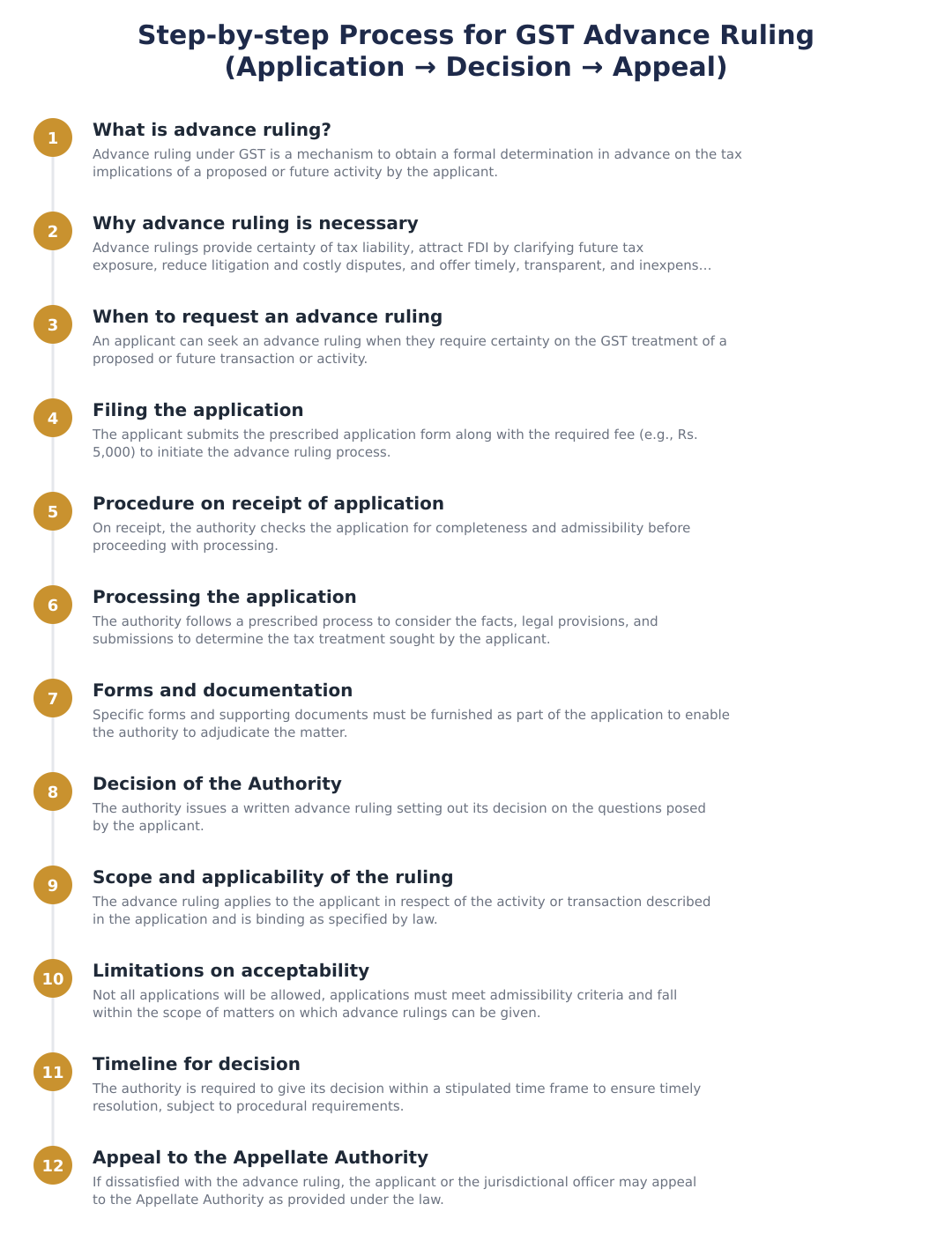
What is advance ruling?
An advance ruling is a written interpretation issued by tax authorities in response to a taxpayer’s request for clarification on specific tax matters. It sets out the tax authority’s view of how the law applies to the facts presented by the applicant, giving the applicant a documented position to rely on.
The core purpose of such a ruling is to provide authoritative guidance ahead of carrying out a transaction or course of action, so the taxpayer can proceed with greater confidence about the tax consequences.
Why is advance ruling under GST necessary?
Advance rulings are intended to provide certainty and reduce litigation by giving written decisions to applicants on specified questions. That certainty helps taxpayers avoid prolonged disputes and the costs associated with defending their tax positions.
Beyond reducing litigation, a written ruling helps in planning and operational decision-making: businesses can price supplies, structure contracts, and make investment choices with a clearer sense of future tax liabilities. For non-resident investors and cross-border transactions, such clarity can be especially valuable in assessing commercial viability.
When can one request for GST Advance Ruling?
Taxpayers typically seek an advance ruling when they face uncertainty about the tax treatment of a proposed or planned transaction and want a written interpretation before taking action. Examples include questions about classification, applicability of tax, or the tax consequences of a particular contractual arrangement.
Seeking a ruling is a proactive compliance measure: instead of testing a position and later challenging assessments, applicants ask the authority to clarify how the law applies to their specific facts so they can make informed decisions.
Procedure on receipt of application
When a tax authority receives a request for an advance ruling it reviews the facts and questions submitted by the applicant to determine whether an authoritative written answer is appropriate. The process is focused on establishing a clear factual record so that the ruling addresses the precise issue raised.
The authority’s response is provided in writing, and that written interpretation is intended to be relied upon by the applicant for the matter specified in the request. The written nature of the ruling is important because it creates a documented basis for reliance and reduces ambiguity.
Process of Advance Ruling under GST
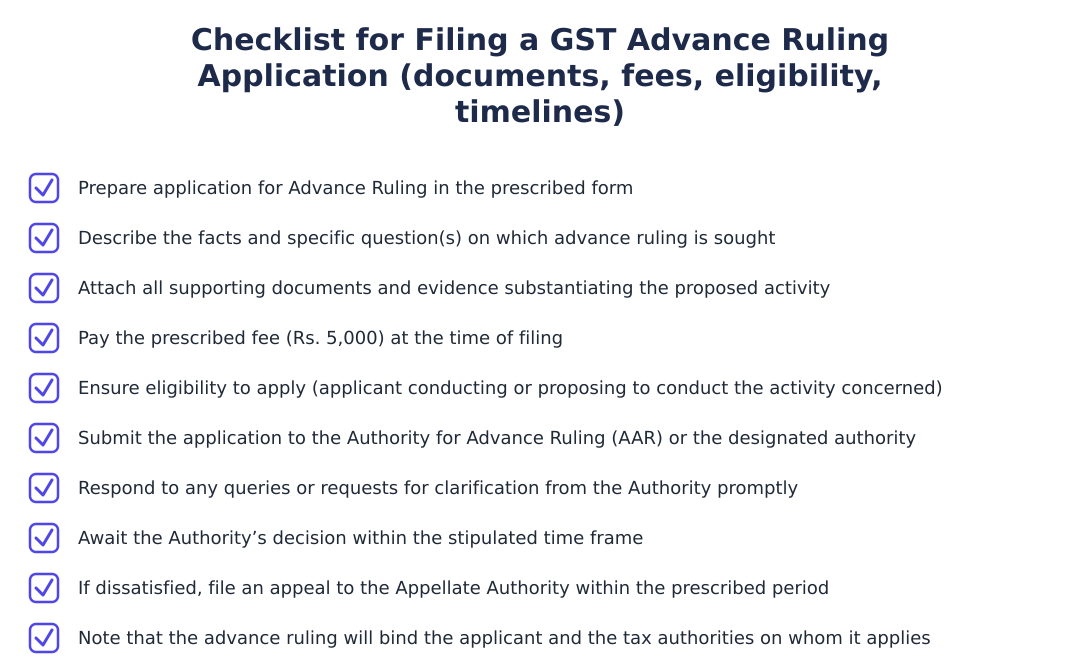
The process centers on a taxpayer presenting a clear set of facts and specific questions and the tax authority issuing a considered, written interpretation. Because advance rulings are question-specific, careful drafting of the application, clearly stating the facts and the exact points on which guidance is sought, improves the usefulness of the final decision.
A well-documented ruling reduces the likelihood of future disputes over the same issue and supports consistent application of tax law. For taxpayers, the value lies in converting uncertainty into a documented position that can inform business strategy and compliance choices.
Decision of the Authority and related considerations
The authority’s written decision interprets the law as it applies to the facts before it, and is designed to be a definitive guide for the applicant on those facts. Because the ruling is written, it serves as an evidentiary reference point for both the taxpayer and the tax authority.
Applicants should be aware that an advance ruling answers the specific questions presented; changes in the underlying facts or reliance on different assumptions may affect whether the ruling remains applicable. The practical takeaway is that advance rulings are powerful tools for managing tax uncertainty when used in the appropriate factual context.
Advance rulings under GST offer taxpayers a formal way to obtain written clarity from tax authorities on specific tax issues before acting. By converting uncertainty into an authoritative interpretation, advance rulings help reduce litigation, support business planning, and provide a documented position that businesses can rely on for compliance and commercial decisions. If you face a novel or unclear tax issue, consider whether an advance ruling could give you the certainty you need to proceed.
Frequently asked questions
What is an advance ruling under GST?
An advance ruling under GST is a written decision issued by the tax authority to an applicant on questions relating to the supply of goods or services. It provides an authoritative interpretation on matters such as classification of goods/services, applicability of notifications affecting tax rates, determination of time and value of supply, entitlement to input tax credit, liability to pay tax, necessity to register, or whether a particular transaction amounts to a supply. The ruling is given in response to a specific application by a person and is intended to clarify tax position for future or proposed activities. Advance rulings are meant to reduce uncertainty and prevent disputes by giving a clear, binding position for the applicant and the jurisdictional tax officers in respect of that applicant.
Why is advance ruling under GST necessary?
Advance ruling under GST is necessary to provide certainty about tax liability for proposed future activities and reduce the risk of disputes. It helps attract foreign direct investment by clarifying tax consequences for non-residents, thereby avoiding lengthy legal battles and unpredictable tax outcomes. Advance rulings also aim to reduce litigation by resolving contentious issues early and to deliver decisions in a timely, transparent and cost-effective manner. This certainty benefits taxpayers planning transactions and the tax administration by lowering the volume of contested cases.
When can I request an advance ruling under GST?
You can request an advance ruling when you are uncertain about how GST law applies to a proposed or future transaction before you undertake it. Typical questions suitable for advance ruling include classification of goods or services, applicability of a notification affecting tax rate, determination of time and value of supply, whether input tax credit will be allowed, whether you must register under GST, and whether a particular act amounts to a supply. The application must relate to the applicant's own proposed activity and cannot be used to challenge matters already decided or pending in proceedings for the same applicant. Advance rulings are aimed at clarifying tax treatment in advance so taxpayers can plan and comply correctly.
What is the procedure after I file an application for advance ruling?
After receipt of the application, the Authority examines it and decides whether to admit it for hearing; if admitted the applicant and concerned officers are given an opportunity of being heard. The Authority may seek further information, call for records from the jurisdictional tax officers, and possibly refer questions to the Appellate Authority if members differ on a point. If the Authority rejects the application for reasons such as the matter being already decided or pending for the applicant, it must give notice and reasons in writing and provide an opportunity of being heard before rejection. The process is designed to be timely and transparent, with specified timelines for decision-making.
Which forms are used to apply for advance ruling under GST?
Applications for advance ruling under GST must be filed in the specified electronic form as prescribed by the GST rules (commonly the designated form for advance ruling applications). The form requires details such as the applicant's particulars, the question(s) for which ruling is sought, facts of the proposed transaction, supporting documents, and a statement that the matter is not already decided or pending for the applicant. Incorrectly furnished or incomplete forms may delay admission, and the Authority will provide an opportunity to rectify defects before rejecting an application. Ensure you attach clear facts and documentary evidence to improve the chance of a substantive ruling.
Will all advance ruling applications be allowed?
No, not all advance ruling applications will be admitted or allowed; the Authority will refuse applications that concern matters already decided for the applicant or are pending in any proceeding for the applicant. Before rejecting an application, the Authority must give the applicant an opportunity of being heard and provide written reasons for rejection. If admitted, the Authority will proceed to decide the question on merits; if not admitted, the applicant may explore other remedies such as regular proceedings or appeals where applicable. This restriction prevents duplicate or conflicting adjudications on the same facts for the same applicant.
How long will it take to get an advance ruling under GST?
The Authority is required to give its decision on an admitted advance ruling application within 90 days from the date of the application. If the members of the Authority differ in opinion on any point, that point is referred to the Appellate Authority, which may affect timing. The advance ruling generally has prospective effect only, meaning it governs future transactions from the date of the ruling and does not typically alter past tax liabilities. Timely filing with complete information helps avoid undue delays in the process.
On whom does an advance ruling apply and when does it cease to bind?
An advance ruling is binding only on the applicant who sought it and on the jurisdictional tax officers in relation to that applicant. The ruling ceases to bind if the law or facts on which the original ruling was based change; in such cases the Authority’s decision will not apply. The binding nature is restricted to the specific facts and questions decided, so different facts or different applicants are not covered by that ruling. This ensures certainty for the applicant while allowing the law to evolve or be reinterpreted for other situations.
Can I appeal against an advance ruling, and what is the appeal process?
Yes, an appeal against an advance ruling can be filed to the prescribed Appellate Authority if you are aggrieved by the decision of the Authority that issued the ruling. The appeal must be filed within the statutory time limit and follow the procedure and form prescribed for appeals under the GST rules, and may require payment of prescribed fees. If members of the Authority had differed on a point, that point may itself be referred to the Appellate Authority during the decision process. Keep in mind that the advance ruling process and appeals are intended to be faster and less costly than ordinary litigation, but strict time limits and procedural requirements must be met.
Need help staying GST compliant?
MoneyGence's AI Finance OS tracks your compliance, wallet share, and finances in one place, built for agencies and growing businesses.
Get started with MoneyGence