Accounting Standards India: Guide to Levels I, II & III Compliance
Accounting standards provide a common language for preparing and presenting financial statements so that users, owners, lenders, analysts and regulators, can understand and compare financial information. This guide explains the purpose and structure of accounting standards, how enterprises are commonly classified for the purpose of applying those standards, and the practical implications for accounting for leases, earnings per share and provisions/contingent items. You will learn what accounting standards aim to achieve, why different types or sizes of enterprises may be subject to different reporting expectations, and what key issues to watch for when accounting for leases, shareholder earnings metrics, and uncertainties such as provisions and contingent liabilities. The discussion is practical and conceptual rather than a rule-by-rule checklist: it focuses on what these standards require in principle, why those requirements exist, and how they affect financial reporting decisions. This will help finance teams, auditors and business owners understand the accounting choices they face and the reasons behind standard-setting, so they can design accounting policies that are transparent, consistent and useful to stakeholders.
Meaning of Accounting Standards
Accounting standards are authoritative principles and rules that guide the recognition, measurement, presentation and disclosure of financial transactions in financial statements. Their objective is to ensure that financial statements are credible, comparable and useful for economic decision-making. By standardising how transactions are recorded, accounting standards reduce ambiguity and increase confidence among users of financial information.
Standards typically cover a broad range of subjects, such as recognition of revenue, treatment of leases, measurement of assets and liabilities, presentation of cash flows and disclosures about related parties or segment performance. While the specifics of each standard vary, the common theme is to require consistent accounting policies, adequate disclosures and clear presentation so that users can assess an entity’s financial position and results of operations.
Classification of Enterprises
Regulators and standard-setters commonly classify enterprises into groups based on characteristics such as listing status, size, business type and financing profile. The purpose of such classification is to tailor reporting expectations: larger or publicly accountable entities generally face more comprehensive disclosure and measurement requirements than smaller or non-public entities.
Typical classification criteria include whether an entity’s securities are publicly traded, whether it operates in regulated sectors (for example, banking or insurance), and quantitative measures such as turnover, borrowings or asset size. These classifications influence which standards or which parts of standards apply, and which disclosure relaxations, if any, are available to smaller or less complex entities.
Level I, II and III Enterprises (conceptual)
A multi-tier classification (often described as levels) groups enterprises by the degree of public accountability and economic significance. Level I typically includes entities with the broadest public accountability, for example, publicly listed companies and entities in regulated sectors. These entities are expected to follow the most comprehensive set of accounting requirements and disclosures.
Level II and Level III represent progressively smaller or less publicly accountable entities. Level II may include medium-sized commercial enterprises or entities with significant outside borrowings, while Level III usually covers smaller businesses with simpler operations. The intent behind tiering is proportionality: to align reporting burden with the capacity and information needs of users while still maintaining meaningful financial reporting.
Applicability of Accounting Standards
Applicability rules determine which entities must apply a particular accounting standard and whether full or partial application is required. These rules can vary by standard and by the tiered classification of enterprises. For example, some standards require full application by the largest entities but allow simplified requirements or exemptions for smaller tiers.
In practice, management and auditors must assess an entity’s classification and then determine the extent to which each standard applies. That assessment affects accounting policies, the scope of disclosures in financial statements, and the level of detail required in supporting notes and schedules. Clear documentation of the applicability assessment and any policy choices helps users understand why certain disclosures are omitted or simplified.
Leases (conceptual)
Accounting for leases addresses how both lessees and lessors present leased assets, liabilities and related expenses in their financial statements. The core issues are identification of a lease arrangement, classification of the lease from the perspective of each party, and the measurement of lease-related assets and liabilities over the lease term.
Conceptually, lease accounting seeks to reflect the substance of the transaction, whether the lessee obtains control and economic benefits of the underlying asset and should therefore recognise a right-of-use asset and a corresponding liability, or whether the arrangement is more akin to a short-term or low-value contract that may be expensed as incurred. Disclosures are important so users can assess the amount, timing and uncertainty of cash flows arising from leases.
Earnings Per Share (conceptual)
Earnings per share (EPS) is a metric that communicates how much of an entity’s profit is attributable to each ordinary share and is widely used by investors to assess profitability on a per-share basis. Proper EPS calculation requires identifying the profit or loss attributable to ordinary shareholders and determining the weighted average number of ordinary shares outstanding during the period.
Key practical considerations include the treatment of potential ordinary shares (such as options or convertible instruments) and the requirement to present basic EPS and, where relevant, diluted EPS. Transparent disclosure of the components and any adjustments used in the EPS calculation helps users understand how the per-share figures were derived and how potential dilution could affect future earnings per share.
Provisions, Contingent Liabilities and Contingent Assets (conceptual)
Provisions and contingencies deal with uncertainty about future outflows or inflows. A provision reflects a present obligation that is probable and can be reliably estimated, whereas contingent liabilities and contingent assets relate to possible obligations or benefits arising from past events that will be confirmed only by the occurrence or non‑occurrence of uncertain future events.
The accounting focus is on recognising and measuring obligations prudently while providing sufficient disclosure about the nature, timing and uncertainties of those obligations. For contingent items that are not recognised, clear narrative disclosure enables users to understand the possible financial effects and the circumstances under which they might materialise.
Accounting standards are the backbone of transparent financial reporting. Understanding their purpose, how entities are classified for reporting, and the conceptual requirements for leases, EPS and provisions/contingent items helps preparers and users make better-informed judgements. For specific numeric thresholds, mandatory application rules, and the detailed wording of any standard, consult the text of the relevant standard or official guidance from the applicable standard-setting authority.
Frequently asked questions
What are accounting standards and who must follow them?
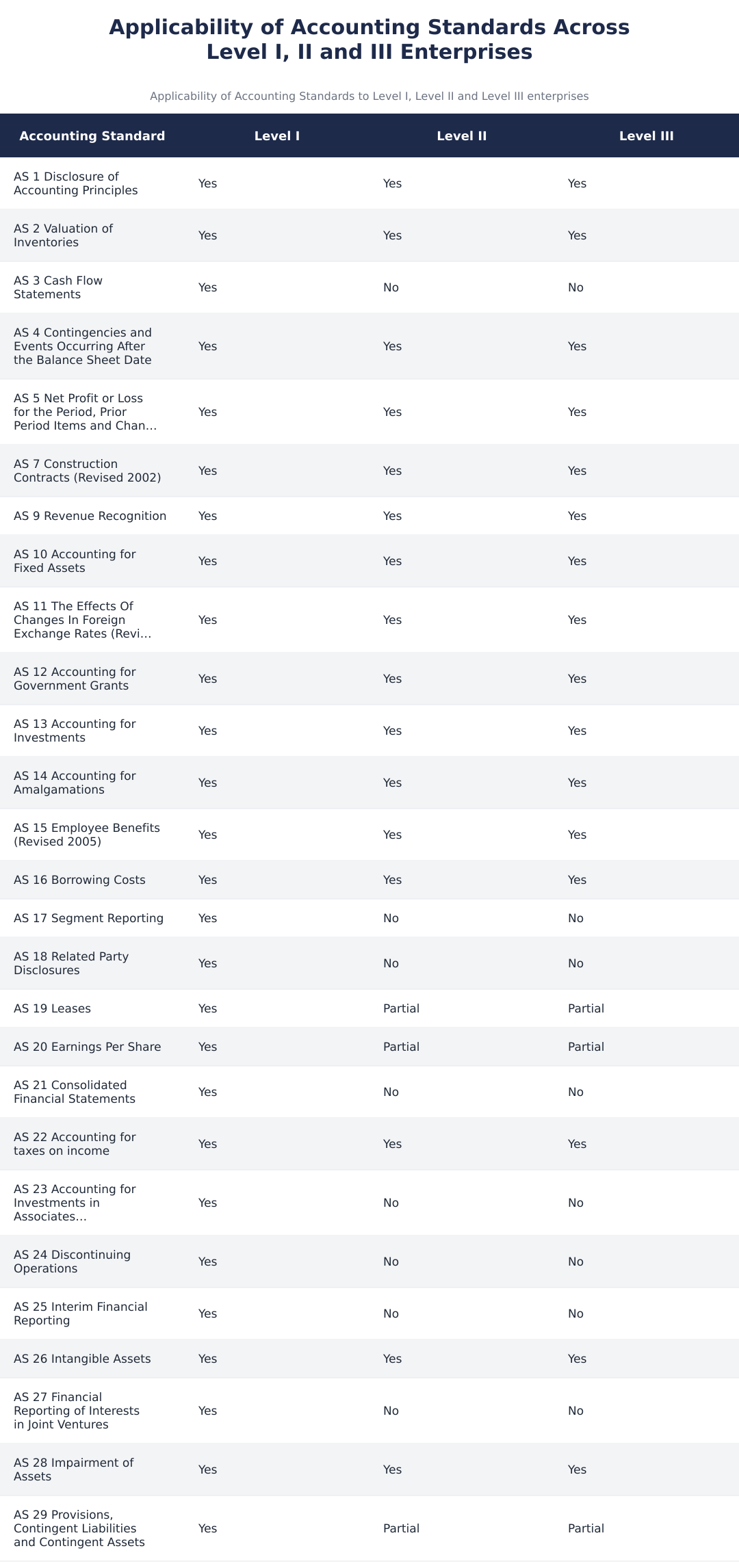
Accounting standards are authoritative rules that prescribe how enterprises should record, present and disclose financial transactions, and enterprises must follow the standards applicable to the level (Level I, II or III) in which they fall. These standards cover areas such as revenue recognition, valuation of inventories, cash flow statements and related party disclosures, and applicability depends on classification criteria like listing status, turnover and borrowings. For example, AS 1 (Disclosure of Accounting Principles) and AS 2 (Valuation of Inventories) apply to all Levels I, II and III, while some standards like AS 3 (Cash Flow Statements) apply only to Level I. Enterprises must check each AS for “Yes”, “No” or “Partial” applicability as per their level to ensure compliance.
How are enterprises classified into Level I, Level II and Level III for accounting standards?
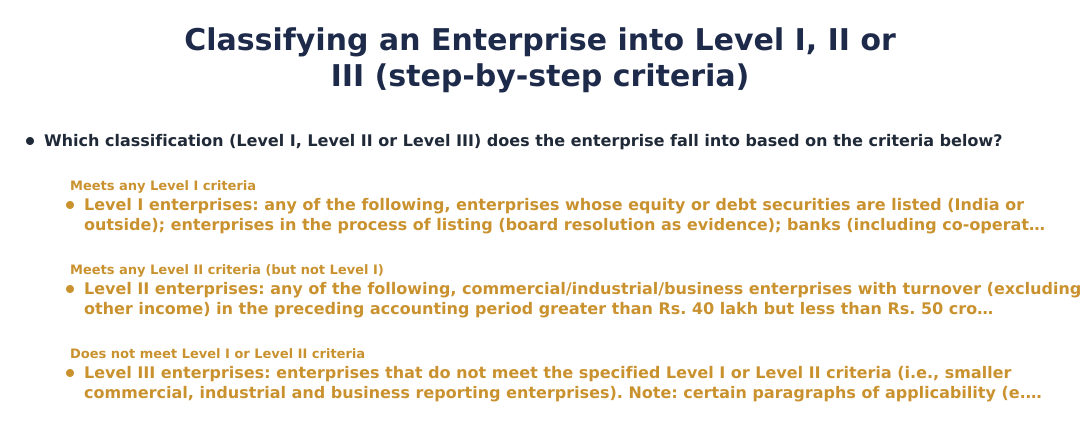
Enterprises are classified into Level I, Level II and Level III based on factors such as listing status, nature of business (banks, financial institutions, insurers), turnover and borrowings. Level I includes listed companies, companies in the process of listing, banks (including co-operative banks), financial institutions, insurers, enterprises with turnover over Rs. 50 crore, borrowings over Rs. 10 crore, and their holding/subsidiary enterprises. Level II covers commercial/industrial enterprises with turnover above Rs. 40 lakh but less than Rs. 50 crore or borrowings more than Rs. 1 crore but less than Rs. 10 crore and their holding/subsidiaries; Level III generally covers smaller enterprises not meeting Level I or II thresholds.
What criteria make an enterprise a Level I enterprise?
An enterprise is Level I if it is listed or in the process of listing, is a bank or financial institution, carries on insurance business, has turnover exceeding Rs. 50 crore, has borrowings (including public deposits) exceeding Rs. 10 crore at any time during the accounting period, or is a holding or subsidiary of any of these. The listing-in-process condition requires a board resolution as evidence. Being Level I means most accounting standards apply fully (many marked “Yes” in the applicability table), including AS 3 (Cash Flow Statements) and AS 17 (Segment Reporting).
What makes an enterprise fall under Level II and what exceptions apply?
An enterprise is Level II if its turnover (excluding other income) is more than Rs. 40 lakh but less than Rs. 50 crore, or if its borrowings are more than Rs. 1 crore but less than Rs. 10 crore, or if it is a holding/subsidiary of such an enterprise. Level II enterprises are required to follow many standards, but some paragraphs of certain ASs do not apply, for example, paragraph 67 does not apply to Level II enterprises, and several standards like AS 3, AS 17, AS 18, AS 21, AS 25 do not apply to Level II. Certain standards are marked “Partial” for Level II (e.g., AS 19 and AS 20) meaning only parts of those standards are applicable.
What is Level III and when does it apply to an enterprise?
Level III applies to smaller commercial, industrial and business reporting enterprises that do not meet the thresholds for Level I or Level II, such as those with turnover below Rs. 40 lakh and borrowings below Rs. 1 crore, and to their holding and subsidiary enterprises. Level III enterprises must follow a core set of accounting standards, but several standards and specific paragraphs are not applicable to them, for example, paragraphs 66 and 67 do not apply to Level III enterprises, and standards like AS 3, AS 17, AS 18, AS 21, AS 25 typically do not apply. Some standards are partially applicable to Level III (for instance AS 19, AS 20 and AS 29 are marked “Partial”), so entities should review each standard’s scope to determine obligations.
Do banks, financial institutions and insurance companies have special accounting standard requirements?
Yes, banks (including co-operative banks), financial institutions and insurance companies are treated as Level I enterprises and thus must comply fully with Level I accounting standards. That means standards like AS 3 (Cash Flow Statements), AS 17 (Segment Reporting) and many others apply to them in full where indicated, regardless of their turnover or borrowings. Being Level I also means related party disclosures (AS 18) and consolidated financial statements (AS 21) may apply if other conditions are met.
Which accounting standards are applicable to all enterprise levels without exception?
Several accounting standards apply to all Levels I, II and III, including AS 1 (Disclosure of Accounting Principles), AS 2 (Valuation of Inventories), AS 4 (Contingencies and Events After the Balance Sheet Date), AS 5 (Net Profit or Loss, Prior Period Items and Changes), AS 7 (Construction Contracts), AS 9 (Revenue Recognition), AS 10 (Fixed Assets), AS 11 (Foreign Exchange), AS 12 (Government Grants), AS 13 (Investments), AS 14 (Amalgamations), AS 15 (Employee Benefits), AS 16 (Borrowing Costs), AS 22 (Taxes on Income), AS 26 (Intangible Assets), and AS 28 (Impairment of Assets). These standards are marked “Yes” for Level I, II and III in the applicability table and therefore must be followed by all enterprises regardless of size or listing status.
Why are some standards marked “Partial” for Level II and Level III, and which ones are those?
A standard marked “Partial” means only certain paragraphs or specific requirements of that accounting standard apply to Level II and/or Level III enterprises rather than the whole standard. For example, AS 19 (Leases), AS 20 (Earnings Per Share) and AS 29 (Provisions, Contingent Liabilities and Contingent Assets) are marked “Partial” for Level II and Level III, indicating limited applicability of certain sections; meanwhile AS 19 and AS 20 are fully applicable to Level I. Enterprises must read the scope and applicability paragraphs of each standard to identify which parts apply. Additionally, some paragraphs such as paragraph 67 (of the relevant standard) do not apply to Level II and paragraphs 66 and 67 do not apply to Level II and III, so specific exclusions are spelled out in the standards' guidance.
Does an enterprise need to prepare cash flow statements and consolidated financial statements?
Preparation of cash flow statements (AS 3) and consolidated financial statements (AS 21) depends on the enterprise level: both AS 3 and AS 21 apply to Level I enterprises but do not apply to Level II and Level III enterprises. Specifically, AS 3 (Cash Flow Statements) is marked “Yes” for Level I and “No” for Levels II and III; AS 21 (Consolidated Financial Statements) is marked “Yes” for Level I and “No” for Levels II and III. However, a Level II or III enterprise that becomes a holding or subsidiary of a Level I enterprise may have to prepare consolidated reports as required by the Level I parent, so check corporate relationships and the standards’ consolidation scope.
Need help staying Accounting compliant?
MoneyGence's AI Finance OS tracks your compliance, wallet share, and finances in one place, built for agencies and growing businesses.
Get started with MoneyGence