Accounting Equation: Detailed Analysis & Examples
The accounting equation is the foundational relationship that underpins double-entry bookkeeping and the structure of the balance sheet. In this guide you will learn what the accounting equation means, why it matters for accurate financial reporting, and how routine business transactions affect the three components of the equation. Understanding this relationship helps business owners, accountants, and managers ensure that resources are being used appropriately, obligations are recognised, and the owner’s interest in the business is tracked correctly. You will also learn practical ways to interpret balance-sheet changes, spot bookkeeping errors, and appreciate the role of the equation in financial analysis and decision-making. By the end of this guide you should be able to explain the components of the equation in plain language, follow how different kinds of transactions change the financial position, and apply that knowledge to basic bookkeeping and review of financial statements. This matters because a correct grasp of the accounting equation prevents common mistakes in recording transactions, supports reliable financial statements, and provides a concise snapshot of a business’s financial position at any point in time.
What the accounting equation is
At its core, the accounting equation expresses the relationship between what a business owns, what it owes, and the residual interest that belongs to the owner(s). It provides the conceptual framework that ensures every entry recorded in the accounts keeps the books balanced. This balance is essential for the integrity of financial statements.
The equation is also a practical tool: it explains why assets appear on one side of the balance sheet and claims against those assets, both external and internal, appear on the other. Maintaining this relationship is the central goal of double-entry bookkeeping and is what enables reliable reporting of a business’s financial position.
Components explained: assets, liabilities and owner’s equity
Assets are resources controlled by the business that are expected to yield future economic benefits. They can be tangible or intangible, current or long-term, and together they represent the means by which a business operates and generates revenue.
Liabilities represent present obligations arising from past events, where settlement is expected to result in an outflow of resources. Owner’s equity (or capital) captures the residual interest in the assets after deducting liabilities. It reflects owner investments and accumulated results of operations retained in the business.
Thinking of these components as a single equation highlights their interdependence: changes in one component will usually require offsetting changes in one or both of the others. That interdependence is what keeps the balance sheet equal on both sides.
How typical transactions affect the equation
Different types of business events change the equation in predictable ways. When a business acquires a resource with cash, one asset increases while another asset decreases, leaving the overall equation unaffected in total. When a business borrows funds, assets increase and liabilities increase by the same amount, again maintaining balance.
Revenue and expense transactions affect owner’s equity. Revenues increase equity while expenses decrease it; the net effect of these items is reflected in the accumulated results portion of equity. Similarly, owner contributions or withdrawals directly change the equity component and will have corresponding effects on asset or liability balances depending on how those transactions are made.
Using the accounting equation for analysis and error detection
Because the accounting equation must always hold true, it becomes a useful control for identifying recording errors. If the balance sheet totals do not match, it signals omissions, duplications, or incorrect postings that need investigation. Reconciliations and trial balances are practical procedures that rely on this underlying equality.
For analysis, tracking how the components change over time helps assess liquidity, solvency and the degree to which operations are financed by owners versus external parties. Interpreting shifts in assets, liabilities and equity provides insight into growth, risk and financing strategy without necessarily requiring deep detail from the income statement.
Practical tips for maintaining the equation
Adopt consistent bookkeeping practices: record each transaction in at least two accounts so that the dual effect on the equation is always captured. Regularly reconcile cash and ledger balances to detect discrepancies early.
Keep clear distinction between owner and business funds, and summarise retained results periodically so that equity accurately reflects accumulated profits and contributions. Use the accounting equation as a checklist whenever you review the balance sheet: verify that changes in assets correspond to logical changes in liabilities or equity.
The accounting equation is simple in form but powerful in effect: it enforces balance, supports reliable financial statements, and guides how transactions are recorded and analysed. Mastering the relationship between assets, liabilities and equity will improve bookkeeping accuracy, aid financial review, and provide clearer insight into a business’s financial health.

Frequently asked questions
What is the accounting equation in simple words?
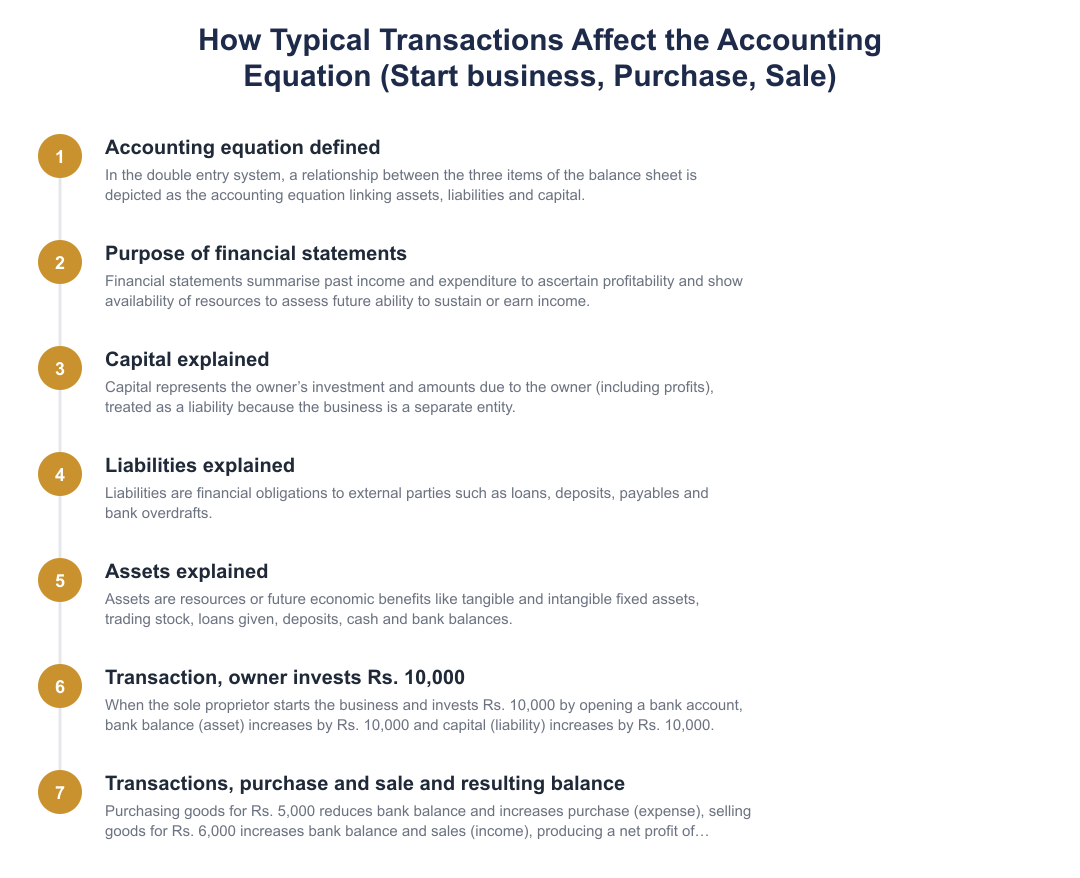
The accounting equation is Assets = Liabilities + Owner's Equity, which shows that everything a business owns is financed either by borrowing or by the owner's investment and retained profits. It is the fundamental relationship behind the double-entry system and ensures the balance sheet always balances; for example, if a proprietor invests Rs. 10,000 and the business has no other transactions, assets (bank) will be Rs. 10,000 and capital (owner's equity) will be Rs. 10,000. Owner's equity (capital) includes the owner's original investment plus accumulated profits (or minus losses), while liabilities cover obligations like loans, trade creditors and payables. This equation must hold after every transaction because every debit has a corresponding credit that affects either assets, liabilities or equity.
Why is capital shown on the liabilities side of the balance sheet?
Capital is shown on the liabilities side because the business is treated as a separate legal entity and the owner's investment is an obligation payable back to the owner ultimately, so it behaves like a claim against the business. In practice, the capital account increases when the owner invests money (for example, Rs. 10,000 invested increases capital on the liabilities side and bank balance on the assets side by Rs. 10,000). Retained profits are also part of capital and are shown on the liabilities side as they represent accumulated claims of the owner on the business resources. Presenting capital as a liability makes the accounting equation Assets = Liabilities + Capital balance correctly.
How do day-to-day transactions affect the accounting equation?
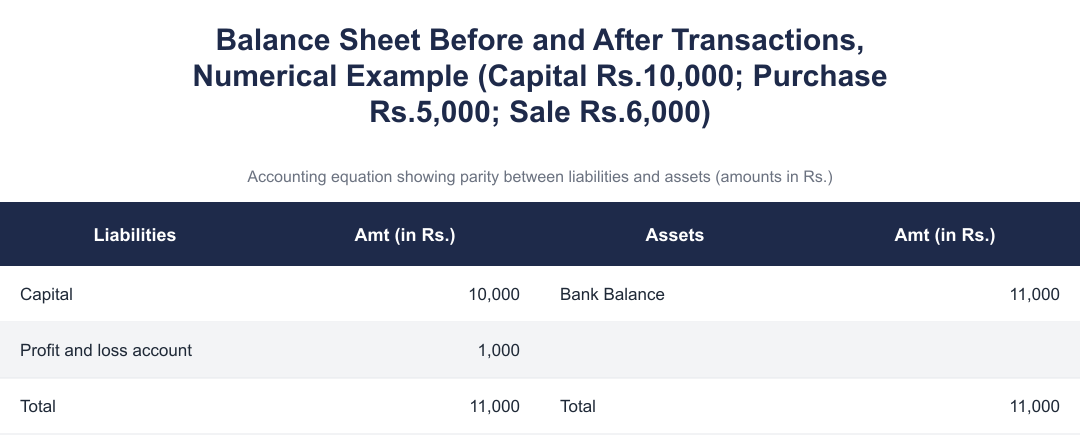
Every transaction changes at least two accounts so that the accounting equation remains in balance, for example investing Rs. 10,000 increases assets (bank) and increases capital by Rs. 10,000. If goods costing Rs. 5,000 are purchased and paid by bank, the bank asset decreases by Rs. 5,000 and the purchase (expense) reduces profit, which ultimately reduces owner’s equity; conversely selling goods for Rs. 6,000 increases bank assets by Rs. 6,000 and increases profit (and thus equity) by Rs. 6,000. Combining the three sample transactions (investment Rs. 10,000, purchase Rs. 5,000, sale Rs. 6,000) results in assets of Rs. 11,000 and liabilities + capital of Rs. 11,000 (capital Rs. 10,000 + profit Rs. 1,000).
How is profit shown in the accounting equation and balance sheet?
Profit increases owner’s equity and therefore appears on the liabilities side of the balance sheet as part of capital (often via the profit and loss account), because it represents an additional claim of the owner on business resources. For example, in the sample set of transactions, sales of Rs. 6,000 less purchases of Rs. 5,000 yield a net profit of Rs. 1,000 which is shown on the liabilities side, bringing capital plus profit to Rs. 11,000 against assets Rs. 11,000. Losses work the opposite way by reducing owner’s equity and decreasing the liabilities-side total. The profit and loss account is closed to capital at period end so retained profit becomes part of owner’s equity on the balance sheet.
What are examples of assets, liabilities and capital in the accounting equation?
Assets include resources expected to bring future economic benefits such as bank balances, cash, loans given, trading stock, tangible fixed assets (plant, building, furniture) and intangible assets (patents, goodwill). Liabilities include obligations such as loans, deposits taken, trade creditors, expenses payable and bank overdrafts. Capital (owner’s equity) represents the owner's investment and accumulated profits (for example, a Rs. 10,000 investment and Rs. 1,000 retained profit would show as capital Rs. 11,000).
Why does the balance sheet always balance (Assets = Liabilities + Capital)?
The balance sheet always balances because every financial transaction is recorded with equal debit and credit entries in the double-entry system, so total increases and decreases to assets, liabilities and equity offset each other and preserve the accounting equation. For instance, when the owner invests Rs. 10,000, assets (bank) increase by Rs. 10,000 while capital increases by Rs. 10,000; subsequent purchase and sale entries similarly change assets and profit but keep totals equal. If the books are correctly recorded and all adjustments are made, the sum of the asset side will equal the sum of liabilities plus capital side at any point in time. Any discrepancy indicates posting errors, omissions, or unrecorded transactions that need to be investigated.
Can an accounting transaction affect only the asset side without changing liabilities or capital?
No, under double-entry accounting every transaction affects at least two accounts, so a change in an asset will always be matched by a change in another asset, liability, or capital, ensuring the accounting equation holds. For example, buying goods for Rs. 5,000 using bank reduces the bank asset by Rs. 5,000 and increases inventory or purchases (affecting profit and ultimately capital) by Rs. 5,000. Even simple cash withdrawals by the owner reduce bank assets and reduce capital (drawings) or are recorded as distributions, so something else changes too. Therefore you will not see only one side change in properly recorded books.
How do you show the accounting equation with the example of Rs. 10,000 investment, Rs. 5,000 purchase and Rs. 6,000 sale?
After those three transactions the accounting equation shows Assets = Liabilities + Capital as Rs. 11,000 = Rs. 0 + Rs. 11,000, where capital comprises the initial Rs. 10,000 investment plus net profit Rs. 1,000. Specifically: bank balance (asset) is Rs. 11,000 (Rs. 10,000 + 6,000 - 5,000), capital (liability side) is Rs. 10,000 and profit and loss account shows Rs. 1,000, totaling Rs. 11,000 on the liabilities side. This demonstrates how revenue and expense flows affect profit and therefore owner’s equity while asset movements mirror those flows. The balance sheet totals match because every transaction was entered with offsetting effects.
Need help staying Accounting compliant?
MoneyGence's AI Finance OS tracks your compliance, wallet share, and finances in one place, built for agencies and growing businesses.
Get started with MoneyGence