56th GST Council Notifications: Key Changes, Rates & Exemptions
This guide explains how to read and respond to new GST notifications that implement decisions of a GST Council meeting. You will learn what kinds of changes such notifications typically bring, for example, amendments to procedural rules, changes in rate schedules or exemptions, modifications to return and refund processes, and directions about tribunal or appellate timelines. The guide also outlines practical compliance steps a taxpayer or tax professional should take when such notifications are published, how to assess the impact on accounting and ERP systems, and how to document and retain records to support compliance. Understanding these elements matters because GST notifications can change filing obligations, input tax credit treatment, refund eligibility, and appeal processes, all of which affect cash flow, tax liability, and audit risk. This article is written for business owners, charters, tax professionals, and compliance teams who need a structured way to interpret and operationalize regulatory changes without getting lost in legal text. It offers a clear framework to prioritise actions, update internal controls, and communicate changes across finance, procurement, and billing functions. At the end you will have a checklist-style approach to ensure you capture all relevant points from a notification and convert them into workable policies and system changes.
What GST notifications usually cover
Notifications that follow a Council meeting often translate policy decisions into operational or legal changes. They can amend existing rules, introduce new forms or return formats, redefine eligibility criteria for schemes or refunds, and update the scope of exemptions or rate schedules. Some notifications are purely procedural while others carry substantive implications for tax computation and compliance timelines.
For compliance teams, it is important to separate immediate operational changes from those that require strategic response. Operational changes may include new filing formats or transitional reliefs that need to be implemented in the short term, while substantive changes, such as alterations to eligibility or liability, might require a review of contracts, pricing, and the tax treatment of supplies.
How to read a notification effectively
Start by identifying the nature of the notification: whether it amends rules, notifies a rate or exemption, prescribes a procedure, or brings a provision into force. The preamble and the operative clauses are both important, the preamble explains intent while the operative clauses specify what changes are to be applied.
Next, map the changes to your operations: which business units are affected, which IT systems need updates, and what documentation will be required to support the new position. Note any transitional or retrospective effect and whether the notification refers to other documents, forms, or circulars that you must also follow.
Practical compliance steps after a notification is issued
As soon as a notification is published, assemble a cross-functional team including tax, finance, IT, and legal to evaluate the impact. Produce a short impact memo that flags changes to returns, refund processes, or documentation requirements and assigns owners for remediation tasks.
Update accounting and invoicing systems promptly where formats or rate classifications change. Where form or return structures are amended, run test filings in your environment to confirm data mapping and reconciliation between accounting ledgers and tax reporting systems.
Managing disputes, appeals and transitional provisions
Notifications sometimes affect pending disputes or provide timelines for appeals and tribunal filings. When that happens, review ongoing cases to see whether the new provision alters legal strategy, settlement prospects, or the need for additional filings. Coordinate with external counsel to reassess positions in light of any amended rules.
Transitional provisions deserve special attention because they determine how supplies straddling the changeover date are taxed. Document the rationale for tax treatments chosen during any transition to reduce exposure at audit or appeal.
Communicating changes to stakeholders
Prepare clear, client- or stakeholder-facing summaries that explain what changed, why it matters, and the actions required. Use Q&A formats and execution checklists so teams in procurement, sales, and billing can implement changes consistently.
Retain a copy of the official notification and related documents in a compliance repository, and log the date on which your organisation implemented system and process changes. This audit trail is useful for internal governance and for responding to any future queries from tax authorities.
When GST notifications implement Council decisions, they can have immediate and wide-ranging effects. A structured approach, identify the type of change, assess operational impact, update systems, review disputes, and communicate clearly, helps businesses convert regulatory updates into controlled, auditable actions. Maintain a compliance calendar and documentation trail to reduce risk and ensure readiness for any follow-up guidance or clarifications from authorities.
Frequently asked questions
What are the key changes introduced by the CBIC notifications implementing the 56th GST Council decisions?
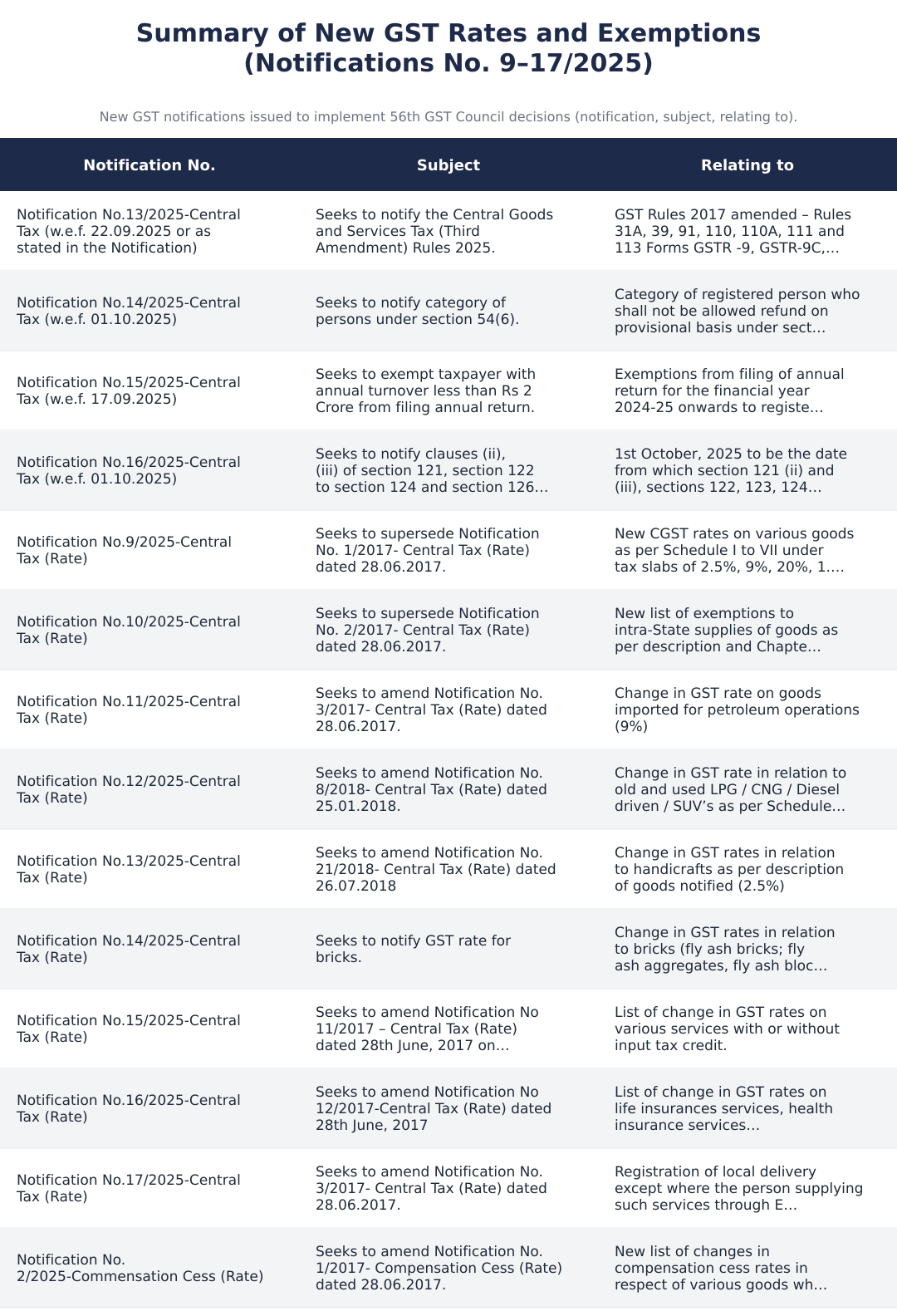
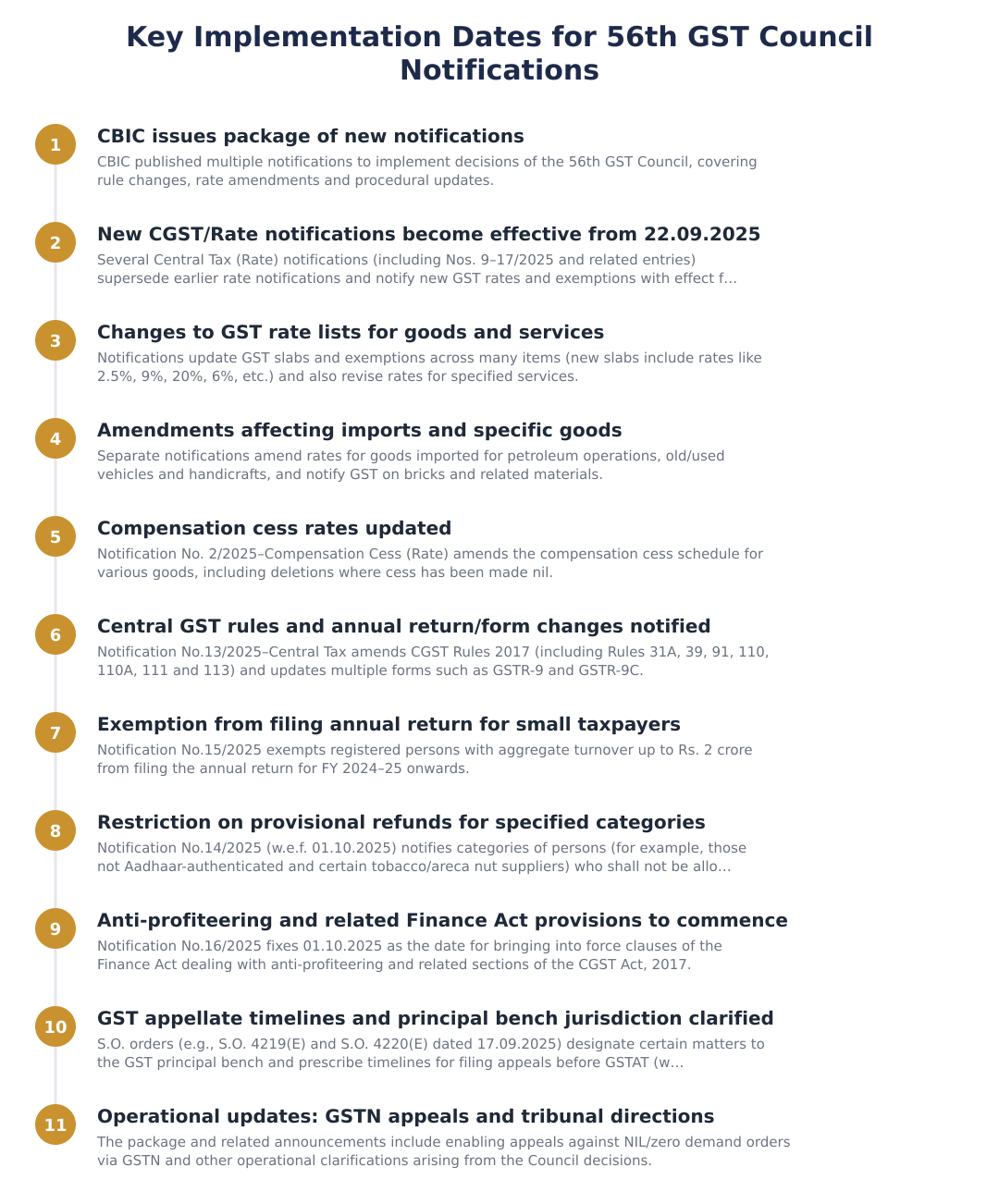
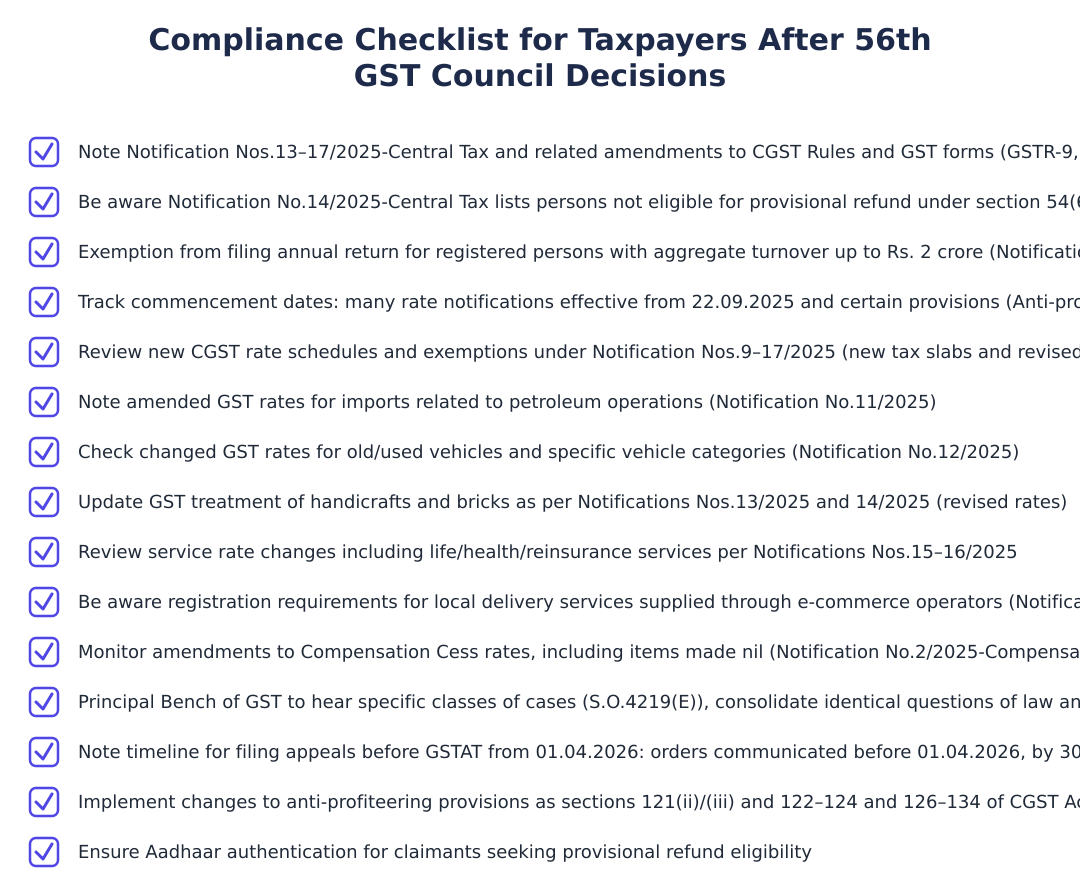
The CBIC notifications implement multiple changes including amended GST rules, revised rates and specific exemptions: Central Tax (Third Amendment) Rules 2025 amend Rules 31A, 39, 91, 110, 110A, 111 and 113 and related forms (GSTR-9, GSTR-9C and various APL forms); new rate and exemption notifications consolidate rates and exemptions across multiple schedules and chapters; and several procedural notifications bring anti‑profiteering provisions and appeal timelines into force. Effective dates include 22.09.2025 for most rate changes and 01.10.2025 for certain provisions of the Finance Act (anti‑profiteering sections), while targeted notifications like the annual return exemption apply from 17.09.2025. These changes cover GST rates, filing and refund rules, tribunal timelines, and sector‑specific measures such as handicrafts, bricks and insurance services.
When do the new GST rates and exemptions announced in the notifications start applying?
Most of the new CGST rate and exemption changes are effective from 22.09.2025 as notified. Specific notifications have their own effective dates: for example, amendments related to petroleum operations and certain service‑rate changes refer to separate notifications that take effect on the same date unless otherwise stated, and anti‑profiteering provisions specified under the Finance Act are notified to commence from 01.10.2025. Taxpayers should check the individual notification number (Notification Nos. 9–17/2025 for rates) to confirm exact applicability for particular goods or services.
Who is exempted from filing the annual GST return under the new Notification No.15/2025-Central Tax?
A registered person whose aggregate turnover in any financial year is up to Rs. 2 crore is exempted from filing the annual return for the financial year 2024‑25 onwards under Notification No.15/2025-Central Tax effective 17.09.2025. This exemption applies to aggregate turnover calculation as defined in GST law and covers any registered person meeting the turnover threshold, but it does not change requirements for regular monthly/quarterly returns like GSTR‑1 or GSTR‑3B. Taxpayers near the threshold should maintain records and monitor turnover since crossing the Rs. 2 crore limit will reinstate annual return filing obligations.
Which categories of persons will not be allowed provisional refunds under section 54(6) of the CGST Act as per Notification No.14/2025?
Notification No.14/2025‑Central Tax (w.e.f. 01.10.2025) specifies categories not eligible for provisional refunds under section 54(6): persons who have not undergone Aadhaar authentication and suppliers of areca nuts, pan masala, tobacco and similar items. The provision therefore bars these specified categories from claiming refunds on a provisional basis while other eligible taxpayers may still get provisional refunds subject to the usual conditions. Taxpayers in these categories must follow the standard refund process and ensure Aadhaar authentication where required to avoid disqualification from provisional relief.
What are the notable GST rate changes for goods like handicrafts and bricks in these notifications?
The rate changes include handicrafts being placed at 2.5% as per Notification No.13/2025‑Central Tax (Rate) and certain types of bricks (including fly ash bricks, fly ash aggregates, and specified building bricks and tiles) being taxed at 6% as notified under Notification No.14/2025‑Central Tax (Rate). Additionally, various goods have been reallocated across tax slabs (2.5%, 9%, 20%, 1.5%, 0.125%, 0.75% and 14%) through Notification No.9/2025 which supersedes the earlier rate schedule. Businesses dealing in these items should update billing, pricing and IT systems to reflect the new slab and check for any linked input tax credit conditions.
How have GST rates for services and insurance been changed in the recent notifications?
Notifications No.15/2025 and No.16/2025 (Central Tax Rate) amend service‑level GST rates, including changes to services with or without input tax credit and specific adjustments for life insurance, health insurance and reinsurance services. The notifications provide a revised list of services and their applicable rates; taxpayers must refer to the amended schedules to determine whether a service attracts the revised rate or remains unchanged. These service rate changes take effect broadly from 22.09.2025 unless an individual notification specifies otherwise, and service providers should review whether input tax credit availability is linked to the new rates.
What procedural and tribunal changes were announced for GST appeals and case allocation?
The CBIC issued S.O. 4219(E) and S.O. 4220(E) dated 17.09.2025 designating certain classes of cases to be heard exclusively by the Principal Bench of the GST Appellate Tribunal (e.g., matters pending before multiple State Benches, issues under section 14/14A of IGST like OIDAR and actionable claims, and matters under section 20 CGST) and prescribing appeal filing timelines from 01.04.2026. For appeal timelines: orders communicated before 01.04.2026 must be appealed by 30.06.2026, and orders communicated on or after 01.04.2026 must be appealed within three months of the order. Litigants should note these timelines and the Principal Bench jurisdiction for specified legal questions when preparing appellate filings.
Are there any changes to GST registration or e‑commerce related requirements in the new notifications?
Yes, Notification No.17/2025‑Central Tax (Rate) amends rules around registration for local delivery, making registration of local delivery mandatory except where the supplier provides services through an e‑commerce operator where a different registration requirement may apply. This means persons providing local delivery services generally need to register for GST unless the supply is routed through an e‑commerce operator who is responsible under the law. Businesses engaged in local delivery should assess whether they must obtain separate registration or can rely on the e‑commerce operator framework to meet compliance obligations.
How do the notifications affect compensation cess rates and goods where cess is now nil?
Notification No.2/2025‑Compensation Cess (Rate) amends the list of goods and alters compensation cess rates, including making the compensation cess Nil on certain items as specified in the notification. The amendment revises the schedule of goods attracting compensation cess to align with the new rate structure and exemptions introduced in the 2025 rate notifications. Manufacturers and importers of goods previously subject to cess should review the updated list to determine if cess has been reduced or removed and update their tax calculations and returns accordingly.
Need help staying GST compliant?
MoneyGence's AI Finance OS tracks your compliance, wallet share, and finances in one place, built for agencies and growing businesses.
Get started with MoneyGence